Call and response songs are songs where a leader sings a line and the group answers, and the best ones for kids include Boom Chicka Boom, Down by the Bay, Going on a Bear Hunt, Who Took the Cookie and Che Che Kule.
Call and response songs are the fastest way to get a room full of kids singing together. One person calls, everyone answers, and even a shy three-year-old can join in by the second line, because the leader hands over the words one phrase at a time.
Below are 40 favorites grouped by setting, each with how it works and an age range, plus a quick table, tips for leading one and a template for making up your own.
Key Takeaways
In call and response, a leader sings a line and the group answers with an echo or a set reply.
The form comes from African and African American music, including work songs and spirituals.
Call and response encourages turn-taking and listening, and its rhyme and repetition support early language.
Toddlers need tiny answers: one word, one sound or one motion.
Short original call and response chants are an easy way to gather a classroom’s attention.
Table of Contents
What Are Call and Response Songs?
Quick Answer
Call and response songs are songs where a leader sings or chants a line (the call) and the group answers (the response), either with an exact echo or a different reply. Kids’ favorites include Boom Chicka Boom, Down by the Bay, Going on a Bear Hunt, The Other Day I Met a Bear and Che Che Kule.
Call and response is a musical form, not a genre: one voice leads, many voices answer, like a conversation. In an echo song, the group repeats exactly what the leader sang. In a true call and response, the group answers with something different, often the same refrain each time while the leader’s lines change.
The form has deep roots. The Library of Congress explains that enslaved Africans brought musical traditions from Africa, that work songs and field hollers used call and response chants, and that spirituals are typically sung with a leader improvising a line and a chorus answering with a steady refrain. Carnegie Hall’s Timeline of African American Music traces call and response to African communal music making and notes that it runs through every genre of African American music, from gospel to the blues.
Children’s music carries that line forward. Smithsonian Folkways first released Ella Jenkins’s album Call-and-Response: Rhythmic Group Singing in 1957, with simple chants from the United States and Africa, and NAEYC calls call and response a hallmark of her music for young children.
Why Call and Response Songs Work So Well for Kids
Nobody needs to know the words in advance, because the leader hands them over one line at a time. That makes these songs ideal for mixed ages, shy kids and brand new groups.
Turn-taking: ZERO TO THREE says music very naturally encourages turn-taking and suggests call and response songs for toddlers for exactly that reason.
Listening: NAEYC lists listening, copying rhythms and following directions among the skills children build with Ella Jenkins’s call and response songs.
Language and rhyme: ZERO TO THREE calls music an easy window into practicing language and notes that the rhyming in most songs supports phonemic awareness.
Belonging: music is by its very nature social, ZERO TO THREE says, and group music can encourage positive peer interactions.
Quick Reference: Favorites by Setting, Age and Energy
Energy level is our own guide to how much movement and volume a song creates: high to burn off wiggles, low to settle a group.
Song
Best setting
Ages
Energy level
Old MacDonald Had a Farm
Home, toddler group
1 to 4
Medium
Where Is Thumbkin?
Lap, car
2 to 4
Low
Who Took the Cookie from the Cookie Jar
Preschool circle
2 to 5
Medium
Down by the Bay
Preschool, car
3 to 6
Low
Going on a Bear Hunt
Classroom, rainy day
3 to 7
High
Tooty Ta
Brain break
3 to 7
High
Che Che Kule
Music class
3 to 8
Medium
Charlie Over the Ocean
Gym, outdoors
4 to 8
High
The Other Day I Met a Bear
Campfire
4 to 10
Medium
Michael Row the Boat Ashore
Campfire, music class
4 to 12
Low
Boom Chicka Boom
Camp, assemblies
5 to 12
High
Miss Mary Mack
Recess, partners
5 to 10
Medium
Princess Pat
Camp
6 to 12
High
Flea Fly
Camp, older kids
7 to 12
High
Call and response favorites with setting, ages and energy level.
Call and Response Songs for Toddlers and Preschool
For toddlers and preschoolers, keep the response tiny: one word, one sound or one motion.
Who Took the Cookie from the Cookie Jar (ages 2 to 5): a circle chant. The group names a child, that child answers and passes the question to a friend, so everyone gets a turn.
Down by the Bay (ages 3 to 6): an echo song: kids sing each line back, then you end on a silly rhyming question. Let them invent new rhymes.
If You’re Happy and You Know It (ages 2 to 5): you sing the action and the kids answer by doing it: a clap, a stomp or a shout.
John the Rabbit (ages 3 to 6): a traditional garden song where kids answer every line with the same short reply, so toddlers can join right away.
Hickety-Pickety Bumblebee (ages 3 to 6): a name game. One child says their name and the group echoes it, clapping the syllables.
Where Is Thumbkin? (ages 2 to 4): a question and answer finger play. You sing the question and two fingers pop out to answer. Great for laps and car rides.
Old MacDonald Had a Farm (ages 1 to 4): you name the animal and the kids answer with its sound, the simplest first call and response there is.
With babies, make a sound, wait, and copy what they give back; ZERO TO THREE notes that caregivers often repeat a baby’s sounds. At bedtime, switch to our best lullabies for babies, and see toddler activities for more circle time ideas.
Big days go better with a good night of sleep.
Got a little one at home too? Our free two-minute quiz builds a gentle, personalized sleep plan for babies and toddlers.
These attention-getters are original Betteroo chants written for this guide, so use and adapt them freely. Each pairs a short call with a short answer, often ending in stillness.
Rocket check (ages 3 to 8): Teacher: Rocket check? Kids: Ready for launch! Use it before lining up.
Snap, snap, clap (ages 4 to 10): Teacher: Snap, snap, clap? Kids: Clap, clap, snap! Kids reverse your pattern, so they must really listen.
Turtle shells (ages 3 to 7): Teacher: Turtle shells? Kids: Tucked in tight! Arms pull in and voices go quiet.
Owl eyes (ages 3 to 7): Teacher: Owl eyes? Kids: Wide awake! Kids make finger circles around their eyes and look at you.
Garden gnomes (ages 3 to 8): Teacher: Garden gnomes? Kids: Frozen still! Everyone freezes like a statue, indoors or out.
Moon and stars (ages 3 to 8): Teacher: Moon and stars? Kids: Shining bright! A whispered signal for rest time.
Popcorn check (ages 3 to 7): Teacher: Popcorn popping? Kids: Popcorn stop! Kids bounce on the call and freeze on the answer.
Listening ears (ages 4 to 9): Teacher: Listening ears? Kids: Switched on here! Kids tap their ears twice.
Teach a chant at a calm moment, practice it as a game, and use it only when you truly need the group so it keeps its power. Thank kids as soon as they answer. Studying space? The moon and stars chant pairs well with our planets for kids guide, and our school appropriate songs cover brain breaks and assemblies.
Camp and Campfire Call and Response Songs
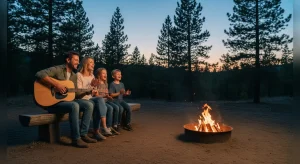
Nobody at a campfire has a song sheet, so camp songs lean on call and response. A strong leader can teach these in one pass.
Boom Chicka Boom (ages 5 to 12): the classic echo chant. The group echoes each line, then the leader names a new style (whisper, opera, slow motion) and it starts again.
Princess Pat (ages 6 to 12): a repeat-after-me song with a hand motion for every line; the group echoes words and moves.
Bazooka Bubblegum (ages 5 to 12): a silly story chant; the group echoes each line and every verse adds a sillier twist.
The Other Day I Met a Bear (ages 4 to 10): a pure echo song about a chase in the woods: each line is echoed, then sung together.
Herman the Worm (ages 4 to 10): a story chant the leader acts out, with the group echoing and a punch line at the end.
Flea Fly (ages 7 to 12): a nonsense-syllable tongue twister. The leader speeds up and the group tries to keep up.
The Great Big Moose (ages 5 to 12): an echo song where each line is echoed in a deep moose voice, then sung together.
My Aunt Came Back (ages 4 to 8): each verse adds a new motion to echo, until everyone is doing every motion at once.
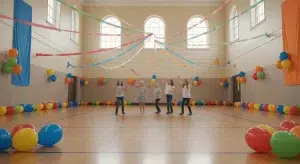
These turn call and response into a game, perfect for a rainy day indoors or recess outside.
Going on a Bear Hunt (ages 3 to 7): a traditional echo chant with knee pats; each obstacle (grass, mud, a river) gets its own sound and motion.
Tooty Ta (ages 3 to 7): an action echo chant that adds one body instruction each round.
Peanut Butter and Jelly (ages 4 to 9): a camp chant where the group echoes each sandwich-making step with a motion.
Charlie Over the Ocean (ages 4 to 8): a circle chase game. The group echoes the walking leader’s lines, then the leader tags someone.
Miss Mary Mack (ages 5 to 10): a traditional hand-clapping game in which each word is repeated three times.
Doggie, Doggie, Where’s Your Bone? (ages 4 to 7): a guessing game. The group sings to the “dog,” the child hiding the bone answers in a disguised voice, and the dog guesses who.
Little Sally Walker (ages 4 to 9): an African American ring play song. The circle sings while the child in the center makes up a move.
For two-year-olds, start with a slow Bear Hunt and add motions as they catch on. Our activities for 2 year olds guide has more ideas.
Echo Songs, Spirituals and Work Songs
These songs show the form at its roots. Teaching them is a chance to tell children, simply and respectfully, that call and response grew from songs sung while working and worshipping.
Che Che Kule (ages 3 to 8): a singing game widely taught as coming from Ghana, with a motion on every echoed phrase. Carnegie Hall’s kindergarten lesson uses it as its echo song.
Jambo (ages 4 to 9): a greeting song built on the Swahili word for hello; the leader greets and the group answers.
Michael Row the Boat Ashore (ages 4 to 12): an African American spiritual where the group answers every line with the same refrain.
Swing Low, Sweet Chariot (ages 5 to 12): a slow African American spiritual with a sung call and a familiar refrain. Gentle for the end of the day.
Follow the Drinking Gourd (ages 7 to 12): an African American folk song Carnegie Hall uses to teach a response that differs from the call.
Who Built the Ark? (ages 4 to 9): a spiritual where the leader asks and the group answers, then the verses count the animals.
Oh, Won’t You Sit Down? (ages 6 to 12): a lively spiritual with a question from the leader and a quick answer from the group.
Amen (ages 4 to 12): a spiritual where the group answers with one repeated word while the leader’s lines change.
John Kanaka (ages 6 to 12): a traditional sea shanty, a sailors’ work song, with a nonsense refrain the group answers.
Day-O (The Banana Boat Song) (ages 6 to 12): a Jamaican folk song: the leader calls a long note and the group answers it.
How to Lead a Call and Response Song
You need a clear, confident call more than a good voice. Carnegie Hall’s kindergarten lesson follows a similar order.
1. Explain the deal: you call, they answer. Point to yourself for the call and open your hands toward them for the response.
2. Teach the answer first: if the response repeats, practice it alone before you start.
3. Keep calls short: one short phrase per call.
4. Keep a steady beat: pat your knees so the answer always lands in the same place.
5. Exaggerate: big faces, big motions and dramatic pauses carry a group better than volume.
6. Change the style: sing it again as a whisper, a mouse or a giant.
7. Hand over the lead: let a child be the caller while you listen.
Stop before the group gets tired, so they ask for it again.
How to Make Up Your Own Call and Response
Kids love a song that belongs to their family or class. Use this five-minute template:
Pick a topic: a pet, a food, the weather or a routine like putting on shoes.
Choose the answer: two to four words the group says every time, ideally with a motion.
Write three to five calls: short lines that leave room for the answer. No rhyme needed.
Set a beat: chant over knee pats or borrow a tune your kids know.
Add a twist ending: a final call that is faster, quieter or funnier.
Our own example: Grown-up: Who has their coat on? Kids: Zip, zip, zip! Grown-up: Who has their shoes on? Kids: Zip, zip, zip! Making up songs together is also lovely across generations; see our grandparent activities.
Call and response songs are the easiest way to get a group of children singing: one voice calls, everyone answers, and nobody needs to know the words first. Start with tiny answers for toddlers, use short original chants to gather a classroom, save the big echo songs for camp, and share the spirituals and work songs that gave the form its roots. Then hand the lead to a child and let them make up the next one.
Frequently Asked Questions
What are call and response songs?
Call and response songs are songs where a leader sings or chants a line and a group answers. The answer can be an exact echo of the call or a different reply, often the same refrain each time. The form comes from African and African American music, including work songs and spirituals.
What is an example of a call and response song?
Boom Chicka Boom is a classic example: the leader chants a line, the group echoes it, and the leader then changes the style. Others include Down by the Bay, Going on a Bear Hunt and the spiritual Michael Row the Boat Ashore.
Why are call and response songs good for kids?
They give every child a part without needing to know the words in advance. ZERO TO THREE notes that call and response songs encourage turn-taking in toddlers, and NAEYC lists listening, copying rhythms and following directions among the skills children practice. The rhyme and repetition also support early language and literacy.
What age are call and response songs best for?
Almost any age. Toddlers from about 1 to 2 can answer with a single sound or motion, as in Old MacDonald Had a Farm. Preschoolers handle short echo songs and name games. School-age kids enjoy camp chants and taking turns as the leader.
Do call and response chants help with classroom management?
Many teachers use short call and response chants as attention signals because the children have to stop and answer, which shifts their focus to the teacher. They work best when taught at a calm moment, used consistently and followed by a quick thank you.
What is the difference between an echo song and a call and response song?
In an echo song, the group repeats exactly what the leader sang, word for word. In a call and response song, the group gives a different answer, often the same short refrain each time while the leader’s lines change. Echo songs are easiest for beginners.
Gentle changes, peaceful nights.
Betteroo builds a personalized sleep plan for your baby or toddler. Take the free two-minute quiz to get started.