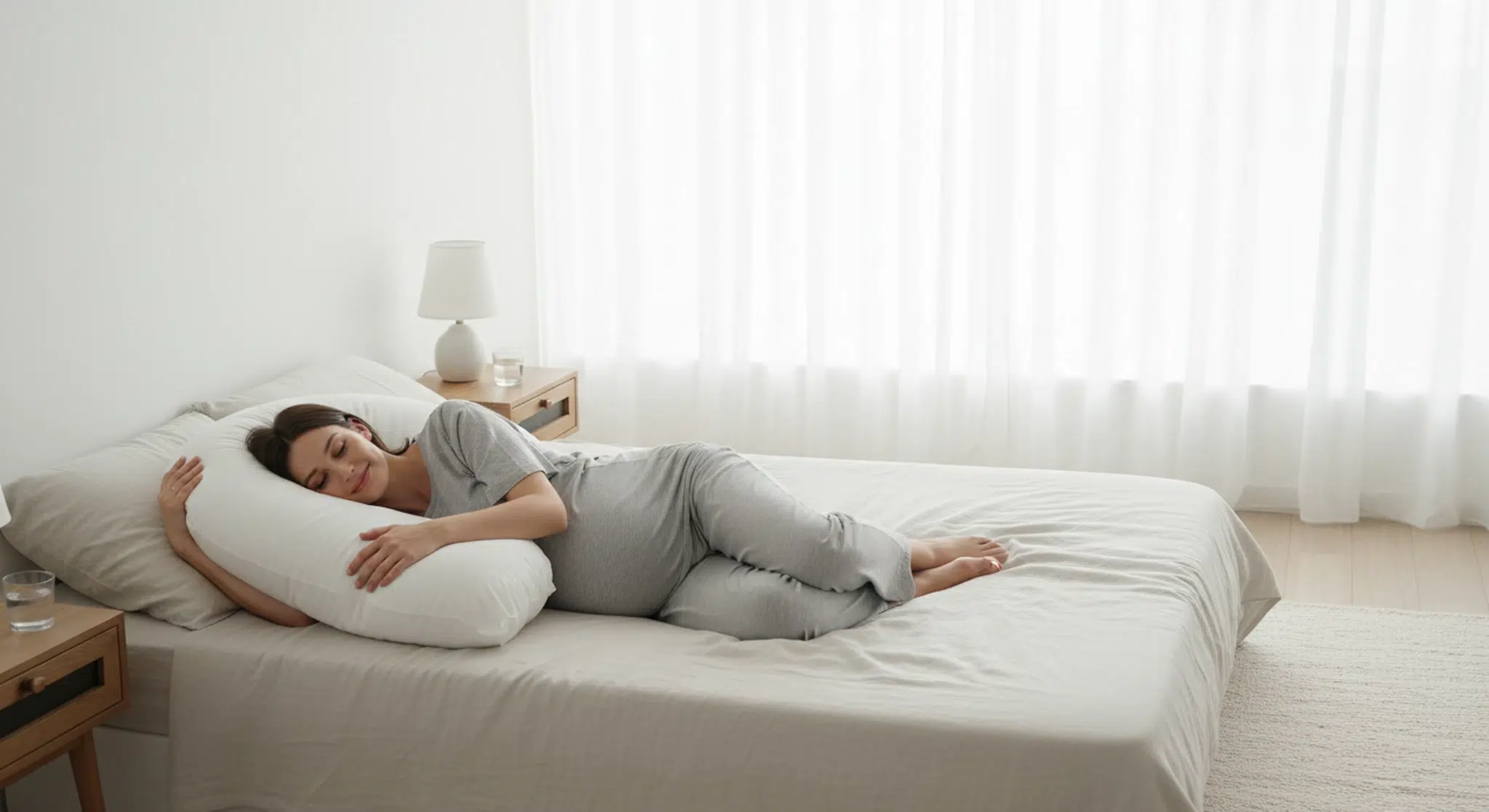
The best pregnancy pillow is the shape that supports side sleeping for your body and bed: a U shape for full support, a C or J shape for a smaller bed, and a wedge for targeted belly or back support.
Choosing the best pregnancy pillow comes down to shape first and features second: how you sleep, where it hurts, and how much bed you can give up.
Below we compare each type, explain fill, loft and covers, show how shape helps with back pain, hip pain and heartburn, and cover the one rule that never bends after birth.
Key Takeaways
Side sleeping may be best in the second and third trimesters, per ACOG, and a pregnancy pillow makes it easier.
U shapes give the most support; C and J shapes suit smaller beds; wedges give targeted lift.
Check the pillow’s dimensions against your mattress and your partner’s space.
A removable, washable, breathable cover matters more than most extras.
After birth, use it only for your own comfort: never let a baby sleep on or near it.
As an Amazon Associate, Betteroo earns from qualifying purchases.
Table of Contents
Best Pregnancy Pillow at a Glance: Match the Shape to Your Body and Bed
Quick Answer
The best pregnancy pillow is the shape that keeps you comfortable on your side in the bed you actually have. Choose a U-shaped pregnancy pillow if you want support on both sides and room to roll over, a C-shaped or J-shaped pregnancy pillow if your bed or budget is smaller, a straight body pillow if you want something simple to hug, and a pregnancy wedge pillow if you only need targeted support under your belly or behind your back.
Targeted belly or back support, travel, propping up
Very small
Compact and portable; firm lift right where you need it
Supports one spot only; not a whole-body solution
Inflatable or belly-cutout pillow
People who miss lying on their front
Medium
Adjustable firmness in some designs
Not a substitute for side sleeping later in pregnancy; ask your provider first
Pregnancy pillow types compared by use, bed space, pros and cons.
This page is about choosing and buying. For step-by-step positioning once your pillow arrives, see our guide on how to use a pregnancy pillow.
Why Side Sleeping Is the Goal
A pregnancy pillow is really a side-sleeping tool. The American College of Obstetricians and Gynecologists (ACOG) says that as your belly grows, sleeping on your back may not be good for you: in the second and third trimesters, lying on your back may compress a major blood vessel that carries blood to the uterus, which can make you dizzy and may reduce blood flow to the fetus. ACOG says sleeping on your side during the second trimester and third trimester may be best.
ACOG also suggests keeping one or both knees bent, placing a pillow between your knees and another under your belly, or trying a full-length body pillow. Every shape below delivers that setup in a different way.
If you wake up on your back, the Mayo Clinic says not to worry; just roll back onto your side. A pillow behind you makes that less likely.
The Main Types of Pregnancy Pillows, In Depth
What each shape does well and who it suits.
U-shaped pregnancy pillow: Two long arms joined by a curved top that sits under your head. You lie in the middle with one arm along your back and the other in front to hug and tuck between your knees. You can turn from side to side without rearranging anything. The trade-off is size: on a full or queen bed there may be little room left for a partner, so check the dimensions first.
C-shaped pregnancy pillow: One continuous curve that wraps from your head, down your back or front, and between your knees. It takes less room than a U, but when you roll to the other side you usually flip the pillow too. It also works propped against a headboard for sitting up.
J-shaped pregnancy pillow: A long straight body with a curled top for your head. You hug the long part and tuck its lower end between your knees. It suits smaller beds but does not support your back, so add a regular pillow behind you if you tend to roll.
Straight body pillow (I shape): The simplest option: one long rectangle or tube you hug and run between your knees. It is easy to wash, store and reuse after pregnancy.
Pregnancy wedge pillow: A small, firm triangle of foam. Slide it under your belly, behind your back, or under your upper body to prop you up. It is the most compact choice, handy for travel and a shared full bed, but supports only one spot.
Inflatable or belly-cutout pillow: These are designed so you can lie face down with your bump in an opening. They do not replace side sleeping later in pregnancy, so ask your doctor or midwife before using one for sleep.
Big days go better after a good night of sleep.
Got a baby or toddler at home too? Our free two-minute quiz builds a gentle, personalized sleep plan for little ones.
Where does it hurt?: Mostly back: look for something that supports behind you (U, C or a wedge at your back). Mostly hips or pelvis: prioritize firm knee support. Heartburn: look for a way to prop up your upper body (see below).
How big is your bed, and who shares it?: On a king, almost any shape fits. On a queen with a partner, a C, J or straight pillow often works better than a full U. On a full bed, a wedge or straight pillow may be the only comfortable option.
Do you roll a lot?: If you change sides several times a night, a U-shaped pillow saves you flipping a pillow in the dark.
Do you sleep hot?: Choose a breathable cotton or cooling-feel cover; a full-body pillow wraps around much of you, so this matters more than with a standard pillow.
Can you wash it?: A removable, machine-washable cover is close to essential for something you will use every night for months.
If you are buying for someone else, our list of gifts for pregnant women has more comfort ideas.
Fiberfill is soft and light; shredded foam is denser and holds its shape; solid foam gives the firmest lift; microbeads mold closely around you
Adjustable loft
Zippered inner liner you can add fill to or remove fill from
Useful if you are unsure how firm or thick you want it; check whether extra fill is included
Cover
Cotton, jersey knit, velour or plush, cooling-feel fabrics
Removable and machine washable; a breathable fabric if you run warm; a zipper that sits away from your face
Size and shape
Length and width listed in inches
Compare to your mattress width and your height; leave room for a partner
Pregnancy pillow features and what to look for.
If you have allergies or sensitive skin, check the fiber content of both fill and cover on the label.
Pregnancy Pain and the Pillow: Back, Hips and Heartburn
A pillow is not a treatment, but the right shape can make aches easier to sleep through.
Back pain: ACOG explains that your growing uterus shifts your center of gravity and stretches and weakens your abdominal muscles. Its sleep advice (side, knees bent, pillows between the knees and under the belly) is easiest with a U, C, or a wedge behind you.
Hip and pelvic pain: For pelvic pain in pregnancy, the NHS suggests putting a pillow between your legs for extra support in bed. The NHS also says to contact your midwife or doctor if pelvic pain makes it hard to move around or it hurts to turn over in bed.
Heartburn: The NHS says propping your head and shoulders up in bed can stop stomach acid coming up while you sleep, and the Mayo Clinic notes that sleeping on your left side with your head elevated can ease heartburn. A wedge under your upper body gives that lift.
Call your doctor or midwife about back pain that is severe or lasts more than two weeks, or back pain with fever, burning when you urinate, or vaginal bleeding, which ACOG says can be signs of preterm labor or a urinary tract infection.
When to Buy a Pregnancy Pillow
There is no medical start date. Many people buy one once side sleeping gets uncomfortable, often in the second trimester. By around 28 weeks pregnant, many want more support than regular pillows give.
Not sure? Test with one regular pillow between your knees and one under your bump. If that helps but keeps slipping, a full-length shape is a good buy; if you only need the belly pillow, a wedge may be enough.
Bringing it to the hospital? A wedge travels more easily than a U. See our hospital bag checklist for what else to pack.
Using a Pregnancy Pillow After Birth: For You, Never for Baby Sleep
Many parents keep using the pillow after delivery for their own comfort: propped behind the back in bed or under an arm while feeding. Our breastfeeding positions guide shows where support helps. Add it to your postpartum essentials if it is working for you.
Safe sleep warning: a pregnancy pillow is never a place for a baby to sleep
The American Academy of Pediatrics (AAP) says to keep pillows, blankets, stuffed toys and bumper pads out of your baby’s bed because soft objects and loose bedding can increase the risk of entrapment, suffocation or strangulation. Never put a baby to sleep on, in, or next to a pregnancy pillow, on your bed or on a couch. Babies sleep alone, on their back, on a firm, flat, bare surface such as a crib, bassinet or play yard. If your baby falls asleep while you are feeding with the pillow, or you feel drowsy, move your baby to their own safe sleep space.
The same rule applies to nursing pillows. The U.S. Consumer Product Safety Commission (CPSC) reported 154 infant deaths linked to nursing pillows from 2010 to 2022, approved a federal safety standard for them in September 2024, and says never to use them for infant sleep or lounging. Treat a pregnancy pillow the same way. Our safe sleep environment checklist and guide to baby pillows explain why.
Care, Cleaning and Making It Last
Wash the cover often: Follow the care label; a spare cover keeps you sleeping on laundry day.
Check the inner pillow’s label: Some inner pillows are machine washable, some are spot clean only.
Fluff and redistribute: Shake out fiberfill and shredded foam pillows so the fill does not clump in one end.
Budget Tips: Getting the Right Support Without Overspending
Start with what you own: Two or three standard bed pillows can recreate the between-the-knees and under-the-belly setup ACOG describes. Buy a full-size pillow if they keep sliding away.
Pick the smallest shape that solves your problem: If only your back hurts, a wedge may do. If you mostly need knee support, a straight body pillow costs less than a U and takes less space.
Pay for the features you will use: A removable washable cover is the one nearly everyone uses.
The best pregnancy pillow is the one that helps you sleep comfortably on your side in your own bed: a U shape for the most support, a C or J shape for a smaller bed, a straight pillow for simplicity, or a wedge for targeted lift. Check the size against your mattress, choose a washable, breathable cover, and keep it strictly for your own comfort after birth, never for your baby’s sleep. If pain, heartburn or poor sleep is getting worse despite good support, talk to your doctor or midwife.
Frequently Asked Questions
What is the best pregnancy pillow shape?
The best pregnancy pillow shape depends on your bed and your aches. A U-shaped pillow supports your back and front at once and suits people who switch sides often. A C or J shape takes less room. A straight body pillow is simple and budget friendly, and a wedge gives targeted support under your belly or behind your back.
When should you start using a pregnancy pillow?
There is no set week. Many people start once side sleeping becomes uncomfortable, often in the second trimester, when ACOG says sleeping on your side may be best. If regular pillows between your knees and under your belly keep slipping, a full-length pregnancy pillow is a good next step. Start whenever it helps you sleep.
Is a U or C shaped pregnancy pillow better?
Neither is better for everyone. A U shape supports both sides, so you can roll over without moving it, but it takes up a lot of bed. A C shape cradles you from head to knees, takes less space and works well for sitting up, but you may need to flip it when you change sides.
Is a pregnancy pillow worth it?
For many people, yes, especially later in pregnancy when back, hip or pelvic aches make side sleeping hard. ACOG suggests a pillow between the knees and under the belly, or a full-length body pillow. If a couple of regular pillows already keep you comfortable, you may not need to buy one at all.
Can I sleep on my back with a pregnancy pillow?
ACOG says that in the second and third trimesters, lying flat on your back may compress a major blood vessel to the uterus, so side sleeping may be best. A pillow behind your back helps keep you on your side. If you wake up on your back, the Mayo Clinic says not to worry; just roll back over.
Can I use a pregnancy pillow after giving birth?
Yes, for your own comfort while you are awake, such as propping your back or supporting your arm during feeding. Never let your baby sleep on, in or next to it. The AAP says pillows and soft objects do not belong in a baby’s sleep space. If your baby dozes off while feeding, move them to a crib or bassinet.
Gentle changes, peaceful nights.
Betteroo builds a personalized sleep plan for your baby or toddler. Take the free two-minute quiz to get started.