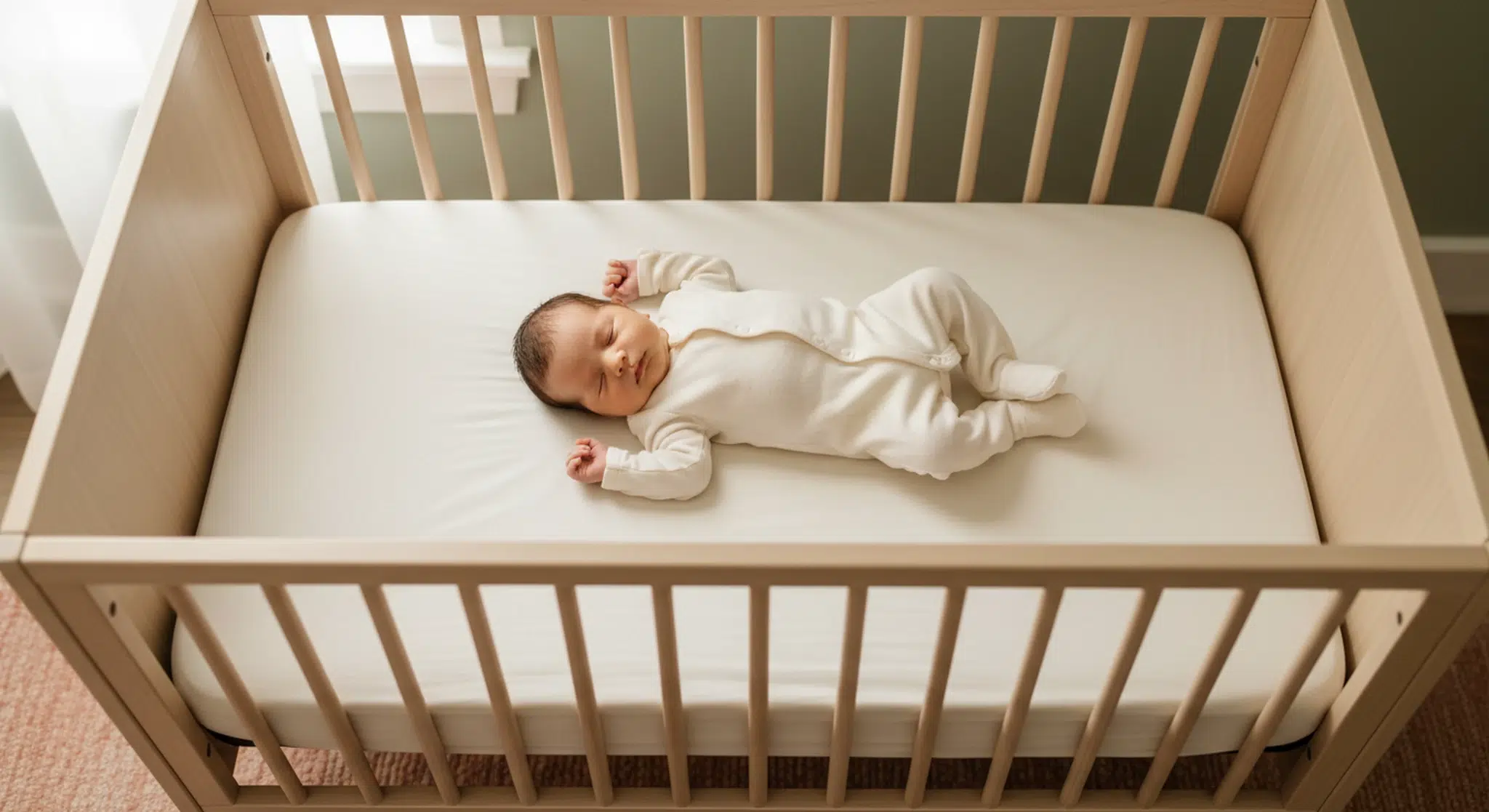


Newborns sleep 14 to 17 hours out of every 24, and almost none of it lands in a block that lets anyone else sleep.
The question of why newborns sleep so much usually arrives in one of two moods. Either you are marveling at a baby who barely opens their eyes, or you are quietly worried that a baby who sleeps this much might be sleeping too much.
This guide covers how much newborn sleep is actually normal, the biology driving it, when the pattern starts to change, whether a newborn can sleep too much, the specific warning signs worth a call, and when you do and do not need to wake a baby to feed.
Key Takeaways
- Newborns sleep 14 to 17 hours a day, in stretches of about 30 minutes to 4 hours, spread evenly across day and night.
- They sleep so much because of rapid brain growth, a high proportion of active REM-like sleep, and growth hormone release.
- Circadian rhythm does not exist at birth and begins to emerge around six to twelve weeks.
- In the first two weeks, wake your baby to feed at least every three hours by day until birth weight is regained.
- Sleepiness becomes concerning when a baby is hard to rouse, feeding poorly, jaundiced, or has too few wet diapers.
- A sudden increase in sleepiness matters more than a consistently sleepy baby.
Table of Contents
How Much Newborns Actually Sleep
Newborns sleep between 14 and 17 hours in a 24-hour period, and anywhere from 11 to 19 hours can still be within normal range according to the consensus ranges used by sleep researchers. That sleep is not delivered in one convenient block. It arrives in stretches of roughly 30 minutes to 3 or 4 hours, scattered evenly across day and night.
This is why the number feels wrong to parents. On paper, 16 hours of sleep sounds like a baby who sleeps most of the time. In practice, a baby who sleeps two hours, feeds for forty minutes, is awake for twenty, and then repeats, around the clock, leaves nobody in the house rested. The total is high; the distribution is brutal.
| Age | Typical total sleep in 24 hours | Longest stretch |
|---|---|---|
| 0 to 4 weeks | 14 to 17 hours | 2 to 4 hours |
| 1 to 2 months | 14 to 17 hours | 3 to 5 hours |
| 3 months | 14 to 16 hours | 4 to 6 hours |
| 4 to 6 months | 12 to 16 hours | 6 or more hours for many babies |
Why Newborns Sleep So Much
- The brain is growing faster than at any other point in life. A newborn’s brain roughly doubles in volume in the first year, and the fastest growth is in the earliest months. Sleep is when a great deal of that construction happens.
- Most of their sleep is active sleep. Around half of newborn sleep is REM-like active sleep, compared with roughly 20 percent in adults. Active sleep is thought to be central to building and pruning neural connections, so a newborn needs far more of it.
- Growth hormone is released during deep sleep. Babies grow at an extraordinary rate, and the hormonal machinery for that runs largely while they sleep.
- Birth is physically demanding. Labor is hard on babies too, and the first 24 to 48 hours often include an especially sleepy stretch as they recover.
- Everything is new and everything is input. Light, sound, temperature, touch, and gravity are all novel. Processing that load is exhausting, and sleep is how a newborn brain resets.
- Feeding is work. Sucking, swallowing, and breathing in coordination burns a surprising amount of energy for a baby, and many fall asleep partway through a feed for exactly that reason.
- Their sleep is not consolidated yet. Without a circadian rhythm, sleep is spread thinly across the whole day, which raises the total needed.
One thing worth emphasizing: newborns are not sleeping through anything in the adult sense. They are cycling through short sleep cycles of about 40 to 50 minutes, compared to 90 or so in adults, and surfacing between them. Some of those surfacings turn into wakings; many do not.
When Does It Change?
Circadian rhythm, the internal day-night clock, is essentially absent at birth. Melatonin production begins to emerge somewhere around six to twelve weeks, and light exposure is the main thing that sets it. That is why days and nights feel indistinguishable at first and then slowly separate.
You can help it along without doing anything elaborate. Get your baby into daylight during the day, particularly in the morning. Keep daytime feeds bright, chatty, and social. Keep night feeds dim, quiet, and dull. Do not tiptoe around naps during the day; a normal level of household noise helps reinforce the difference.
Total sleep drifts down slowly rather than dropping off a cliff. By three months most babies are consolidating more sleep into the night, and by four to six months many have a genuinely long nighttime stretch. That is also when the four month sleep regression often shows up, because sleep architecture itself is maturing.
Apps can show you the data. A plan tells you what to do with it.
Our free two-minute quiz builds a gentle, personalized sleep plan for your child’s age and temperament.
Can a Newborn Sleep Too Much?
Occasionally, yes, and this is the question underneath most searches on this topic. A sleepy newborn is usually just a newborn. But excessive sleepiness is also one of the few nonspecific signs that something needs checking, particularly in the first two weeks.
The useful distinction is between a baby who sleeps a lot and wakes well, and a baby who is difficult to rouse. A normal sleepy newborn, when woken, will open their eyes, root, latch, feed with reasonable vigor, and have periods of quiet alertness during the day. A baby who does not do those things needs to be seen.
Call your pediatrician today if your newborn:
- Is consistently sleeping more than four to five hours between feeds in the first two weeks, before birth weight has been regained.
- Is hard to wake, or wakes only briefly and will not feed effectively.
- Has fewer wet diapers than expected, roughly six or more a day from day five, or is not gaining weight as expected.
- Is increasingly yellow in the skin or the whites of the eyes. Jaundice makes babies sleepy, and sleepy babies feed less, which worsens jaundice. It is a loop worth interrupting early.
- Has a temperature of 100.4F (38C) or higher, or is unusually cool. Any fever in a baby under three months is an immediate call.
- Is floppy, unusually limp, or not responding as usual, or has a weak, high-pitched cry.
- Is breathing fast, grunting, flaring nostrils, or has any blue or dusky color around the lips.
- Has suddenly become much sleepier than they were, which is more concerning than a baby who has always been sleepy.
Do You Need to Wake a Newborn to Feed?
In the first two to three weeks, usually yes. The standard guidance is to wake a newborn to feed at least every three hours during the day and every four to five hours overnight until they have regained birth weight and are gaining steadily. Your pediatrician may adjust that if your baby was premature, is jaundiced, or has had weight concerns.
Once birth weight is regained and growth is on track, most pediatricians are happy for babies to set their own night pattern, which is when longer stretches gradually appear. Our guide to when you can stop waking your baby to feed goes into the specifics.
Practical ways to rouse a sleepy newborn: unswaddle down to a diaper, change the diaper, rub the back or the soles of the feet, use a cool washcloth on the cheeks, hold them upright, talk to them, dim-but-not-dark lighting, and hand express a little milk onto your nipple or the bottle nipple so the taste triggers sucking. Skin-to-skin contact is often the most effective of all.
Making the Most of a Sleepy Newborn Phase
A sleepy newborn phase does not last, and it is worth using rather than fighting. Two practical suggestions, neither of which is about optimizing anything.
First, sleep when you can, not when it feels productive. The advice to sleep when the baby sleeps is repeated so often it has become a joke, but the underlying point stands: the sleep deficit you accumulate in the first weeks compounds. A 40-minute daytime nap is worth more than a tidy kitchen.
Second, do not use this phase to build habits you will want to break. It is fine to feed to sleep, hold a sleeping newborn, and contact nap in the first weeks; none of that creates a permanent problem at this age, and safe contact napping is a supervised, awake-adult activity. Around three to four months, when sleep starts to consolidate, is the natural point to start thinking about the setup you want longer term. Our newborn sleep routine guide covers how to ease into that gently.
What a Pediatrician Checks at the First Visits
At the early well-baby visits, sleepiness is assessed indirectly, through weight, feeding, and output. A baby who is gaining, feeding effectively, and producing the expected number of wet diapers is a baby whose sleepiness is almost certainly just newborn physiology.
The two conditions most often behind genuine excessive sleepiness in the first weeks are jaundice and inadequate intake, and they frequently occur together in a self-reinforcing loop: a jaundiced baby is sleepy, a sleepy baby feeds less, and less feeding slows the clearance of bilirubin. Interrupting that early is why the feeding and weight checks in the first two weeks matter so much.
Trust the change rather than the absolute number. A baby who has always slept 17 hours and feeds well is different from a baby who slept 14 hours last week and 19 hours this week. Sudden change in a newborn is always worth a phone call, and no reasonable clinician will mind you making it.
Frequently Asked Questions
How many hours a day should a newborn sleep?
Most newborns sleep between 14 and 17 hours in a 24-hour period, with the wider normal range running from about 11 to 19 hours. That sleep comes in stretches of roughly 30 minutes to 3 or 4 hours spread across both day and night, because newborns have no circadian rhythm yet.
Why do newborns sleep so much?
Their brains are growing faster than at any other time in life, and around half of newborn sleep is active REM-like sleep that supports building neural connections. Growth hormone is also released during deep sleep, birth itself is physically demanding, and processing an entirely new sensory world is exhausting.
Can a newborn sleep too much?
Usually a sleepy newborn is simply a newborn, but excessive sleepiness can signal a problem. The distinction that matters is whether your baby wakes well: a normal sleepy newborn will rouse, root, and feed with reasonable vigor. A baby who is hard to wake, will not feed effectively, is jaundiced, or has fewer wet diapers than expected needs to be seen.
Should I wake my newborn to feed?
In the first two to three weeks, yes. The usual guidance is to wake your baby at least every three hours during the day and every four to five hours overnight until they have regained birth weight and are gaining steadily. Once growth is on track, most pediatricians are happy for babies to set their own night pattern.
When do newborns start sleeping less during the day?
Melatonin production and a day-night rhythm begin to emerge around six to twelve weeks. By about three months, sleep starts consolidating into the night, and by four to six months many babies have a genuinely long nighttime stretch with more defined daytime naps.
Calmer bedtimes, better nights.
Betteroo builds a personalized sleep plan for your child. Take the free two-minute quiz to get started tonight.
5 Sources
- American Academy of Sleep Medicine. Recommended Amount of Sleep for Pediatric Populations.
https://jcsm.aasm.org/doi/10.5664/jcsm.5866 - American Academy of Pediatrics, HealthyChildren.org. Sleep Position: Why Back Is Best and Newborn Sleep Patterns.
https://www.healthychildren.org/English/ages-stages/baby/sleep/Pages/Getting-Your-Baby-to-Sleep.aspx - StatPearls. Physiology, Sleep Stages.
https://www.ncbi.nlm.nih.gov/books/NBK526132/ - American Academy of Pediatrics, HealthyChildren.org. Jaundice in Newborns.
https://www.healthychildren.org/English/ages-stages/baby/Pages/Jaundice.aspx - Mayo Clinic. Newborn sleep: What to expect.
https://www.mayoclinic.org/healthy-lifestyle/infant-and-toddler-health/in-depth/baby-sleep/art-20045014