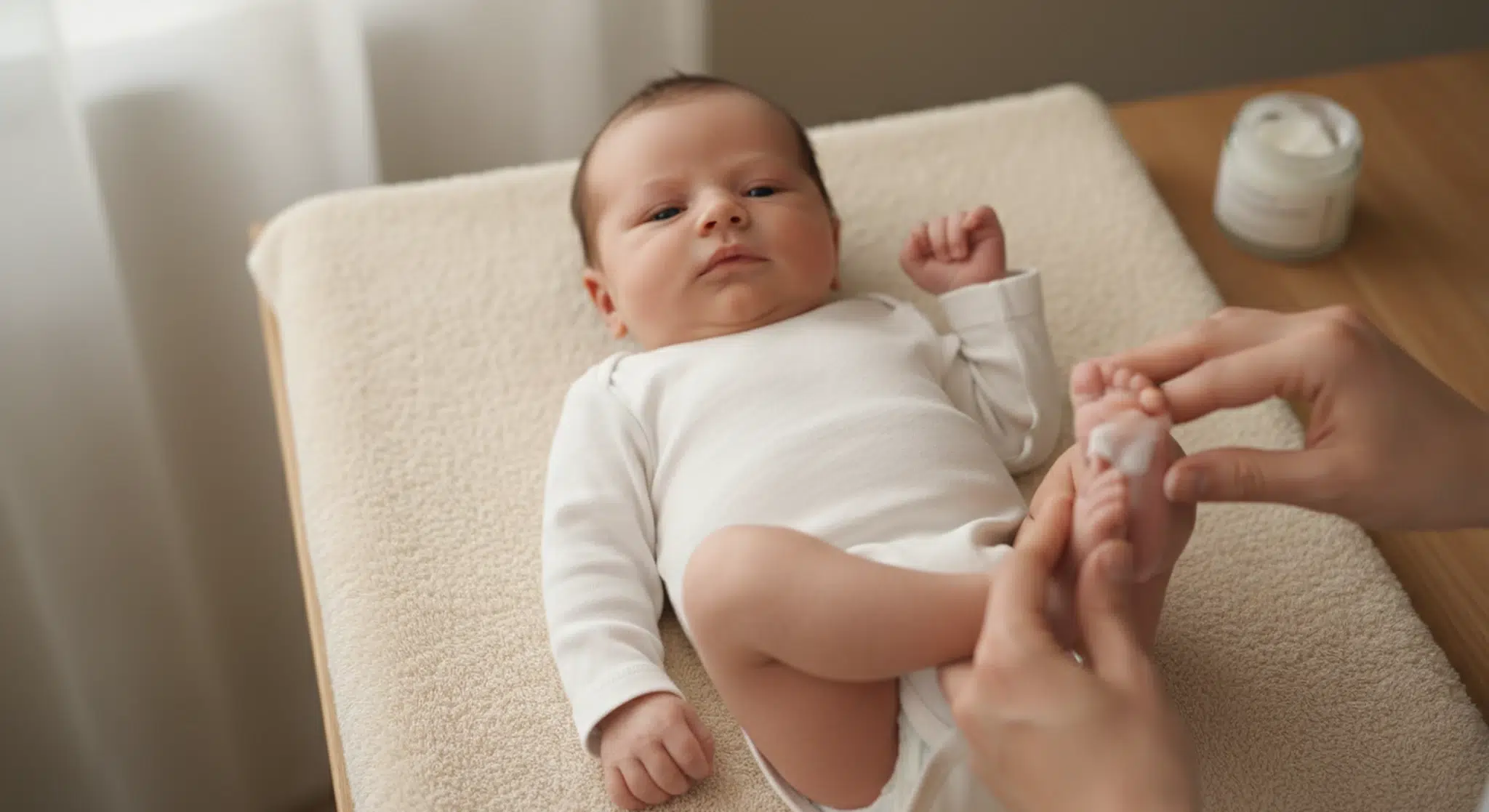
When can you put lotion on a newborn? You can use a small amount of plain, fragrance-free moisturizer on dry or cracked patches from the first weeks, but the peeling most newborns have in the first two weeks is normal and usually needs nothing at all.
Flaky hands and feet are one of the most common reasons parents ask when can you put lotion on a newborn. The good news is that newborn peeling is expected: Cleveland Clinic says all newborns go through a peeling phase in the first two weeks of life.
This guide explains why newborn skin peels, how to choose between lotion, cream and ointment, what to keep off your baby’s skin, how to moisturize after a bath, what the big eczema prevention trials actually found, and when a skin change is worth a call.
Key Takeaways
Newborn peeling in the first two weeks is normal and usually clears on its own.
If you use a moisturizer, choose a small amount of a plain, fragrance-free, hypoallergenic product, applied right after a bath.
Skip fragrances, adult products, essential oils and talc powder, and be cautious with olive and other kitchen oils.
Large trials (BEEP and PreventADALL) found daily moisturizer did not prevent eczema in babies.
Call your pediatrician for peeling past three weeks, red or irritated skin, and right away for any fever under 3 months.
Table of Contents
When Can You Put Lotion on a Newborn? The Short Answer
Quick Answer
You can use a small amount of a plain, fragrance-free moisturizer on a newborn when skin is dry or cracked, but most newborns do not need it. Cleveland Clinic says all newborns go through a peeling phase in the first two weeks, and it usually clears on its own. The American Academy of Pediatrics (AAP) suggests a small amount of fragrance-free, hypoallergenic moisturizing lotion after a bath if you want to use one. Ask your pediatrician what they prefer, especially for a premature baby.
Cleveland Clinic is blunt about typical newborn peeling: a petroleum-based moisturizer “won’t make the skin look better, but it won’t hurt.” A little moisturizer can make dry patches more comfortable, but the peeling finishes on its own schedule either way.
Why Newborn Skin Peels: Vernix and Post-Term Babies
Before birth, your baby’s skin is covered in vernix, the white, creamy coating you may have seen in the delivery room. The AAP calls vernix a natural moisturizer and advises leaving it on newborn skin for a while to help prevent the skin from drying out.
Cleveland Clinic explains that vernix protects the skin from amniotic fluid in the womb. Once it is wiped or washed away after birth, babies are likely to shed a few layers of skin, often on the hands, feet and ankles.
Babies born past their due date: Cleveland Clinic notes that vernix thins over time, so babies born later have had more exposure to amniotic fluid and tend to peel more.
Do not pick or peel: Cleveland Clinic advises letting flakes fall off naturally because the old layer is protecting new skin underneath.
Lotion vs Cream vs Ointment: What to Look For in a Newborn Moisturizer
Moisturizers come in three basic textures. The AAP explains the differences:
Type
What it is (AAP)
When it may suit a baby
Ointment
Contains the most oil. Has no preservatives and should not sting when applied
Extremely dry or irritated areas
Cream
Also contains a lot of oil, which helps seal moisture into the skin
Dry patches and everyday dry skin
Lotion
Thinner and lighter, with more water and less oil
Warmer months or skin that is only a little dry
Moisturizer types. Source: AAP HealthyChildren.org, Avoiding Dry Winter Skin in Babies and Toddlers.
Plain petroleum jelly is an ointment, and Cleveland Clinic lists petroleum-based moisturizers as an option for newborn peeling. Whatever texture you choose, check the label:
Fragrance-free and hypoallergenic: the AAP recommends fragrance-free lotions, partly because phthalates can hide under “fragrance” or “parfum” on a label. The American Academy of Dermatology (AAD) also points parents to products labeled hypoallergenic and fragrance-free.
Not just “unscented”: the AAD advises avoiding products labeled “unscented” and those with many plant-based ingredients, such as essential oils.
What to Avoid on Newborn Skin
Newborn skin care is mostly about what you leave out:
Fragrance: Cleveland Clinic advises avoiding fragrances in soap, shampoo, lotion and laundry detergent. The AAP suggests a “free and clear” detergent and no dryer sheets or fabric softeners.
Adult products: the AAP says bubble baths and foamy, scented soaps can irritate skin and strip natural oils. Perfumed adult lotions belong in the same category.
Essential oils: the AAD lists them among plant-based ingredients to avoid on babies’ skin.
Talc powder: the AAP says talc-based baby powder can contain asbestos fibers and advises avoiding talc for infants and children. Inhaling large amounts of talc can cause severe lung disease, and even talc-free cornstarch powder can irritate the airways if inhaled.
Scrubbing and heavy soap: Cleveland Clinic advises against scrubbing or exfoliating newborn skin, and the AAP says soaps can dry out a baby’s skin, so use mild soap sparingly.
What about olive oil? In a pilot trial of 115 healthy full-term newborns (Cooke and colleagues, Acta Dermato-Venereologica), babies had olive oil, sunflower oil or no oil applied twice a day for four weeks. Both oil groups had better skin hydration but less improvement in the structure of the skin’s protective lipid layers than the no-oil group, and the authors urged caution in recommending oils for newborn skin. A pilot does not prove harm, but it is a good reason not to reach for kitchen oils by default.
Big days go better with a good night of sleep.
Got a little one at home too? Our free two-minute quiz builds a gentle, personalized sleep plan for babies and toddlers.
The best moment to moisturize is right after a bath: the AAP says to apply moisturizer while skin is still damp. Our guide on how to bathe a newborn covers the bath itself. The skin-care steps:
Keep baths short and lukewarm: the AAP and Cleveland Clinic both suggest baths of 10 minutes or less in warm, not hot, water.
Sponge bathe until the cord stump falls off: usually by about one or two weeks of age, per the AAP. See newborn belly button stages.
Pat, do not rub: the AAP says rubbing strips more oil from the skin surface.
Use a small amount: smooth a thin layer over dry areas such as wrists, ankles and feet.
Dress in soft cotton: the AAP suggests cotton clothing soon after moisturizing to help hold in moisture.
How often? The AAP says newborns do not need a daily bath, and three baths a week in the first year may be enough, because bathing more often dries the skin. For dry skin, the AAP suggests moisturizer at least twice a day. If your baby’s skin looks fine, you do not need a routine at all.
Newborn Eczema: Signs to Watch For
Atopic dermatitis is a form of eczema, as the AAP notes. The AAD lists these signs of eczema in babies up to 12 months:
A rash that looks pink, red, purple or brown. On lighter skin it tends to look pink or red; on darker skin it can look deep brown or purple.
Itchy skin, sometimes with scratch marks.
Dry or scaly skin and small bumps.
Blisters that leak fluid, and swelling.
Where it shows up. The AAD says baby eczema usually appears on the face, neck folds, scalp, trunk and outer arms or legs, and not typically in the diaper area; Cleveland Clinic agrees it rarely affects the diaper area. For diaper-area rashes, see diaper rash vs yeast infection.
The AAD notes that cradle cap, psoriasis and yeast infections can look like eczema, and that babies with eczema are more likely to get skin infections. If good skin care does not clear a rash within a few days, see your pediatrician. Do not start any medicated cream on a newborn without their advice.
Do Daily Moisturizers Prevent Eczema? What the Trials Found
You may have read that daily lotion prevents eczema. The largest trials did not find that.
Study
Who was included
What was tested
What it found
BEEP (Chalmers and colleagues, The Lancet, 2020)
1,394 full-term newborns in the UK with a parent or sibling who had eczema, hay fever or asthma
Daily emollient for the first year plus standard skin-care advice, vs advice alone
Eczema at age 2 in 23% of the emollient group vs 25% of controls: no meaningful difference. More skin infections in the emollient group in the first year
PreventADALL (Skjerven and colleagues, The Lancet, 2020)
About 2,400 babies from the general population in Norway and Sweden
Bath oil and facial cream starting at 2 weeks of age (plus a separate early-food arm)
Eczema by 12 months in 11% of the skin-care group vs 8% with no intervention. Neither skin care nor early foods reduced eczema
Two large randomized trials of infant moisturizers for eczema prevention.
The BEEP authors found no evidence that daily emollient prevents eczema in high-risk babies, and PreventADALL’s authors said their results do not support emollients for prevention by 12 months. The AAD’s parent page still says moisturizer might help prevent eczema in higher-risk babies, so advice is not fully settled. A fair summary: moisturizing treats dry skin, but daily lotion on healthy newborn skin is not proven to prevent eczema. If eczema, asthma or allergies run in your family, ask your pediatrician what makes sense.
Use the same plain product: a little of your fragrance-free moisturizer is enough; no special massage oil needed.
Skip essential oils and perfumed oils: per the AAD and AAP guidance above.
Check for nut oils: the AAP notes that nut oils can hide under other names, such as “arachis oil” for peanut oil.
When massage is over, your baby sleeps on their back, alone, on a firm, flat, bare surface with no blankets or pillows.
Cradle Cap, Baby Acne and Other Skin Changes That Do Not Need Lotion
Some newborn skin changes are not dry skin, and lotion will not fix them.
Cradle cap: the AAP calls scaly scalp patches a harmless condition that appears in many babies, and says you can loosen the scales with a soft-bristled brush or leave them alone. Our cradle cap guide covers gentle care step by step.
Baby acne: small bumps on the face are a different issue from dryness, with their own care; see baby acne.
Heat rash: tiny bumps in warm, covered areas are about overheating, not dryness; see baby heat rash.
Cleveland Clinic also mentions ichthyosis, a rare genetic condition with skin that cracks, flakes and itches; it is not ordinary peeling, and your baby’s medical team guides its care.
Lotion for Premature Babies
The AAP notes that premature babies’ skin is highly prone to injury. Follow your NICU team’s or pediatrician’s plan for products and baths, and before going home ask exactly which moisturizer, if any, to use and how often. Our NICU baby guide covers what else to ask.
Peeling lasts more than three weeks: or skin looks red, bloody or irritated (Cleveland Clinic).
A rash does not improve: within a few days of gentle care, or your baby seems uncomfortable (AAD).
You see possible eczema: dry, scaly, itchy patches on the face, scalp, neck folds or trunk (AAD).
Skin reacts to a product: new redness or bumps after starting a lotion. Stop the product and call.
Call right away, day or night, if:
Your baby is under 3 months and has a fever: the AAP says to call right away for a temperature of 100.4 F (38.0 C) or higher in a baby younger than 3 months (12 weeks).
Fever comes with an unexplained rash: at any age (AAP).
You see blisters, oozing or swelling: the AAD notes babies with eczema are more likely to get skin infections, so weeping or spreading skin needs a prompt look.
Your baby seems unwell: Cleveland Clinic advises prompt care if a baby with skin changes has a fever or seems uncomfortable.
For trouble breathing, a limp or unresponsive baby, or if you feel something is seriously wrong and cannot reach your pediatrician, call 911 or go to the emergency room. This article is general education, not medical advice.
Frequently Asked Questions
When can you put lotion on a newborn?
You can use a small amount of plain, fragrance-free moisturizer from the first weeks if your baby’s skin is dry or cracked. Most newborns do not need it, because Cleveland Clinic says the peeling in the first two weeks is normal and clears on its own. Ask your pediatrician first if your baby was born early.
Should I put lotion on my newborn’s peeling skin?
You do not have to. Cleveland Clinic says a petroleum-based moisturizer will not make peeling skin look better, but it will not hurt. If cracks in the wrists or ankles look uncomfortable, a thin layer of fragrance-free ointment or cream can help. Let flakes fall off naturally instead of peeling them.
Can I use olive oil or baby oil on my newborn?
It is best to be cautious. A pilot trial of 115 newborns found that babies given olive or sunflower oil twice daily had less improvement in the skin’s protective lipid structure than babies given no oil, and the authors urged caution. A plain, fragrance-free cream or ointment is a simpler choice.
Is petroleum jelly safe for newborns?
Plain petroleum jelly is an ointment, and Cleveland Clinic lists petroleum-based moisturizers as an option for newborn peeling. The AAP notes ointments contain the most oil, have no preservatives and should not sting. Use a thin layer on dry or cracked areas. Premature babies should follow their care team’s advice.
How often should I put lotion on my baby?
Only as often as their skin needs it. Healthy newborn skin may need nothing. For dry skin, the AAP suggests moisturizing at least twice a day, ideally right after a bath while the skin is still damp. The AAP also says three baths a week may be enough in the first year.
Does putting lotion on a baby prevent eczema?
The largest trials say probably not. In BEEP, daily emollient for the first year did not reduce eczema at age 2 and was linked to more skin infections. In PreventADALL, bath oil and facial cream did not reduce eczema by 12 months. Moisturizing still helps treat dry skin and existing eczema.
Gentle changes, peaceful nights.
Betteroo builds a personalized sleep plan for your baby or toddler. Take the free two-minute quiz to get started.
Chalmers JR, et al. Daily emollient during infancy for prevention of eczema: the BEEP randomised controlled trial. The Lancet. 2020;395(10228):962-972. PMC (NIH). https://www.ncbi.nlm.nih.gov/pmc/articles/PMC7086156/
Skjerven HO, et al. Skin emollient and early complementary feeding to prevent infant atopic dermatitis (PreventADALL): a factorial, multicentre, cluster-randomised trial. The Lancet. 2020;395(10228):951-961. PubMed. https://pubmed.ncbi.nlm.nih.gov/32087121/