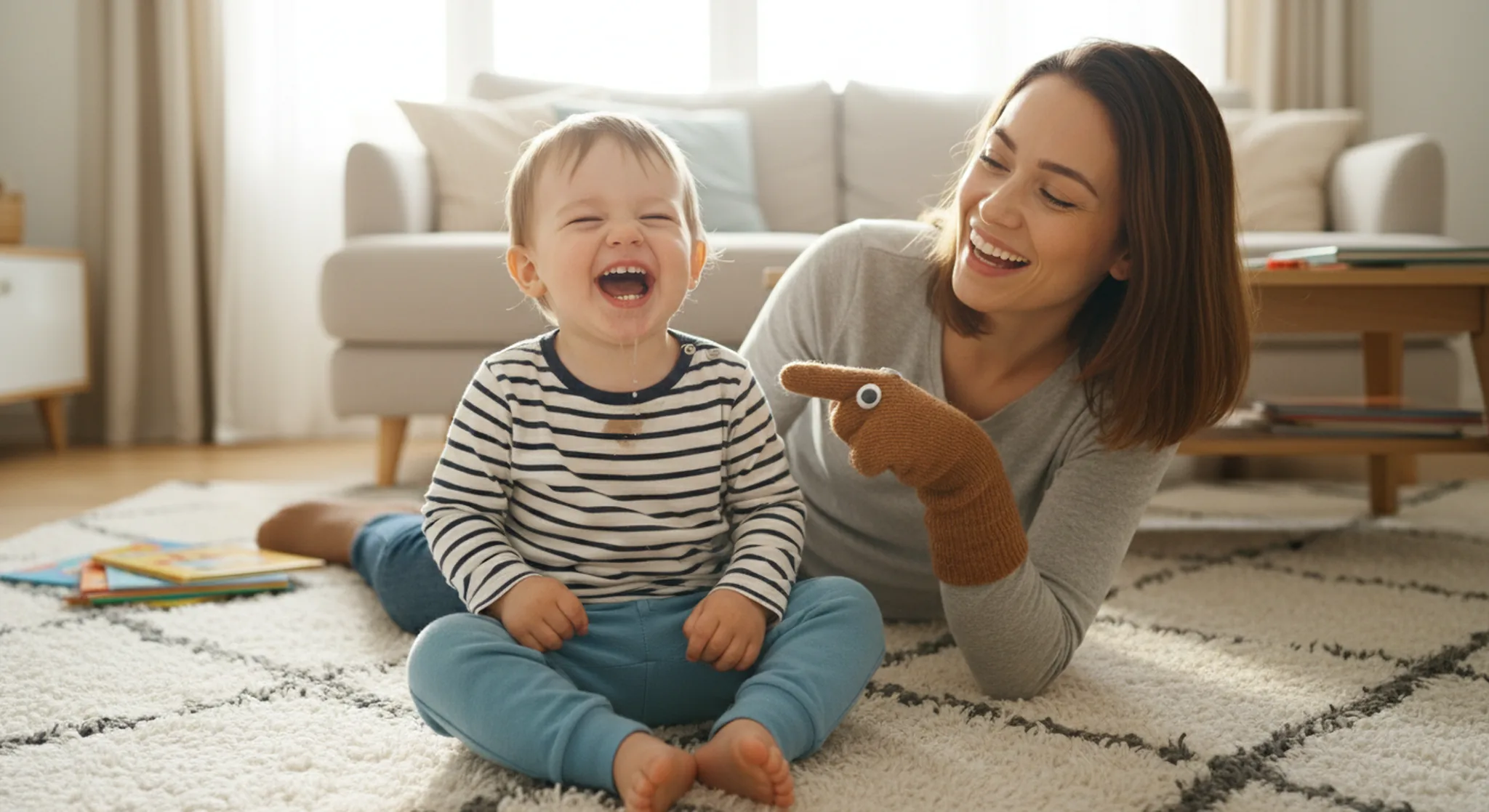
The funniest joke in the world, if you are two, is a cow that says quack.
Most joke lists for kids are packed with puns that toddlers simply do not understand yet. These toddler jokes are different: they are short, silly, and built on the kind of humor little kids actually find hilarious, from animals making the wrong sound to bananas that are not peeling well.
Below you will find 50 funny jokes for toddlers, grouped into animal jokes, food jokes, easy knock-knock jokes, and silly questions, plus a quick guide to how humor develops from ages one to seven and how to tell jokes that land with a tiny audience.
Key Takeaways
Toddlers laugh at incongruity: things that are wrong on purpose, like a cow that says quack or a sock on your ear.
Wordplay and puns usually start to click around ages four to six.
The best toddler jokes are short, visual, and repeated often. Familiarity is part of the fun.
Laugh at your toddler’s own jokes, even when they make no sense. It teaches the rhythm of conversation.
Keep humor kind, since toddlers copy what they hear.
A silly joke is a great tool for smoothing transitions like bath time and bedtime.
Table of Contents
What Makes a Toddler Laugh (and Why Puns Fall Flat)
Toddler humor is its own genre. Most two and three year olds do not yet get wordplay, because a pun depends on knowing that one word can mean two different things. What they do get, instantly and with enormous delight, is something being wrong on purpose: a cow that says “quack,” a sock on your ear, Daddy pretending to be a baby. Researchers who study the development of humor describe this stage as incongruity humor, and it is one of the first signs that a child understands how the world is supposed to work.
So the best toddler jokes are short, visual, and gloriously silly. Do not worry if your child laughs at the wrong part or tells the punchline before the setup. Toddlers often “tell” a joke by copying the rhythm of one, and that is exactly how the skill develops.
Silly Animal Jokes for Toddlers
What does a cow say? Quack! (Wait for the giggle, then let them correct you.)
What do you call a sleeping bull? A bulldozer!
Why do fish live in salt water? Because pepper makes them sneeze!
What do you call a pig that does karate? A pork chop!
What is a cat’s favorite color? Purrr-ple!
What do you call a dog that is a magician? A labracadabrador!
What do ducks eat with their soup? Quackers!
What does a frog wear on its feet? Open toad shoes!
Why are frogs so happy? Because they eat whatever bugs them!
What do you call a bear with no teeth? A gummy bear!
What animal is always at a baseball game? A bat!
What do you get when you cross a snake and a pie? A pie-thon!
Food Jokes Toddlers Love
Why did the banana go to the doctor? It was not peeling well!
What do you call a sad strawberry? A blueberry!
Why did the cookie go to the doctor? It felt crummy!
What kind of cheese is not yours? Nacho cheese!
Why did the orange stop rolling? It ran out of juice!
What did the baby corn say to the mama corn? Where is pop corn?
What is a pretzel’s favorite dance? The twist!
Why did the grape stop in the middle of the road? Because it ran out of juice!
What do you call cheese that is sad? Blue cheese!
What did the lettuce say to the carrot? Nothing, silly, lettuce cannot talk!
Big days of play go better with a good night of sleep.
Got a little one at home too? Our free two-minute quiz builds a gentle, personalized sleep plan for babies and toddlers.
Knock-knock jokes teach turn-taking: you say a line, they say a line. For toddlers, choose ones where the punchline is funny even without understanding the pun.
Knock knock. Who’s there? Tank. Tank who? You’re welcome!
When they are ready for more, our collection of knock-knock jokes for kids has dozens of the next level up.
Silly Questions and Absurd Jokes (No Punchline Needed)
These are not really jokes in the adult sense, but they are the funniest thing in the world to a two year old. The humor is in the mistake.
Put a sock on your hand and ask, “Is this where socks go?”
Point at their nose and call it an elbow.
“Is that a dog?” (pointing at a cat)
Say the wrong name for their favorite toy, very confidently.
“Time to put on your shoes!” and then try to put them on your own ears.
“What does a lion say? Tweet tweet?”
Pretend a banana is a telephone and answer it.
Read a familiar book but swap one word for something ridiculous.
These games also do real developmental work: to find it funny, your child has to know the right answer, so every laugh is a tiny vocabulary check.
Funny Jokes for Toddlers About Everyday Things
Why did the teddy bear say no to dessert? Because she was already stuffed!
What has ears but cannot hear? A cornfield!
What goes up but never comes down? Your age!
Why did the kid bring a ladder to school? Because it was high school!
What do you call a sleeping dinosaur? A dino-snore!
What has one head, one foot, and four legs? A bed!
Why is the sky so high? So birds do not bump their heads!
What do you call a train that sneezes? Achoo-choo train!
Why did the sun go to school? To get brighter!
Why did the toilet paper roll down the hill? To get to the bottom!
What do you call a monster that loves to dance? The boogie man!
Why did the cow cross the road? To get to the udder side!
What do you call a dinosaur that is sleeping in a car? A dino-snore on wheels!
Once puns start to land, around ages four to six, move on to our jokes for kids and silly jokes for kids collections. And for the grown-ups, there is always a stash of dad jokes.
How to Tell Jokes to a Toddler
Go slow and exaggerate. Big pauses, big faces, and a dramatic reveal matter more than the words.
Repeat, repeat, repeat. Toddlers love hearing the same joke twenty times. Familiarity is part of the fun.
Laugh at their jokes. A toddler joke is often just a random word followed by a proud giggle. Celebrate it. You are teaching the rhythm of conversation.
Use props. A stuffed animal telling the joke is funnier than you telling it.
Skip mean humor. Keep jokes kind. Toddlers copy what they hear, including teasing.
Shared laughter is a powerful bonding tool, and humor is quietly linked to language, social skills, and emotional regulation. When a toddler laughs at a cow that says quack, they are showing that they understand categories and expectations. When they try to tell a joke back, they are practicing turn-taking and storytelling. Humor can also be a great way to defuse a meltdown or a tough transition, like getting into the car seat or starting the bedtime routine. A silly joke at bath time is often all it takes to turn a battle into a giggle.
Frequently Asked Questions
What are good jokes for toddlers?
Good toddler jokes are short and silly, with a punchline that is funny even without understanding wordplay. Examples: “What does a cow say? Quack!”, “What do you call a sleeping dinosaur? A dino-snore!”, and the interrupting cow knock-knock joke. Absurd questions, like calling their nose an elbow, often get the biggest laughs.
At what age do toddlers understand jokes?
Babies laugh at peekaboo and funny faces in the first year. Around ages two to three, toddlers start finding mistakes and absurdity funny, like wrong animal sounds. Real understanding of puns and double meanings usually develops between four and seven years old.
Why do toddlers tell jokes that make no sense?
Toddlers often copy the rhythm of a joke, a question followed by a silly answer and laughter, before they understand how jokes work. It is a normal and important step in language and social development, so laugh along and celebrate it.
What are easy knock-knock jokes for toddlers?
The easiest toddler knock-knock jokes are “Cow says. Cow says who? No silly, cow says moo!”, “Boo. Boo who? Don’t cry, it’s only a joke!”, and “Interrupting cow. Interrupting c… MOO!” They work because the punchline is a sound or a silly surprise.
Are potty jokes normal for toddlers?
Yes. Potty words are hilarious to toddlers and preschoolers, partly because they notice adults react. It is a normal phase. Staying calm, offering other silly words to play with, and setting simple limits about when and where potty talk is okay usually works better than a big reaction.
Gentle changes, peaceful nights.
Betteroo builds a personalized sleep plan for your baby or toddler. Take the free two-minute quiz to get started.