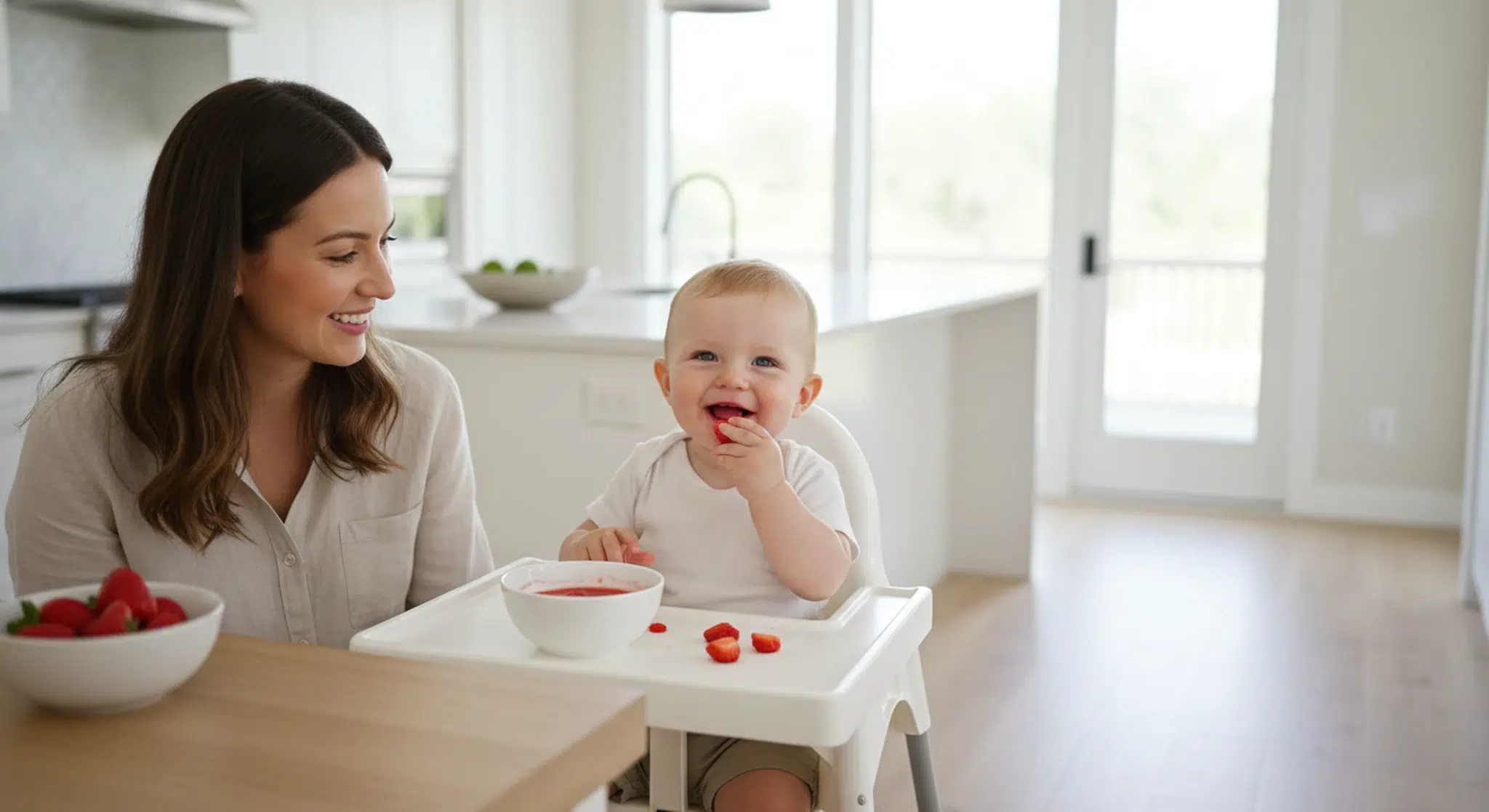
Strawberries for baby are safe from the start of solids at about 6 months when they are mashed or pureed at first and later cut into small soft pieces, and they are not a major food allergen.
Strawberries for baby are a favorite first fruit: sweet, soft when ripe and easy to mash. The two questions parents ask most are how to cut them safely and whether that red rash around the mouth means an allergy.
This guide answers both, with an age-by-age serving table, tips for a 9 month old, washing advice from the FDA, simple puree ideas and clear signs for when to call. Safety points come from the CDC, the FDA and the American Academy of Pediatrics.
Key Takeaways
Babies can have strawberries from the start of solids, at about 6 months.
Strawberries are not one of the nine major food allergens listed by the FDA.
Serve them mashed or pureed at first, then in soft pieces no larger than one-half inch.
Whole uncut berries are a choking hazard for young children.
A flat red rash where the fruit touched is usually contact irritation, not an allergy.
Table of Contents
Strawberries for Baby: The Short Answer
Quick Answer
Strawberries for baby are fine from the start of solids, which the CDC puts at about 6 months. Strawberries are not one of the nine major food allergens listed by the FDA. Serve them mashed or pureed at first, then in small soft pieces no larger than one-half inch as your baby learns to pick up food, following the American Academy of Pediatrics (AAP). Never give whole uncut berries to a young child: the CDC lists uncut berries as a choking hazard.
Ripe strawberries are soft, sweet and easy to mash with a fork, which makes them one of the friendliest fruits to offer a new eater. They also stain everything they touch, so a bib and a washable floor are your best friends.
The main things to get right are texture and size for your baby’s stage, washing, and knowing the difference between a harmless red mark around the mouth and a real allergic reaction. This guide covers all three, plus how to serve strawberries to a 9 month old, simple puree ideas and when to call your pediatrician.
When Can Babies Have Strawberries?
The CDC says your child can begin eating solid foods at about 6 months and that introducing foods before 4 months is not recommended. Strawberries can be part of that first stage. There is no rule that berries must wait until later in the first year.
Readiness is about your baby, not the fruit. The CDC lists signs such as good control of the head and neck, sitting up alone or with support, bringing objects to the mouth, trying to grasp small objects, and swallowing food rather than pushing it back out onto the chin. If you are just getting started, our starting solids guide walks through the first weeks.
When strawberries are a new food, the CDC suggests offering one single-ingredient food at a time at first and waiting 3 to 5 days between each new food. That makes it easier to tell what caused a reaction if one happens.
Are Strawberries a Common Allergen?
No. The FDA’s list of major food allergens includes milk, eggs, fish, crustacean shellfish, tree nuts, peanuts, wheat, soybeans and sesame. Strawberries are not on it. That does not mean a strawberry allergy is impossible: the Sydney Children’s Hospitals Network notes that allergic reactions to different fruits and vegetables can develop in children at any age.
Because strawberries are not a top allergen, you do not need a special plan to introduce them the way you might for egg or peanut. Our guide to introducing allergens covers those foods. Simply offer strawberries as a single new food, start with a small amount and watch your baby over the next few hours.
The FDA says food allergy symptoms can appear within a few minutes to a few hours after eating and can include hives, flushed skin or a rash, a tingling or itchy feeling in the mouth, vomiting or diarrhea, and coughing or wheezing. Severe reactions (anaphylaxis) can cause difficulty breathing, swelling of the throat and loss of consciousness. Call 911 right away for any of those.
Feeding and sleep go hand in hand.
Our free two-minute quiz builds a gentle, personalized sleep plan around your baby’s feeds.
This is the most common worry parents have with strawberries, and it is usually not an allergy. The Sydney Children’s Hospitals Network explains that some children develop a rash around the mouth after eating acidic foods, strawberries among them, and calls this “a common reaction called perioral contact dermatitis.” It adds that perioral contact dermatitis does not mean you need to remove a particular food from your child’s diet.
What you see
Likely meaning
What to do
Flat redness only where strawberry touched the skin (lips, chin, cheeks)
Contact irritation (perioral contact dermatitis)
Wipe the skin with water; keep watching; usually no need to stop the food
Raised, itchy welts (hives), especially spreading beyond the mouth
Possible allergic reaction
Stop the food and call your pediatrician
Vomiting, diarrhea, coughing or wheezing after eating
Possible allergic reaction
Stop the food and call your pediatrician
Difficulty breathing, throat swelling, or a baby who passes out
Anaphylaxis
Call 911
Rash around the mouth vs allergy signs. Sources: Sydney Children’s Hospitals Network, Fruit and vegetable allergy factsheet; FDA, Food Allergies: What You Need to Know.
Wiping your baby’s face with water after the meal can help limit contact. If your baby also drools a lot, a rash around the mouth may be from saliva instead; our drool rash guide explains how to tell. If you are not sure what you are seeing, take a photo and show your pediatrician.
How to Serve Strawberries to Baby by Age
How you cut strawberries is the biggest safety decision you will make. The CDC’s choking hazard list includes “uncut grapes, berries, cherries, or melon balls,” and its advice is to cook and prepare food to the right shape, size and texture for your child’s development. The AAP says to cut food for infants and young children into pieces no larger than one-half inch.
Age
How to serve strawberries
Avoid
About 6 to 8 months
Pureed or well mashed with a fork; stirred into plain yogurt or cereal; thicker, lumpier mash as your baby’s eating skills develop (CDC)
Whole berries, firm or underripe chunks
About 8 to 12 months
Finely chopped or small soft pieces no larger than one-half inch (AAP) that your baby can pick up
Whole berries, large halves
12 months and up
Small pieces or thin slices, mixed into meals and snacks
Whole uncut berries (CDC); keep cutting while your child learns to chew
How to serve strawberries by age. Sources: CDC, When, What, and How to Introduce Solid Foods; CDC, Choking Hazards; AAP, Choking Prevention.
You may see baby-led weaning advice to offer a very large whole strawberry for a 6 month old to gnaw on. The CDC and AAP guidance we read does not include that approach; it focuses on mashing, pureeing and cutting food small. We suggest following that guidance and talking with your pediatrician if you want to try a different method. Our baby-led weaning guide explains gagging versus choking and other finger-food basics.
The AAP adds a few habits for every meal: supervise mealtimes, and have your child sit down to eat rather than eating while walking, running or lying down. It also advises keeping higher-risk foods, such as whole grapes and raw fruit chunks, from children until 4 years of age or older, depending on their development.
How to Serve Strawberries to a 9 Month Old
Around 9 months, many babies are working on picking up small foods between the thumb and finger, a skill called the pincer grasp. The CDC lists trying to grasp small objects, such as toys or food, among the signs of readiness for solids, and it advises cutting soft food into small pieces or thin slices. Small, soft strawberry pieces make good practice.
Choose ripe berries: soft, deep red strawberries mash easily between your fingers. Firm, pale berries are harder to chew.
Cut small: chop into pieces no larger than one-half inch, which is the AAP’s size guide for infants and young children.
Offer a few at a time: put a small handful of pieces on the tray instead of a pile, so your baby does not stuff too many in at once.
Pair it: serve strawberry pieces alongside a soft protein or grain, such as mashed beans, egg or soft toast strips.
Sit and watch: keep your baby seated upright in the high chair and stay at the table for the whole meal.
Strawberries are eaten raw with the skin on, so washing matters. The FDA’s tips for cleaning fruits and vegetables apply:
Wash your hands for 20 seconds with warm water and soap before and after preparing fresh produce.
Gently rub produce while holding it under plain running water. The FDA says there is no need to use soap or a produce wash.
Cut away any damaged or bruised areas before preparing or eating.
Dry produce with a clean cloth or paper towel to further reduce bacteria that may be present.
Rinse strawberries just before serving, then hull them (remove the green leafy top) and cut. Throw out any berries that are moldy or mushy. If you buy frozen strawberries for purees, thaw and mash them, and serve them soft rather than as hard frozen pieces.
Strawberry Puree and Easy Ideas
You do not need a recipe to make strawberry puree. Wash and hull ripe berries, then mash with a fork or blend until smooth. If your baby is new to solids, you can thin it with a little breast milk or formula.
Strawberry yogurt: stir mashed strawberries into plain whole-milk yogurt instead of buying flavored yogurt. The CDC lists flavored yogurts among foods with added sugars.
Strawberry oatmeal: swirl puree into soft cooked oatmeal or infant cereal.
Strawberry and banana mash: mash both together for a naturally sweet, thick puree.
Strawberry and cheese: pair small strawberry pieces with finely shredded cheese; see can babies have cheese for safe cheese textures.
Strawberry on toast: spread a thin layer of mashed strawberries on soft toast strips.
Jam and sweetened strawberry products: the CDC says children younger than 24 months should not have added sugars. Mashed fresh berries give the same flavor.
Strawberry juice: the CDC says children younger than 12 months should not drink any fruit or vegetable juice, and that juice after 12 months is unnecessary.
Honey: do not sweeten strawberries with honey. The CDC says honey given to children younger than 12 months may cause a severe food poisoning called botulism. Our guide on why babies cannot have honey explains more.
Call 911 if your baby has difficulty breathing, swelling of the throat or face, or loses consciousness after eating. The FDA lists these among the severe symptoms of anaphylaxis, a life-threatening allergic reaction. If your baby is choking and cannot cry, cough or breathe, call 911 and start infant first aid.
Call your pediatrician’s office if you see hives, vomiting, diarrhea, coughing or wheezing after strawberries; if a rash spreads beyond the areas the fruit touched; if your baby has severe eczema or a past food reaction and you are unsure about new foods; or if a rash around the mouth keeps coming back and you want help sorting out the cause.
A flat red patch where strawberry juice touched the skin, in a baby who is otherwise happy and well, is usually contact irritation. It is still fine to ask your pediatrician at the next visit.
Frequently Asked Questions
When can I start strawberries for baby?
Babies can have strawberries once they start solid foods, which the CDC says is at about 6 months. Offer them pureed or well mashed at first. Strawberries are not a major food allergen, so no special introduction plan is needed. Offer them as a single new food and watch your baby for a few hours afterward.
How do I serve strawberries to a 9 month old?
Choose soft, ripe berries, wash and hull them, and cut them into small soft pieces no larger than one-half inch, the size the American Academy of Pediatrics recommends for infants. Put a few pieces on the tray at a time, keep your baby seated upright, and stay close for the whole meal.
Why does my baby get a rash around the mouth from strawberries?
Acidic foods like strawberries can irritate the skin around the mouth. The Sydney Children’s Hospitals Network calls this perioral contact dermatitis and says it does not mean you need to remove the food. Hives that spread, vomiting, or breathing trouble are different and need a call to your pediatrician or 911.
Are strawberries a choking hazard for babies?
Whole strawberries can be. The CDC lists uncut berries among choking hazards for young children. Mash or puree strawberries for new eaters, then cut them into small soft pieces no larger than one-half inch. Always supervise meals and have your child sit down to eat rather than eat while moving.
Can babies be allergic to strawberries?
It is possible, but strawberries are not one of the nine major food allergens listed by the FDA. Allergic reactions to fruits can develop at any age. Watch for hives, vomiting, diarrhea, coughing or wheezing after eating, and call 911 for difficulty breathing or throat swelling.
Can babies have strawberry jam or juice?
It is best to skip both. The CDC says children younger than 24 months should not have added sugars, which jam usually contains, and that children younger than 12 months should not drink any fruit juice. Mash fresh, ripe strawberries and spread them on toast or stir them into plain yogurt instead.
Calmer days, better nights.
Betteroo builds a personalized sleep plan for your baby. Take the free two-minute quiz and have it ready before the newborn weeks.