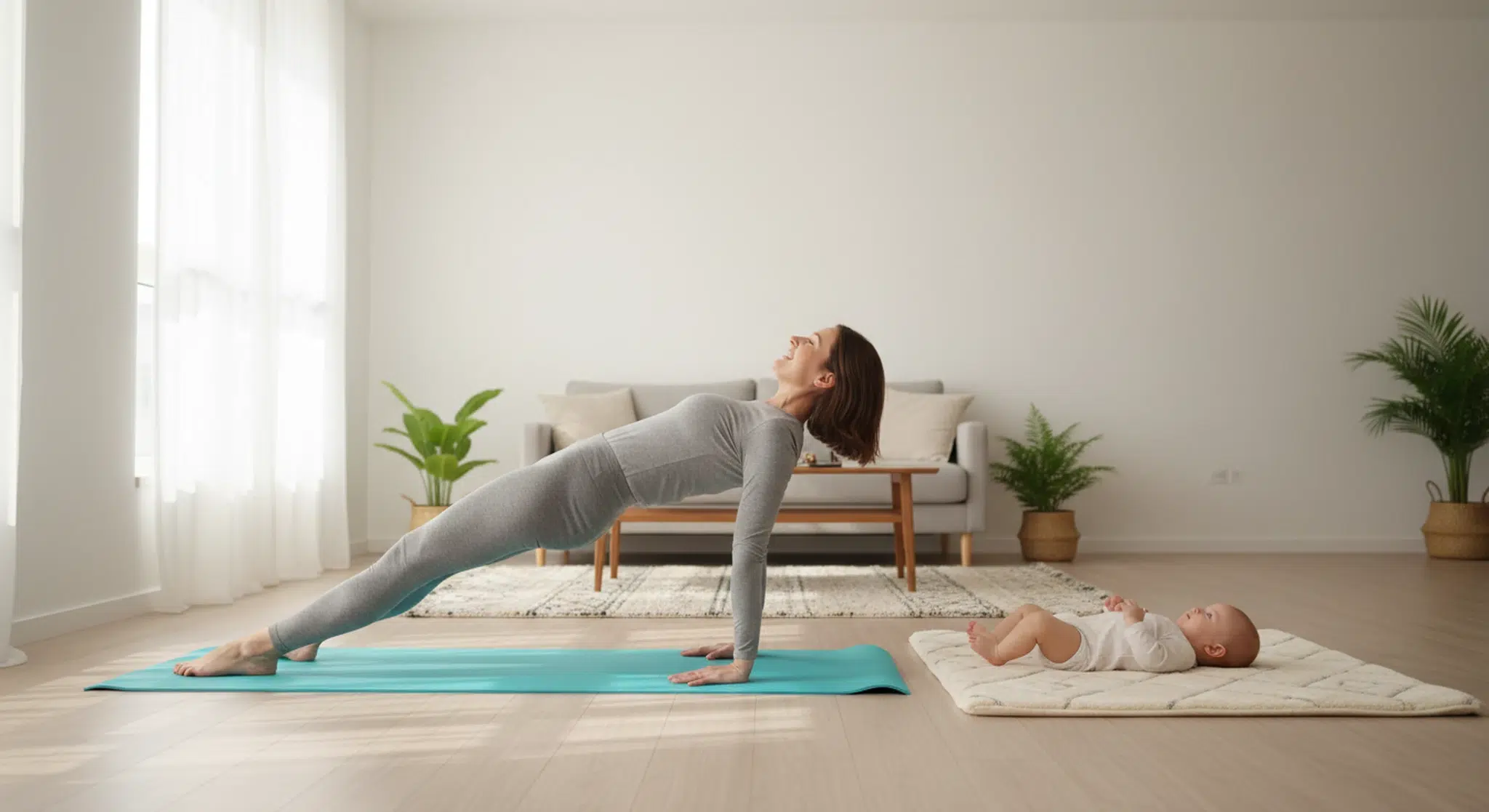


A safe postpartum workout plan starts with walking, gentle stretches and pelvic floor exercises within days of an uncomplicated vaginal birth (or on your provider’s timeline after a cesarean), then builds gradually toward 150 minutes of moderate activity a week.
Whether you are itching to move again or cannot imagine it yet, a postpartum workout plan should follow your healing, not the calendar. This guide walks you through each phase, from the first gentle walks to strength training and, if you want it, running.
Everything here is based on guidance from ACOG, Mayo Clinic, the NHS, Cleveland Clinic and the CDC. Use it as a starting point for a conversation with your doctor or midwife, who knows your birth and your body.
Key Takeaways
- After an uncomplicated vaginal birth, gentle exercise can usually start within days, as you feel ready.
- After a cesarean or complicated birth, your provider sets the timeline.
- Start with walking, Kegels and gentle core work, then build toward 150 minutes of moderate activity a week.
- Moderate exercise does not appear to affect milk supply; feed or pump first for comfort.
- Stop and get help for pain, leaking, vaginal heaviness, abdominal doming or heavy bleeding.
Table of Contents
Postpartum Workout Plan: When Can You Start?
Quick Answer
ACOG’s Committee Opinion 804 says exercise can be resumed gradually once it is medically safe, and that timing depends on how you gave birth and whether you had complications. There is no single start date that fits everyone. The NHS puts it simply: after a straightforward birth, begin gentle exercise as soon as you feel up to it. ACOG notes that even 10 minutes of exercise benefits your body.
Benefits of Postpartum Exercise for Body and Mood
Postpartum exercise is not about “bouncing back.” According to ACOG and Mayo Clinic, regular activity after birth can strengthen your abdominal muscles, boost your energy, relieve stress, support better sleep, improve your fitness, help you lose pregnancy weight alongside healthy eating, and help prevent or reduce symptoms of postpartum depression.
The NHS notes that depression can be common after birth and that gentle exercise, rest and accepting help can lift your mood. If you feel hopeless or unable to cope, talk to your doctor or midwife.
Be realistic about sleep. When nights are broken, a 10 minute walk in daylight may serve you better than a hard session that leaves you drained, and rest is part of recovery. Read more in sleep deprivation and postpartum depression and sleep deprivation for new parents.
Sample Postpartum Workout Plan by Phase
The table below is a general example built from ACOG, Mayo Clinic, NHS and UK return-to-running guidance. It is not medical advice. Your timeline depends on your birth, your healing and your provider’s clearance, so move on only when the current phase feels easy and symptom free.
| Phase | Focus | Example activities | Before moving on |
|---|---|---|---|
| Weeks 0 to 2 | Rest, healing, finding your pelvic floor | Short, easy walks as you feel up to it; gentle stretches; Kegels (NHS, ACOG) | After a cesarean or complicated birth, follow your provider’s timeline first |
| Weeks 2 to 6 | Gentle daily movement and core basics | Longer walks; Kegels (3 sets of 10 a day); pelvic tilts; happy baby pose (Mayo Clinic); 20 to 30 minutes of easy activity a day (ACOG) | No pain, no heavier bleeding, no leaking or heaviness |
| Weeks 6 to 12 | Build aerobic time and add strength | Brisk walking; swimming once cleared (NHS: 7 days after bleeding stops); low-impact classes; strength work on 2 days a week (ACOG) | Your provider’s OK at your postpartum checkup, which the NHS advises before any high-impact exercise |
| Week 12 and beyond | Work toward 150 minutes a week; return to impact if you want it | Longer cardio, progressive strength training, a graded return to running if you pass readiness tests (Goom, Donnelly and Brockwell) | No leaking, heaviness, pelvic pain or abdominal doming during or after workouts |
The First 6 Weeks: Walking, Breathing and Gentle Core Work
These weeks overlap with the fourth trimester. You are still bleeding and healing (see our postpartum essentials checklist), and your baby is feeding around the clock, so keep everything gentle.
- Walk: the NHS calls walking great exercise and suggests getting out as much as you can. Start with a few minutes and gradually increase pace and distance, warming up and cooling down each time (Mayo Clinic).
- Pelvic floor: ACOG’s Committee Opinion 804 says pelvic floor exercises can begin in the immediate postpartum period (technique below).
- Pelvic tilt (Mayo Clinic): lie on your back with knees bent. Tighten your abs to press your lower back flat against the floor, tilting your pelvis up slightly. Hold up to 10 seconds. Start with 5 and work up to 10 to 20, a few times a day.
- Happy baby pose (Mayo Clinic): on your back, bring your knees toward your chest, a little wider than your hips, and hold the outside of your feet with soles facing up. Gently draw your knees toward the floor, relax your pelvic muscles and work toward about 90 seconds.
ACOG suggests 20 to 30 minutes of activity a day once you are ready, starting with simple core and back exercises and adding intensity gradually. The NHS warns that your core and lower back may be weaker and your joints more flexible for a few months, so avoid stretching or twisting too far. On tired days, remember that feeding a newborn is hard work; see why breastfeeding makes you so tired.
Baby on the way? Get ahead on sleep.
Our free two-minute quiz builds a gentle, personalized sleep plan you can use from the first weeks at home.
How to Do Kegels After Birth
Kegels train your pelvic floor muscles, and ACOG lists them among the strengthening exercises to include after pregnancy. Mayo Clinic describes the technique:
- Find the muscles: tighten your pelvic floor as if you were stopping your urine midstream. Do not actually practice while urinating, Mayo Clinic says.
- Hold and release: hold the squeeze for up to 10 seconds, then release and relax for 10 seconds. Shorter holds are fine at first.
- Repeat: aim for at least 3 sets of 10 repetitions a day.
Keep your belly, thighs and buttocks relaxed and keep breathing. If you cannot tell whether you are using the right muscles, or you keep leaking urine as the weeks go by, ask your provider about a pelvic floor physical therapist.
Diastasis Recti: Check Before You Crunch
Diastasis recti is a separation of the left and right rectus abdominis muscles that usually happens during pregnancy. Cleveland Clinic says it affects about 6 in 10 women after childbirth. Signs include a bulge or “pooch” just above or below the belly button, doming when you use your abs, low back pain and poor posture. It is not painful in itself.
A simple self-check, as described by Cleveland Clinic:
- Lie on your back with knees bent and feet flat.
- Lift your shoulders slightly off the floor, as if starting a sit-up.
- Place your fingertips just above your belly button, pointing toward your toes, and feel for a gap between the muscles.
- If two or more fingers fit in the gap, Cleveland Clinic advises talking to your provider.
A self-check is not a diagnosis. Cleveland Clinic says the gap starts to close after several weeks as your muscles regain strength, and it is never too late to work on it. Until you get guidance, it suggests avoiding crunches and sit-ups, unmodified planks and push-ups, poses like downward dog and boat pose, Pilates double leg lifts and scissors, and any move that makes your abs bulge, cone or dome. Deep-core work with an experienced physical therapist is the main treatment.
Weeks 6 to 12: Building Strength and Cardio
Many people talk with their provider about doing more at a postpartum checkup. The NHS advises getting advice at your postnatal check before any high-impact exercise such as aerobics or running.
- Aerobic activity: ACOG describes moderate intensity as exercise that raises your heart rate and makes you sweat while you can still talk. Brisk stroller walks count.
- Swimming: the NHS says to wait until 7 days after your postnatal bleeding has stopped; the RUH Bath NHS leaflet adds that any wound should be healed.
- Strength: ACOG recommends muscle strengthening on at least 2 days a week, such as yoga, Pilates or weight lifting. Start light, with moves you can do without doming or leaking.
Postpartum Exercise After a C-Section
A cesarean is major abdominal surgery, and the NHS says recovery takes longer after a cesarean or complicated delivery. Mayo Clinic and ACOG advise asking your provider when to start an exercise program, and the NHS says to check before doing anything strenuous.
- Ask at each visit which activities are OK now and which should wait.
- Confirm with your provider that early pelvic floor exercises suit you.
- Wait for the go-ahead before swimming; the RUH Bath NHS leaflet lists a healed wound as a requirement.
- Treat walking as your main cardio until you are cleared, and stop if anything hurts (Mayo Clinic, ACOG).
Breastfeeding and Postpartum Exercise
Moderate exercise is not thought to affect breast milk quantity or quality, or your baby’s growth, according to Mayo Clinic, and ACOG’s Committee Opinion 804 says postpartum exercise does not affect lactation. Mayo Clinic notes high-intensity exercise may make milk taste sour, though this is likely rare.
- Feed or pump first: ACOG suggests this to avoid the discomfort of full, engorged breasts. Our breastfeeding guide covers the basics.
- Hydrate: Mayo Clinic recommends keeping a water bottle nearby and staying well hydrated.
- Support: wear a well-fitting, supportive bra (ACOG, Mayo Clinic). The NHS suggests getting measured, since your size may have changed.
If you are worried about supply, read signs your milk supply is decreasing and talk with your provider or a lactation consultant before blaming your workouts.
Returning to Running and High-Impact Exercise
The UK guideline Returning to Running Postnatal (Goom, Donnelly and Brockwell, 2019) recommends a return to running between 3 and 6 months after birth at the earliest, and a Royal United Hospitals Bath NHS leaflet based on it says running before 12 weeks is not recommended. Before you run, the guideline suggests you can do these without pain, heaviness, dragging or leaking:
| Test | Target |
|---|---|
| Walking | 30 minutes |
| Balance on one leg | 10 seconds |
| Single-leg squat | 10 each side |
| Jog on the spot | 1 minute |
| Forward bounds | 10 |
| Hop in place | 10 each leg |
| Single-leg calf raise, single-leg bridge, single-leg sit-to-stand, side-lying leg lift | about 20 each side |
The RUH leaflet also lists good pelvic floor control (ideally confirmed by a pelvic health physical therapist) and an abdominal gap under 2 cm without bulging among its readiness checks.
Warning Signs to Stop Exercising
ACOG and Mayo Clinic both say to stop if you feel pain. The RUH Bath NHS leaflet lists these as signs to stop and get advice from your doctor or a pelvic health physical therapist:
- Leaking urine or stool.
- Heaviness or dragging in the vagina, which can signal prolapse.
- Low back or pelvic pain.
- A bulging belly or a gap in your abdominal muscles.
Stop and call, too, if bleeding gets heavy: the CDC lists soaking one or more pads in an hour, or passing clots bigger than an egg, as urgent warning signs. For what later bleeding looks like, see your first period after baby.
Related Betteroo Guides
- pregnancy weight gain
- Postpartum Essentials Checklist
- The 4th Trimester
- Sleep Deprivation and Postpartum Depression
- Your First Period After Baby
- How to Increase Milk Supply
- Does Breastfeeding Make You Tired?
When to Call Your Doctor or Midwife
The CDC says some pregnancy-related problems can happen up to a year after delivery. Call 911 or go to the emergency room right away if you have:
- Chest pain, a fast-beating heart or trouble breathing.
- Fainting or dizziness that does not go away.
- Thoughts about harming yourself or your baby.
- Heavy bleeding: soaking one or more pads in an hour or passing clots bigger than an egg.
Call your doctor or midwife promptly (the CDC calls these urgent warning signs) if you notice:
- A headache that will not go away or gets worse, or changes in your vision.
- A fever of 100.4 F or higher.
- Severe belly pain that does not go away.
- Swelling, redness or pain in one leg or arm (the CDC flags this up to 6 weeks after birth).
- Foul-smelling vaginal discharge, or overwhelming tiredness that sleep does not relieve.
Book a regular appointment for ongoing leaking, vaginal heaviness, pain with exercise or abdominal doming, and ask whether a pelvic floor physical therapist could help. This article is general education, not medical advice.
Frequently Asked Questions
What is a good postpartum workout plan for beginners?
Start with short daily walks, gentle stretches and pelvic floor exercises in the first weeks. Add pelvic tilts and longer walks as you feel ready, then build toward 150 minutes of moderate activity a week plus strength work on 2 days, as ACOG recommends. Get your provider’s clearance before high-impact exercise.
How soon after giving birth can I exercise?
After a healthy pregnancy and uncomplicated vaginal birth, ACOG and Mayo Clinic say you can usually begin a few days after delivery or whenever you feel ready, starting with gentle activity like walking. After a cesarean birth, an extensive vaginal repair or a complicated delivery, ask your provider when to start.
When can I exercise after a C-section?
Talk with your provider, since recovery takes longer after a cesarean. Mayo Clinic and ACOG advise asking your provider when to start an exercise program, and the NHS says to check before doing anything strenuous. Gentle pelvic floor work and short walks are often first steps, but confirm what is right for you.
Does exercise affect breast milk supply?
Moderate exercise is not thought to affect breast milk quantity or quality, or your baby’s growth, according to Mayo Clinic, and ACOG says postpartum exercise does not affect lactation. Feeding or pumping before a workout can prevent the discomfort of full breasts, and drinking plenty of water helps you stay hydrated.
When can I start running after having a baby?
UK return-to-running guidance from Goom, Donnelly and Brockwell recommends waiting until 3 to 6 months after birth at the earliest, and an NHS leaflet based on it advises against running before 12 weeks. You should also be able to walk, hop and jog on the spot without pain, leaking or heaviness.
How do I know if I have diastasis recti?
Signs include a bulge or pooch near your belly button and doming when you use your abs. Cleveland Clinic describes a self-check: lie on your back, lift your shoulders slightly and feel for a gap above your belly button. If two or more fingers fit, talk to your provider.
Calmer days, better nights.
Betteroo builds a personalized sleep plan for your baby. Take the free two-minute quiz and have it ready before the newborn weeks.
7 Sources
- American College of Obstetricians and Gynecologists (ACOG). Exercise After Pregnancy (FAQ).
https://www.acog.org/womens-health/faqs/exercise-after-pregnancy - ACOG Committee Opinion No. 804. Physical Activity and Exercise During Pregnancy and the Postpartum Period. Obstet Gynecol. 2020.
https://www.acog.org/clinical/clinical-guidance/committee-opinion/articles/2020/04/physical-activity-and-exercise-during-pregnancy-and-the-postpartum-period - Mayo Clinic. Exercise after pregnancy: How to get started.
https://www.mayoclinic.org/healthy-lifestyle/labor-and-delivery/in-depth/exercise-after-pregnancy/art-20044596 - NHS. Exercising after having a baby (Keeping fit and healthy with a baby).
https://www.nhs.uk/baby/support-and-services/keeping-fit-and-healthy-with-a-baby/ - Cleveland Clinic. Diastasis Recti.
https://my.clevelandclinic.org/health/diseases/22346-diastasis-recti - Royal United Hospitals Bath NHS Foundation Trust. Return to running after having a baby (PHY047), based on Goom T, Donnelly G, Brockwell E. Returning to running postnatal, 2019.
https://www.ruh.nhs.uk/patients/patient_information/PHY047_Return_to_running.pdf - Centers for Disease Control and Prevention. Urgent Maternal Warning Signs (Hear Her).
https://www.cdc.gov/hearher/maternal-warning-signs/index.html