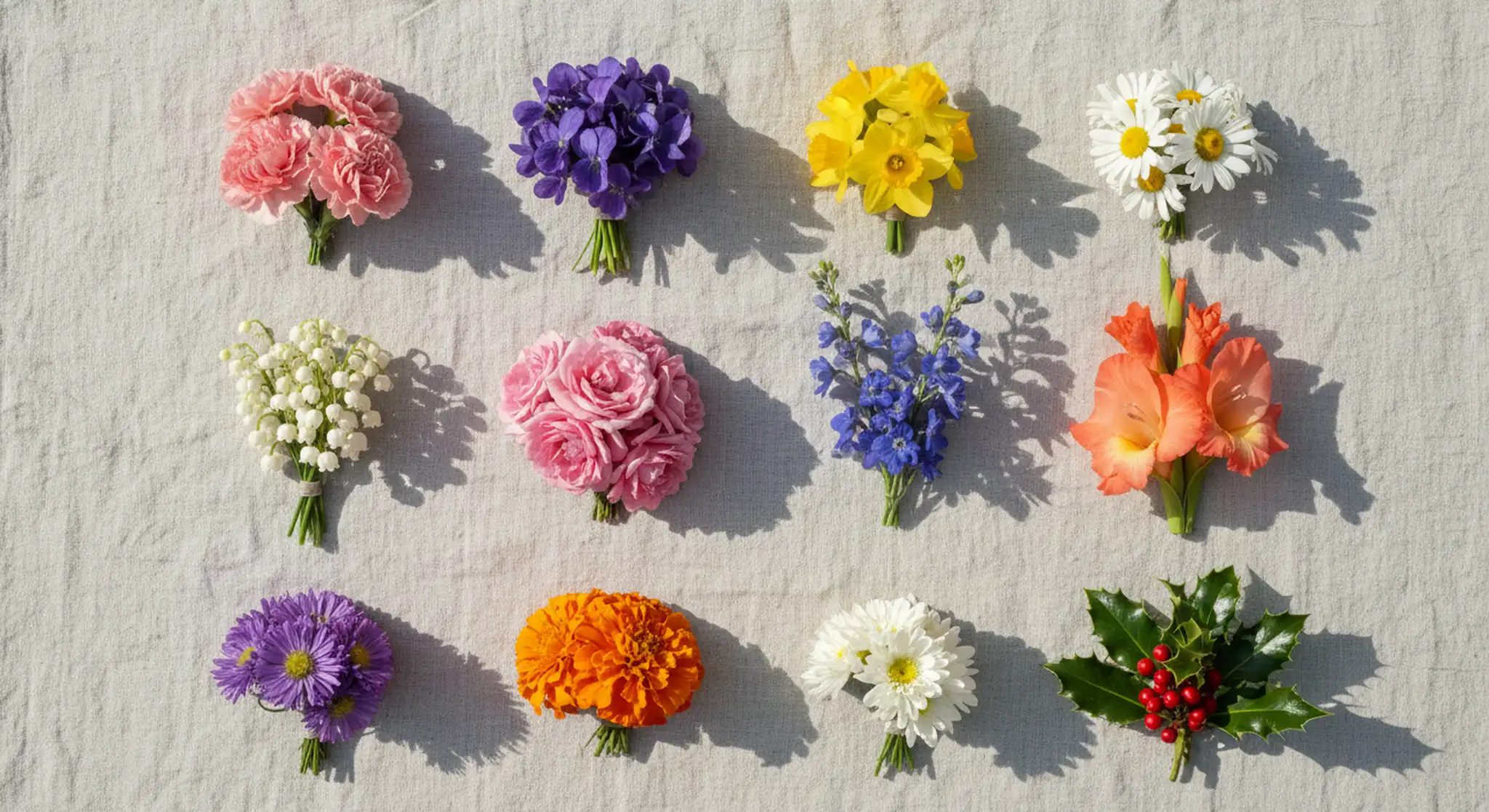
Birth month flowers are the one or two blooms traditionally linked to each month of the year, so your birth flower is simply the flower for the month you were born, from January’s carnation to December’s narcissus and holly.
Looking up birth flowers for a new baby, a birthday gift or a nursery theme? This guide puts all 12 months in one chart, then walks through each month’s flower and the meaning tradition gives it.
We built the chart from The Old Farmer’s Almanac and the Society of American Florists and show where they disagree. Then we add what parents need: baby names inspired by each flower, and which birth flowers are poisonous to children or pets.
Key Takeaways
Your birth flower goes by birth month. Most months have two, and either counts.
Lists differ. The florists’ list names a flower the Almanac does not for more than half the months.
Flower meanings are folklore, much of it Victorian, not established fact.
Lily of the valley, daffodils, larkspur and holly berries are poisonous if eaten.
For a baby, the safest birth flower is on paper, on the wall or in a name. Never put flowers in or near a crib.
Table of Contents
Birth Month Flowers Chart: Every Birth Flower by Month
Quick Answer
Your birth flower is the flower traditionally linked to your birth month: carnation (January), violet (February), daffodil (March), daisy (April), lily of the valley (May), rose (June), larkspur (July), gladiolus (August), aster (September), marigold (October), chrysanthemum (November) and narcissus (December). Most months also have a second flower.
This birth flower chart compares The Old Farmer’s Almanac with the Society of American Florists (SAF). Where they disagree, both are printed: there is no single official list.
Month
Primary birth flower (Almanac)
Second flower (Almanac)
Florists’ list (SAF)
Meanings the Almanac lists
January
Carnation
Snowdrop
Carnation
Love, fascination, hope
February
Violet
Primrose
Iris, violet
Modesty, loyalty, youthfulness
March
Daffodil
Jonquil (a type of daffodil)
Daffodil
New beginnings, rebirth, prosperity
April
Daisy
Sweet pea
Daisy, peony
Innocence, purity, gratitude
May
Lily of the valley
Hawthorn
Lily, lily of the valley
Happiness, sweetness, hope
June
Rose
Honeysuckle
Rose
Love, passion, affection
July
Larkspur
Water lily
Delphinium
Positivity, lightness, purity
August
Gladiolus
Poppy
Dahlia, gladiolus
Strength, remembrance, peace
September
Aster
Morning glory
Aster, forget-me-not
Patience, love, affection
October
Marigold
Cosmos
Calendula (also called marigold)
Creativity, passion, joy
November
Chrysanthemum
None listed
Chrysanthemum
Friendship, loyalty, honesty
December
Narcissus (paperwhite)
Holly
Poinsettia, holly, narcissus, paperwhite
Rebirth, hope, protection
Birth flowers by month from The Old Farmer’s Almanac and the Society of American Florists. Meanings are folklore, not fact.
What Are Birth Flowers and Where Does the Tradition Come From?
Birth flowers work like birthstones: every month has one or two, and yours is the one for the month you were born. The Old Farmer’s Almanac says the custom has been around for many generations and that each month’s flower is usually tied to the season when it blooms.
The meanings are older than the monthly list. Penn State Extension’s Master Gardeners trace flower symbolism to ancient Greek, Roman, Egyptian and Chinese texts and to folklore, and note that the “language of flowers” was especially popular in the Victorian era. The SAF says its historic meanings were compiled from Victorian-era flower dictionaries.
Two caveats. Penn State is blunt that these meanings rest on folklore, not scientific study. And none of the references we read names who first matched a flower to each month, so treat any tidy origin story as unproven.
January, February and March Birth Flowers
January birth flower: carnation and snowdrop. The Almanac ties carnations to love and remembrance, with color shades of meaning: pink for a mother’s love, white for innocence, dark red for deep love. The snowdrop stands for hope. Penn State’s Master Gardeners list the snowdrop for January too.
February birth flower: violet and primrose. The Almanac lists violets for modesty, faithfulness and everlasting love, and says the primrose meant young love to the Victorians. The SAF pairs the violet with the iris instead.
March birth flower: daffodil. The Almanac’s chart adds the jonquil, which is simply a type of daffodil. Daffodils are traditionally associated with rebirth, new beginnings and good fortune. In Wales, the Almanac notes, they are worn on St. David’s Day (March 1).
April, May and June Birth Flowers
April birth flower: daisy and sweet pea. The daisy is traditionally linked with innocence, purity and true love. The Almanac says a bunch of sweet peas can mean goodbye or thank you for a lovely time. The SAF names the daisy and the peony.
May birth flower: lily of the valley and hawthorn. The Almanac connects lily of the valley with sweetness, humility, motherhood and a return to happiness, and the hawthorn with hope. The SAF lists both lily and lily of the valley. Lily of the valley is poisonous, so see the safety table below.
June birth flower: rose and honeysuckle. Roses are the classic symbol of love, and color changes the message: red for romance, pink for admiration, white for innocence, yellow for cheer (the Almanac) or friendship (the SAF). Honeysuckle is traditionally linked with happiness and affection.
Baby on the way? Get ahead on sleep.
Our free two-minute quiz builds a gentle, personalized sleep plan you can use from the first weeks at home.
July birth flower: larkspur and water lily. The Almanac lists larkspur for positivity and lightheartedness, and the water lily for purity and rebirth. The SAF names delphinium, a close relative of larkspur. Larkspur and delphinium are highly toxic if eaten, so enjoy them in a print while your children are small.
August birth flower: gladiolus and poppy. Gladiolus takes its name from the Latin word for sword, after its blade-shaped leaves, and the Almanac associates it with strength, victory and honor. The poppy has long stood for remembrance. The SAF pairs gladiolus with the dahlia.
September birth flower: aster and morning glory. Aster comes from the Greek word for star, and the Almanac lists love, wisdom and patience among its meanings. Morning glory has long been associated with love. The SAF pairs the aster with the forget-me-not.
October, November and December Birth Flowers
October birth flower: marigold and cosmos. The Almanac’s marigold meanings run from joy and warmth to remembrance, and it notes that marigolds are central to Day of the Dead in Mexico. Cosmos is linked with harmony and peace. The SAF lists calendula, the pot marigold, which the Almanac says is a different plant from the garden marigold.
November birth flower: chrysanthemum. This is the one month where the Almanac lists a single flower, and the SAF agrees. The Almanac’s chart gives friendship, loyalty and honesty, and says a red mum means “I love you.”
December birth flower: narcissus and holly. The Almanac’s narcissus is the paperwhite, a midwinter relative of the daffodil. In Victorian times, it says, a narcissus told someone they were the only one, while holly stood for protection. The SAF also lists the poinsettia.
Why Birth Flower Lists Differ and How to Find Your Birth Flower
Searched “what is my birth flower” and found two answers? Both were probably right. The Almanac says not all cultures agree on the monthly flowers and that some are not as available in different regions. The florists’ list swaps in the iris, peony, lily, delphinium, dahlia, forget-me-not and poinsettia.
Go by birth month only. The day and year do not matter.
Start with the primary flower, then look at the second. Either one counts.
If you like neither, check the florists’ column. A February baby can claim the iris, an August baby the dahlia.
Born in the Southern Hemisphere? The Almanac’s editors say the list rests on folklore that likely developed in the Northern Hemisphere, and that most Australian and New Zealand sources still use the same months.
“Zodiac flowers” for star signs are a separate idea. None of the references used here covers them, so they are not included.
Baby Names Inspired by Each Birth Flower
A birth flower makes a sweet first or middle name. Every name below is on our flower names list, which gives the full origin and meaning for each.
Month
Birth flower
Names it can inspire
January
Carnation, snowdrop
Diantha (from dianthus, the carnation’s botanical name), Eirlys (Welsh for snowdrop)
Which Birth Flowers Are Poisonous to Children or Pets?
Most birth flower guides skip this. Several of these plants can make a child or a pet sick if eaten. We looked up each one in October 2026 on Poison Control (the National Capital Poison Center), the ASPCA’s toxic plant list or the North Carolina State (NC State) Extension Gardener Plant Toolbox.
Birth flower
Month
What the sources say
Lily of the valley
May
On Poison Control’s poisonous list. ASPCA: toxic to dogs, cats and horses (vomiting, irregular heartbeat, seizures).
Daffodil, jonquil, narcissus, paperwhite
March, December
Poison Control: all parts are toxic, the bulb most of all. Eating any part can cause nausea, vomiting, abdominal pain and diarrhea. Toxic to pets.
Larkspur, delphinium
July
NC State: high severity. Flowers, leaves, seeds and stems can cause serious illness or death. ASPCA: toxic to dogs, cats and horses.
Holly
December
Poison Control: the berries are poisonous to people and pets. Children have had symptoms after as few as 2 berries.
Sweet pea
April
NC State: seeds are poisonous to humans (low severity). ASPCA: perennial sweet pea is non-toxic to dogs and cats, toxic to horses.
Chrysanthemum, daisy
November, April
NC State: mums can cause stomach upset, vomiting and skin rashes. ASPCA: daisies and mums (Chrysanthemum species) are toxic to dogs and cats.
Snowdrop
January
NC State: nausea, vomiting and diarrhea if eaten in quantity.
Carnation, primrose
January, February
NC State: low severity, mild stomach upset. Both flagged as a problem for cats, dogs and horses.
Gladiolus
August
NC State: drooling, vomiting and diarrhea, with the corms (bulbs) most concentrated. Flagged for cats, dogs and horses.
Morning glory
September
Poison Control: the flowers are not dangerous unless a child chokes, but the seeds can be poisonous, especially in large amounts.
Iris
February (SAF)
On Poison Control’s poisonous list.
Rose, poinsettia
June, December (SAF)
On Poison Control’s non-poisonous list (poinsettia may cause irritation). Any plant can still be a choking hazard.
Toxicity of birth flowers, checked October 2026. A plant missing from this table is not proven safe: look up any plant before you bring it home.
Keep bouquets, potted plants and bulbs where children cannot reach them, as Poison Control advises.
Know the names of the plants in your home and yard. The American Academy of Pediatrics (AAP) says families with young children or pets may want to remove plants known to be poisonous.
Never put flowers or plants in or near a crib. Babies under 12 months sleep alone, on their back, on a firm, flat, bare surface. See our safe sleep environment checklist.
If your child eats any part of a plant, call Poison Help at 1-800-222-1222 or use the webPOISONCONTROL online tool. Both are free and confidential. The AAP says to call 911 right away if a child is unconscious, not breathing, or having convulsions or seizures.
For a pet, call your veterinarian or the ASPCA Animal Poison Control Center at (888) 426-4435 (a consultation fee may apply).
7 Ways to Use Your Baby’s Birth Flower
Nursery art: a framed botanical print or a mural gives you the flower with none of the risk. See our nursery decor ideas and nursery themes.
Birth or pregnancy announcement: a small drawing of the flower says the month without spelling it out. More pregnancy announcement ideas here.
Baby shower theme: use the due month’s flower on invitations and the cake. Due dates move, so keep it loose. Start with how to host a baby shower.
Baby book page: note the flower and its traditional meaning on the first page. See what to write in a baby book.
First birthday bouquet: take a yearly photo with the same flower, held by you or set out of reach.
A plant in the garden: plant it the year your baby is born. Check the safety table first.
Birth flower tattoo or family print: a fine-line stem for each child, or one bouquet of the whole family’s months.
Birth Flower vs Birthstone: What Is the Difference?
Both hand each month a symbol, and the Almanac describes birth flowers as similar to birthstones. A birth flower is seasonal and inexpensive, and you can grow it, draw it or give it fresh every year. A birthstone is a gem, usually given once as jewelry meant to last.
They pair well: the flower on paper now, the stone as a keepsake later. For the stone, check a gem association’s current list.
Birth flowers are a tradition, so there is no wrong answer: go by your birth month, pick the flower you like best, and enjoy the meaning as folklore. For a baby, the safest birth flower is one on paper, on the wall or in a name. If you bring home the real thing, check whether it is toxic and keep it far from the crib.
Frequently Asked Questions
What are birth month flowers?
Birth month flowers are flowers traditionally assigned to each month of the year, much like birthstones. Most months have a primary flower and a second one, such as the rose and honeysuckle for June. The lists come from folklore and custom, so they vary a little between sources.
What is my birth flower?
Find your birth month on a birth flower chart. On The Old Farmer’s Almanac list: January carnation, February violet, March daffodil, April daisy, May lily of the valley, June rose, July larkspur, August gladiolus, September aster, October marigold, November chrysanthemum and December narcissus.
How do I find my birth flower by date of birth?
Only the month matters. Birth flowers are assigned by calendar month, so the day and the year you were born do not change the answer. Someone born on June 1 and someone born on June 30 share the rose and the honeysuckle.
Why are there two birth flowers for each month?
None of the references we checked gives one firm reason. The Old Farmer’s Almanac notes that cultures do not all agree on the monthly flowers and that some are harder to find in certain regions, so a second flower gives people a choice.
Does everyone have two birth flowers?
Not on every list. The Old Farmer’s Almanac gives two flowers for eleven months but only the chrysanthemum for November. The Society of American Florists lists one flower for some months, such as the rose for June, and four for December.
Are any birth flowers poisonous to babies or pets?
Yes. Poison Control lists lily of the valley, daffodils and holly as poisonous, and North Carolina State Extension rates larkspur as high severity. Keep bouquets and plants out of reach, never place them in or near a crib, and call Poison Help at 1-800-222-1222 if a child eats any part of a plant.
Calmer days, better nights.
Betteroo builds a personalized sleep plan for your baby. Take the free two-minute quiz and have it ready before the newborn weeks.