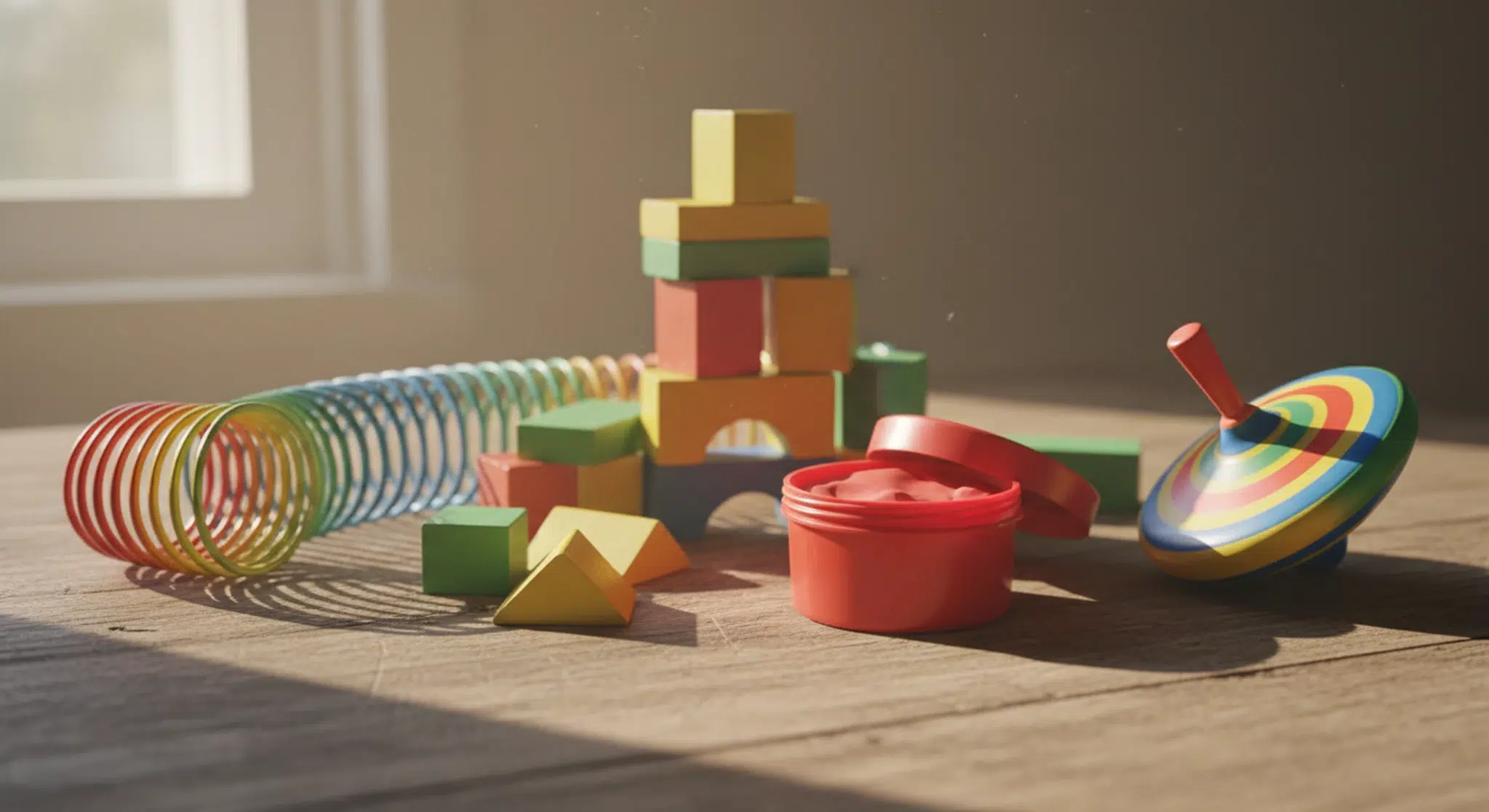


Certain toys pull you straight back to childhood: the click of a Rubik’s Cube, the stretch of a Slinky, the beep of a Tamagotchi. Here is a fond tour of nostalgic childhood toys by era, and why so many classics are still worth sharing with your own kids today.
Few things spark nostalgia like the toys we grew up with. Long before tablets and apps, childhood meant Slinkys tumbling down stairs, Beanie Babies lined up on shelves, and Tamagotchis beeping from a backpack. Many of these classics have quietly endured because they are genuinely great toys, encouraging imagination, patience, and hands-on play.
This guide is a warm walk through classic childhood toys by era, from timeless staples to the must-have crazes of the 1980s and 1990s. Whether you are feeling sentimental or looking for a screen-free toy to share with your own children, these are the ones worth remembering, and many are still easy to find.
Key Takeaways
- Many classic toys have survived for decades because they are open-ended, hands-on, and screen-free.
- Timeless staples like Slinky, Etch A Sketch, and building blocks are still sold today.
- The 1980s brought puzzle crazes and holiday frenzies like Rubik’s Cube and Cabbage Patch Kids.
- The 1990s were a golden age of collectibles and pocket tech: Beanie Babies, Tamagotchi, and Furby.
- Sharing your childhood favorites with your kids connects generations through unhurried play.
Table of Contents
The Toys That Defined Growing Up
Certain toys have a way of pulling you straight back to childhood: the click of a Rubik’s Cube, the satisfying stretch of a Slinky down the stairs, the beep of a Tamagotchi begging to be fed. Nostalgic toys are more than plastic and memories. Many of the best have quietly survived for decades because they are genuinely great at what they do, encouraging imagination, patience, and hands-on play in a way few gadgets can match.
This is a fond tour through classic childhood toys by era, from timeless staples that predate your grandparents to the must-have crazes of the 1980s and 1990s. Whether you are feeling sentimental or hunting for a screen-free toy to share with your own kids, these are the ones worth remembering, and many are still easy to find today.
Timeless Classics
Some toys are so simple and satisfying that they never really went out of style. These early classics were invented decades ago and are still sold today, often to the very kids of the people who first loved them.
- Slinky, the walking spring that tumbles down stairs, a hit since the 1940s
- View-Master, the stereoscope that turned reels into tiny 3D worlds
- Etch A Sketch, drawing with two knobs and shaking to erase, a 1960s icon
- Mr. Potato Head, mixing and matching silly faces on a plastic spud
- Play-Doh, the squishable modeling compound that smells like childhood
- Lincoln Logs and building blocks, the original open-ended construction toys
- Lite-Brite, poking colorful pegs into a glowing screen to make pictures
- Barbie and Hot Wheels, the dolls and die-cast cars that launched entire worlds of play
Toys of the 1970s and 1980s
The 70s and 80s brought a wave of clever puzzles, cuddly characters, and toys tied to blockbuster movies and cartoons. Many became full-blown crazes with lines out the door at the holidays.
- Rubik’s Cube, the maddening color puzzle that became a worldwide sensation in the early 1980s
- Simon, the electronic memory game that lit up and beeped a sequence to repeat
- Cabbage Patch Kids, the soft-sculpted dolls that sparked holiday shopping frenzies
- Care Bears and My Little Pony, pastel characters that filled shelves and screens
- Transformers and Star Wars action figures, fueling hours of imaginative battles
- Teddy Ruxpin, the animatronic bear that read stories aloud
- Speak and Spell, an early electronic learning toy that helped with reading
Toys of the 1990s
The 90s were a golden age of collectible crazes and pocket-sized tech. If you grew up in this decade, at least one of these probably lived in your backpack.
- Beanie Babies, the understuffed plush animals that became a collecting obsession in the mid-1990s
- Tamagotchi, the keychain virtual pet you fed, cleaned, and kept alive, a late-1990s phenomenon
- Furby, the chatty animatronic creature that learned to speak, released in 1998
- Tickle Me Elmo, the giggling plush that sold out everywhere in 1996
- Polly Pocket, tiny dolls and playsets that folded into a compact case
- Super Soaker, the pressurized water blaster that upgraded every summer
- Pogs, the collectible cardboard discs and slammers traded on playgrounds
- Game Boy, the handheld console that put video games in your pocket
- Skip-It, the ankle toy you swung and counted, and Nerf blasters for indoor battles
Older kids keep you busy by day, little ones keep you up at night.
If a younger sibling is still fighting sleep, our free two-minute quiz builds a personalized plan.
A Quick Timeline of Toy Crazes
| Era | Toy | What Made It Special |
|---|---|---|
| 1940s to 1960s | Slinky, Etch A Sketch, Lite-Brite | Simple, hands-on, and endlessly replayable |
| 1980s | Rubik’s Cube, Cabbage Patch Kids | Puzzle mania and the first holiday shopping frenzies |
| Early 1990s | Beanie Babies, Polly Pocket | Collecting culture and pocket-sized play |
| Late 1990s | Tamagotchi, Furby, Tickle Me Elmo | Interactive tech toys that felt almost alive |
Part of the magic is how many of these are still around. You can hand a Slinky, an Etch A Sketch, or a set of building blocks to a child today and watch the same delight unfold, no charging cable required.
Why Nostalgic Toys Still Win
It is easy to be sentimental about old toys, but many classics genuinely earn their staying power. The best of them are open-ended, meaning there is no single right way to play, which invites imagination and problem-solving. They are hands-on, building fine motor skills and patience, and most importantly they are screen-free, drawing kids into focused, unhurried play and into playing together.
Sharing your childhood favorites with your own kids is also a lovely way to connect across generations. Teaching a child to solve a Rubik’s Cube, build with Lincoln Logs, or fill in a Lite-Brite creates the same slow, satisfying play you remember, and often becomes a shared ritual. If you are building a screen-free toy shelf, pair these classics with a few good card games and paper games for endless low-tech fun.
Old Toys, Timeless Benefits
Nostalgia aside, the qualities that make classic toys great are exactly the ones child-development experts still champion: open-ended, hands-on, and screen-free play. Toys that do less often ask more of a child’s imagination, and that effort is where creativity, focus, and problem-solving grow. A plain set of blocks can hold a preschooler’s attention longer, and teach more, than a flashy toy that does all the entertaining itself.
Unhurried, screen-free play also supports calmer evenings and better sleep, since winding down with a quiet, hands-on toy is far gentler on a child’s brain than a bright screen before bed. If you are refreshing the toy shelf, a few timeless classics are a smart, low-tech anchor. For more ideas on filling downtime without screens, see our indoor activities for kids.
Frequently Asked Questions
What are some classic nostalgic toys?
Classic nostalgic toys span several eras. Timeless staples include the Slinky, View-Master, Etch A Sketch, Mr. Potato Head, Play-Doh, Lite-Brite, and building blocks. The 1980s brought the Rubik’s Cube, Simon, Cabbage Patch Kids, Care Bears, and Transformers, while the 1990s were famous for Beanie Babies, Tamagotchi, Furby, Polly Pocket, Super Soaker, Pogs, and the Game Boy. Many of these are still made and enjoyed today.
What were the most popular 90s toys?
The 1990s were packed with crazes. Beanie Babies became a collecting obsession, Tamagotchi virtual pets and Furby brought interactive tech to keychains and toy shelves, and Tickle Me Elmo sold out everywhere in 1996. Polly Pocket, Super Soakers, Pogs, Skip-It, and the handheld Game Boy were also everywhere. Together they defined a decade of collectible culture and pocket-sized play.
Are old toys better for kids than modern ones?
Not automatically, but the qualities that make many classic toys great are exactly what child-development experts recommend: open-ended, hands-on, and screen-free play. Toys that do less often invite more imagination and problem-solving, and unhurried play supports focus and calmer evenings. A simple set of blocks can hold a child’s attention and teach more than a flashy toy that entertains for them, which is why classics endure.
What nostalgic toys can I still buy today?
Plenty of classics are still in production. You can readily find Slinky, Etch A Sketch, Play-Doh, Lite-Brite, Mr. Potato Head, Rubik’s Cube, Nerf blasters, and building blocks, and modern versions of Tamagotchi, Furby, and Polly Pocket have been reissued. These make wonderful screen-free gifts and a fun way to share your own childhood favorites with your kids.
Why do classic toys make good gifts?
Classic toys tend to be durable, affordable, and open-ended, so they last through years of play and grow with a child’s imagination. They are also screen-free, which supports focused play and gentler evenings, and they carry a nostalgic charm that makes them a heartfelt way to connect with your own children. Pairing a timeless toy with a deck of cards or a few paper games rounds out a low-tech play shelf.
Fun for them, rest for you.
Betteroo helps the whole family sleep better. Take the free two-minute quiz for a plan tailored to your child.
4 Sources
- The Strong National Museum of Play – National Toy Hall of Fame
https://www.toyhalloffame.org/toys - Smithsonian Institution – History of Toys
https://www.si.edu/ - AAP HealthyChildren.org – Choosing Toys
https://www.healthychildren.org/English/ages-stages/toddler/Pages/Selecting-Appropriate-Toys-for-Young-Children.aspx - American Academy of Pediatrics – The Power of Play
https://publications.aap.org/pediatrics/article/142/3/e20182058/38649/The-Power-of-Play-A-Pediatric-Role-in-Enhancing