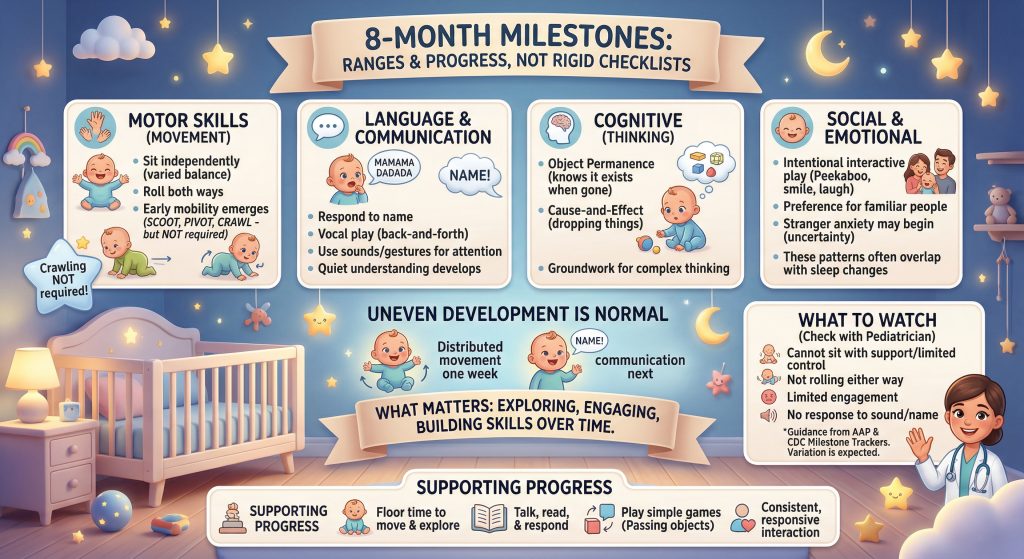
8 month milestones describe the range of skills many babies begin developing around this age—including movement, communication, and early social interaction—but they don’t follow a single path or exact timeline. Guidance from the AAP (American Academy of Pediatrics)1 and the CDC Milestone Trackers (Centers for Disease Control and Prevention)2 outline common developmental patterns, but even within those, variation is expected.
Most babies at 8 months can sit independently, roll both ways, and babble with repeated syllables — but the timing and order varies widely.
Crawling is not required at this age. Some babies scoot, pivot, or skip crawling entirely.
Development is often uneven — a baby may focus on movement one week and communication the next. This is normal.
What matters most is whether your baby is engaging, exploring, and gradually building new skills over time.
At eight months, development often becomes more visible. Babies are moving more, interacting more, and starting to show clearer patterns of curiosity and connection. At the same time, differences between babies can feel more noticeable, which is often what brings parents here in the first place.
Some babies are already moving across the floor. Others are still mostly stationary but highly engaged. Both can fall well within a typical range.
beginning to move toward things they want (pivoting, scooting, or crawling)
babbling with repeated sounds like “ba” or “da”
responding to their name
showing interest in people, objects, and interaction
These changes reflect rapid development across movement, communication, and awareness. They don’t always happen at the same time or in the same order.
8 month milestones by category
Motor milestones at 8 months
Movement is often the most noticeable area at this age. Many babies can sit independently and use their hands more freely while sitting. Rolling is usually well established, and some form of mobility may begin to emerge, this might look like scooting, pivoting, or early crawling.
It’s important to note that not all babies crawl at this stage, and some skip traditional crawling altogether. What matters more is whether your baby is finding ways to move and explore their environment over time.
Language and communication milestones at 8 months
Babbling tends to become more consistent and varied around this age. You may hear repeated syllables like “mamama” or “dadada,” though these aren’t usually attached to meaning yet. Many babies also begin responding to their name and engaging in simple back-and-forth vocal play. They may use sounds, facial expressions, or gestures to get your attention. Understanding continues to develop quietly here, even if expressive communication is still emerging.
Cognitive milestones at 8 months
This is often when object permanence starts to take shape, the understanding that something still exists even when it’s out of sight. You might notice your baby looking for a dropped toy or reacting when something disappears. There’s also growing curiosity about cause and effect, like repeatedly dropping objects to see what happens. These early patterns lay the groundwork for more complex thinking later on.
Social and emotional milestones at 8 months
At this stage, many babies become more socially aware. They may show clear preferences for familiar people and begin to feel uncertain around unfamiliar ones. This can look like clinging, hesitation, or what’s often called stranger anxiety. At the same time, babies are increasingly interactive. Smiling, laughing, and engaging in simple games like peekaboo become more intentional and responsive. These patterns often overlap with shifts in sleep at 8 months, as heightened awareness can make settling harder.
A simple way to think about 8 month milestones
It can be tempting to focus on whether your baby is hitting specific milestones, especially when movement becomes more visible. But development at this age is rarely linear. Some babies focus heavily on motor skills, spending long stretches practicing movement. Others put more energy into communication or social interaction. These differences can make timelines look uneven, even when development is progressing well. What tends to matter most is whether your baby is engaging, exploring, and gradually building new skills over time.
What 8 month milestones look like in real life
In everyday life, development at this age can look surprisingly inconsistent. A baby might roll confidently but show no interest in crawling. They may sit steadily but tip over when reaching too far. You might see a new skill appear briefly and then not show up again for a few days. Interest also plays a role. Some babies are highly motivated to move, while others are more focused on observing and interacting. These variations are part of how development unfolds, not signs that something is off.
Sleep regressions at 8 months are common
Get Betteroo’s personalized sleep guidance to see what your baby actually needs right now.
There’s a wide range of normal at 8 months. Some babies are already crawling, while others are still primarily rolling or pivoting. Some babble frequently, while others are quieter but attentive and responsive. Differences in temperament, opportunity for movement, and individual pace all contribute to this variation. If you’re tracking your baby’s progress across areas, our baby sleep schedule by age guide covers how sleep needs shift alongside development.
At the same time, it may be worth checking in if your baby:
is not able to sit with support or shows very limited control
is not rolling in either direction
shows limited engagement with people or surroundings
does not respond to sounds or their name
These signs don’t automatically indicate a problem, but they can help guide whether additional support or evaluation might be useful.
Do babies need to be crawling at 8 months?
No. Crawling is often expected around this age, but it is not required for healthy development. Some babies crawl later, and some use alternative ways of moving, like scooting or rolling. Others may move directly toward pulling up or walking without spending much time crawling. What matters more than the specific form of movement is whether your baby is developing strength, coordination, and interest in exploring their environment.
How to support your 8 month old’s development
Support at this stage is largely built into everyday interaction and play. Giving your baby time on the floor to move and explore can help build strength and coordination. Talking, reading, and responding to their sounds supports early communication. Simple games like peekaboo or passing objects back and forth encourage social engagement and attention. You don’t need a structured plan. Consistent, responsive interaction tends to support development more effectively than any specific activity.
When to talk to your pediatrician
If something feels unclear or concerning, it’s reasonable to ask. You don’t need to wait for a clear problem. Pediatricians can help you understand what’s within a typical range 3 and whether anything would benefit from a closer look. Often, the goal is not to find something wrong, but to better understand what you’re seeing.
A quick reference: common 8 month milestones
Common 8 month milestones by development area
Trait
Motor
Language
Cognitive
Social/Emotional
Key skills
Sitting, rolling, early mobility
Babbling, responding to name
Object permanence, cause-and-effect
Stranger awareness, interactive play
What it looks like
Sits without support, pivots or scoots
Repeated syllables like ba, da, ma
Looks for dropped toys, drops objects on purpose
Clings to caregivers, plays peekaboo
Typical range
Some crawl, many don’t yet
Quiet to very vocal
Emerging gradually
Varies by temperament
When to check in
No sitting with support, no rolling
No response to sounds or name
No interest in objects
Very limited engagement
Motor
Movement & physical control
Key skillsSitting, rolling, early mobility
What it looks likeSits without support, pivots or scoots
Typical rangeSome crawl, many don’t yet
When to check inNo sitting with support, no rolling
Language
Sounds & early communication
Key skillsBabbling, responding to name
What it looks likeRepeated syllables like ba, da, ma
Typical rangeQuiet to very vocal
When to check inNo response to sounds or name
Cognitive
Learning & problem-solving
Key skillsObject permanence, cause-and-effect
What it looks likeLooks for dropped toys, drops objects on purpose
Typical rangeEmerging gradually
When to check inNo interest in objects
Social / Emotional
Connection & awareness
Key skillsStranger awareness, interactive play
What it looks likeClings to caregivers, plays peekaboo
Typical rangeVaries by temperament
When to check inVery limited engagement
Motor
Movement & physical control
Key skillsSitting, rolling, early mobility
What it looks likeSits without support, pivots or scoots
Typical rangeSome crawl, many don’t yet
When to check inNo sitting with support, no rolling
Language
Sounds & early communication
Key skillsBabbling, responding to name
What it looks likeRepeated syllables like ba, da, ma
Typical rangeQuiet to very vocal
When to check inNo response to sounds or name
Cognitive
Learning & problem-solving
Key skillsObject permanence, cause-and-effect
What it looks likeLooks for dropped toys, drops objects on purpose
Typical rangeEmerging gradually
When to check inNo interest in objects
Social / Emotional
Connection & awareness
Key skillsStranger awareness, interactive play
What it looks likeClings to caregivers, plays peekaboo
Typical rangeVaries by temperament
When to check inVery limited engagement
Swipe to compare
This reflects common patterns, not fixed expectations. Many babies will fall slightly outside these ranges in one or more areas.
FAQ: 8 month milestones
What are the most important 8 month milestones?
Rather than a single milestone, what matters most at this age is how different areas of development are progressing together. Movement, communication, and engagement all contribute to the overall picture.
A baby who is exploring their environment in some way, responding to people, and beginning to communicate through sounds or gestures is typically showing meaningful developmental progress, even if certain milestones are still emerging. Looking at patterns across areas tends to give a clearer understanding than focusing on one specific skill.
Should my baby be sitting up at 8 months?
Many babies can sit independently by 8 months, but there is still some variation. Some may sit steadily, while others are still working on balance or transitioning in and out of sitting. What’s more important than perfect sitting is whether your baby is gaining strength and control over time. If your baby cannot sit even with support or shows very limited head and trunk control, it may be helpful to check in.
Is it normal if my 8 month old isn’t crawling?
Movement may show up in different forms first, like rolling, pivoting, or scooting. What matters most is that your baby is developing coordination and finding ways to explore. If there is very limited movement overall or a lack of interest in exploring, it may be worth discussing further. Otherwise, variation in how and when babies move is expected.
Yes, it’s normal. Crawling can happen before, during, or after this age, and some babies skip it altogether.
What sounds should an 8 month old make?
Many babies at this age babble using repeated syllables like “ba,” “da,” or “ma.” These sounds are part of practicing speech patterns, even if they don’t yet have meaning. You may also notice your baby responding to sounds, turning toward voices, or engaging in back-and-forth vocal play. If your baby is very quiet, does not respond to sounds, or shows limited vocalization, it can be helpful to check in to better understand what’s happening.
Do 8 month milestones need to happen at the same time?
They don’t. Development at this stage is often uneven, with different areas progressing at different rates. A baby might focus more on movement for a period of time, while communication develops more gradually, or the reverse. This can make it feel like something is “behind,” when in reality development is just distributed differently. What matters most is whether skills are emerging over time, even if they don’t all appear at once.
Do 8 month milestones affect sleep?
Yes, developmental changes around this age – especially increased mobility, separation awareness, and cognitive leaps like object permanence – can temporarily disrupt sleep. Many families notice more night wakings or shorter naps during this period. This is sometimes called the 8 month sleep regression, though it’s driven by normal development rather than a setback.
How much should an 8 month old weigh?
Weight varies widely at this age. According to WHO growth charts, the average is roughly 17–20 lbs (7.7–9 kg), but healthy babies can fall above or below this range. Your pediatrician tracks growth over time using percentile curves, which matters more than any single number.
Not sure why sleep got worse?
Take the Betteroo 3-minute quiz to see if your baby is going through the 8 month sleep regression and what can help.
Lipkin, P.H. & Macias, M.M. (2020). Promoting Optimal Development: Identifying Infants and Young Children With Developmental Disorders Through Developmental Surveillance and Screening. Pediatrics, 145(1), e20193449.https://pubmed.ncbi.nlm.nih.gov/31843861/
Zubler, J.M., Wiggins, L.D., Macias, M.M., et al. (2022). Evidence-Informed Milestones for Developmental Surveillance Tools. Pediatrics, 149(3), e2021052138.https://pubmed.ncbi.nlm.nih.gov/35132439/