5 month milestones describe the range of skills many babies begin developing around this age, including movement, communication, and early interaction, but they don’t follow a strict timeline or sequence. Guidance from the American Academy of Pediatrics (AAP) reflects common patterns 1, but even within those, variation is expected.
At 5 months, babies are building strength, coordination, and social awareness — but not all skills appear at the same time.
Common 5 month milestones include pushing up during tummy time, reaching for objects, making varied sounds, and smiling responsively.
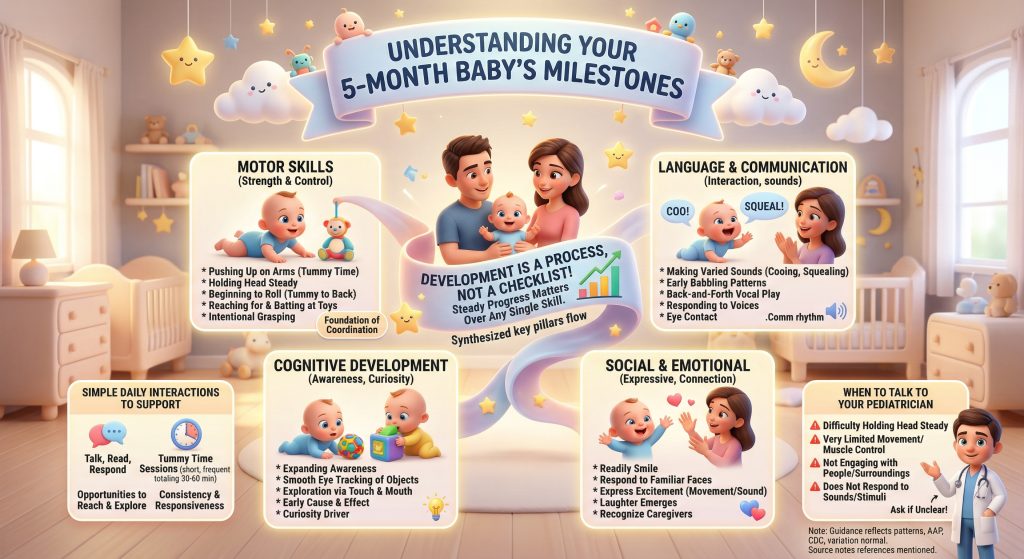
Development at this age is best understood as a process, not a checklist — steady progress matters more than any single skill.
If something feels unclear, checking in with your pediatrician is always reasonable.
At five months, development is often less about big, obvious changes and more about steady, foundational progress. Babies are building strength, becoming more aware of their surroundings, and beginning to interact in more intentional ways.
Some babies are already rolling and reaching constantly. Others are still working on control and coordination but are highly engaged socially. Both can fall within a healthy range.
Understanding milestones at this stage is less about checking for specific skills and more about noticing how your baby is growing over time.
5 month milestones infographic
What are typical 5 month milestones?
Around 5 months, many babies are:
gaining better head and neck control
pushing up during tummy time
beginning to roll (often from tummy to back first)
reaching for and grasping objects
making more varied sounds
engaging more actively with people
These shifts reflect early coordination between strength, awareness, and interaction. They don’t always appear all at once, and they don’t need to. 2
5 month milestones by category
1. Motor milestones at 5 months
Motor development at this stage is largely about building strength and control. Many babies can push up on their arms during tummy time and hold their head steady. Some begin rolling, often from tummy to back first, though not all babies do this at the same time. If your baby was born around 4 months, you may already be seeing the early signs of these shifts.
Reaching becomes more intentional. You may notice your baby batting at toys, grasping objects, or bringing hands to their mouth. Even when movement feels limited, important groundwork is being laid. Strength, coordination, and body awareness are all developing beneath the surface.
2. Language and communication milestones at 5 months
Communication at this age is still pre-verbal but increasingly interactive. Babies often make more varied sounds like cooing, squealing, and experimenting with their voice. You may hear early babbling patterns beginning to emerge. There’s also more back-and-forth. Babies respond to voices, make eye contact, and may “take turns” making sounds during interaction.
This stage is less about words and more about learning the rhythm of communication.
Every baby develops at their own pace
Get a personalized sleep and development plan built around your baby’s age, needs, and your family’s routine.
Awareness is expanding quickly. Babies begin to show more interest in objects and may track movement more smoothly with their eyes. They explore through touch and by bringing objects to their mouth. You might also notice early signs of cause and effect, such as repeating an action that produces a sound or reaction. Curiosity is beginning to drive behavior, even if it’s still expressed in simple ways.
4. Social and emotional milestones at 5 months
Social interaction becomes more engaging and expressive. Babies often smile readily, respond to familiar faces, and show excitement through movement and sound. Laughter may emerge, along with clearer expressions of enjoyment or frustration. There’s also growing recognition of caregivers. Your baby may seek you out visually or respond differently to familiar versus unfamiliar people. Connection is a central part of development at this stage.
A simple way to think about 5 month milestones
At five months, it can help to shift away from thinking in terms of milestones as events and instead think of development as a process. Skills are not fully formed yet, they are still emerging. A baby who is not yet rolling may be building the strength needed to do so soon. A baby who is not reaching consistently may still be developing coordination and control.
Progress at this stage is often subtle but meaningful. Small changes including more control, more engagement, more consistency, tend to matter more than any single milestone.
What 5 month milestones look like in real life
In everyday life, development at this age can feel gradual and sometimes hard to measure. You might see your baby push up strongly during tummy time one day and seem less interested the next. They may reach for a toy but miss it, then try again later. Some babies are very physically active, constantly moving and practicing new skills. Others are more focused on watching, listening, and interacting. These differences often reflect individual pace and temperament, not a problem.
What’s typical variation vs what to watch
There’s a wide range of normal at 5 months. Some babies are already rolling, while others are still working toward it. Some are highly vocal, while others are quieter but attentive.
Variation is expected, especially this early.
It may be worth checking in with your pediatrician if your baby:
has difficulty holding their head steady
shows very limited movement or muscle control
is not engaging with people or surroundings
does not respond to sounds or visual stimuli
These signs don’t necessarily indicate a problem, but they can help guide whether additional support or evaluation might be useful. 3
What if my baby isn’t rolling at 5 months?
It’s common for parents to focus on rolling at this stage, but not all babies roll by 5 months. Some babies roll earlier, while others take more time. Rolling requires a combination of strength, coordination, and opportunity to practice. What matters more is whether your baby is building the underlying skills including pushing up, shifting weight, and showing interest in movement. If those pieces are developing, rolling often follows. For a closer look at how sleep and movement connect at this stage, see our 6 month old sleep schedule guide.
How to support your 5 month old’s development
Support at this stage is simple and built into daily interaction.
Tummy time helps build strength for future movement. Talking, reading, and responding to your baby’s sounds support early communication. Offering opportunities to reach and explore objects encourages coordination. You don’t need to structure this in a formal way. Consistency and responsiveness tend to matter more than any specific activity. 4
When to talk to your pediatrician
If something feels unclear, it’s reasonable to ask.
You don’t need to wait for a clear concern. Pediatricians can help you understand what falls within a typical range and whether anything would benefit from a closer look. Often, reassurance comes from understanding what you’re seeing, not from trying to predict what comes next.
A quick reference: common 5 month milestones
Common 5 month milestones by development area
Development Area
What You May See Around 5 Months
Motor
Pushing up, early rolling, reaching and grasping
Language
Cooing, early babbling, vocal play
Cognitive
Tracking objects, exploring with hands and mouth
Social/Emotional
Smiling, responding to faces, early laughter
Motor
Movement & physical control
What you may seePushing up, early rolling, reaching and grasping
Language
Sounds & early communication
What you may seeCooing, early babbling, vocal play
Cognitive
Learning & exploration
What you may seeTracking objects, exploring with hands and mouth
Social / Emotional
Connection & awareness
What you may seeSmiling, responding to faces, early laughter
Motor
Movement & physical control
What you may seePushing up, early rolling, reaching and grasping
Language
Sounds & early communication
What you may seeCooing, early babbling, vocal play
Cognitive
Learning & exploration
What you may seeTracking objects, exploring with hands and mouth
Social / Emotional
Connection & awareness
What you may seeSmiling, responding to faces, early laughter
Swipe to compare
This reflects common patterns, not fixed expectations. Many babies will fall slightly outside these ranges in one or more areas.
FAQ: 5 month milestones
What are the most important 5 month milestones?
At this age, no single milestone defines development. What matters more is how different areas, including movement, communication, and interaction, are beginning to come together. A baby who is gaining strength, showing curiosity, and engaging with people is typically demonstrating meaningful progress, even if certain skills are still emerging. Looking at overall patterns tends to be more helpful than focusing on one specific milestone.
Should my baby be rolling at 5 months?
Some babies are rolling by 5 months, but many are not yet doing so consistently. Rolling depends on strength, coordination, and opportunity for practice. Babies often roll from tummy to back first, with back-to-tummy rolling coming later. If your baby is pushing up during tummy time, shifting weight, and showing interest in movement, they are likely building the skills needed for rolling.
What sounds should a 5 month old make?
Many babies at this age make a range of sounds, including cooing, squealing, and early babbling. You may notice more variety and intentionality in how they use their voice. They often respond to voices and engage in back-and-forth vocal interaction, even if it doesn’t resemble words yet. If your baby is very quiet and not responding to sound, it may be helpful to check in.
How much tummy time should a 5 month old have?
By 5 months, many babies benefit from multiple short sessions of tummy time throughout the day, building up to around 30–60 minutes total. This doesn’t need to happen all at once. Short, frequent opportunities tend to be more manageable and effective. Tummy time supports strength, coordination, and preparation for future movement like rolling and crawling.
Do 5 month milestones need to happen at the same time?
They don’t as development at this stage is often uneven. A baby may focus more on movement for a period of time, while communication develops more gradually, or the reverse. What matters most is whether skills are emerging over time, even if they don’t all appear together.
Understand Your Baby’s Development—Step by Step 👶📈
Every stage brings new milestones, questions, and surprises. Get clear, expert-backed guidance tailored to your baby’s age and needs.
Lipkin PH, Macias MM. Promoting optimal development: identifying infants and young children with developmental disorders through developmental surveillance and screening. Pediatrics. 2020. https://pubmed.ncbi.nlm.nih.gov/31843861/
Zubler JM, Wiggins LD, Macias MM, et al. Evidence-informed milestones for developmental surveillance tools. Pediatrics. 2022. https://pubmed.ncbi.nlm.nih.gov/35132439/