

2 year milestones describe the typical range of skills children begin developing around 24 months across language, movement, thinking, and social interaction, but they are not a checklist every child must complete exactly on time.
At this age, development tends to move quickly, unevenly, and sometimes in ways that feel hard to interpret from the outside. One child may be talking in short phrases but still struggling with coordination. Another may move confidently through their environment but use fewer words. Both can fall well within a typical and healthy range.
The goal of understanding milestones at this stage is not to measure your child against a list. It’s to help you recognize patterns, notice progress, and understand when something might benefit from a closer look.
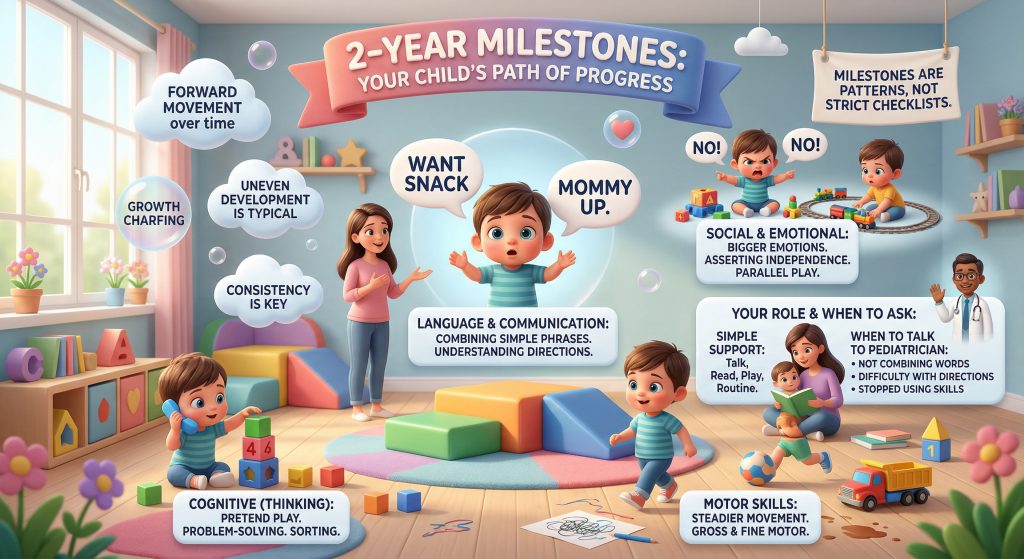
Table of Contents
What are typical 2 year milestones?
Around age two, many children are beginning to combine words into simple phrases (“more milk,” “go outside”), follow simple directions, explore more independently, and show early signs of imaginative play. You may notice a growing sense of personality alongside stronger opinions and bigger emotional reactions.
What’s changing underneath all of this is not just one skill, but multiple systems developing at once, language, motor coordination, emotional regulation, and social awareness. Because of that, development rarely looks smooth or evenly distributed.
The most useful question at this stage isn’t “Is my child doing everything?” It’s whether you’re seeing forward movement over time.
2 year milestones by category
Language and communication milestones at 2 years
Language often becomes more noticeable around this age, but it doesn’t develop in a straight line. Many 2-year-olds begin combining two words into simple phrases like “want snack” or “mommy up,” and their vocabulary is expanding, sometimes quickly, sometimes more gradually.
Understanding typically outpaces expression. A child may follow simple one- or two-step directions or point to familiar objects even if they aren’t saying many words yet. It’s also very common for speech to be difficult for unfamiliar listeners to understand. While there is a large variation, around age two many children will have a vocabulary of roughly 50+ words 1. This is a significant shift from where communication begins – if you’re curious about how it started, our guide to 2 month old milestones covers those earliest social cues.
What matters here is not perfect clarity or a specific word count, but whether your child is trying to communicate and gradually adding new ways to do so.
Cognitive milestones at 2 years
This is often when play starts to shift. You may see your child pretending to feed a doll, talking into a toy phone, or repeating everyday routines in play.
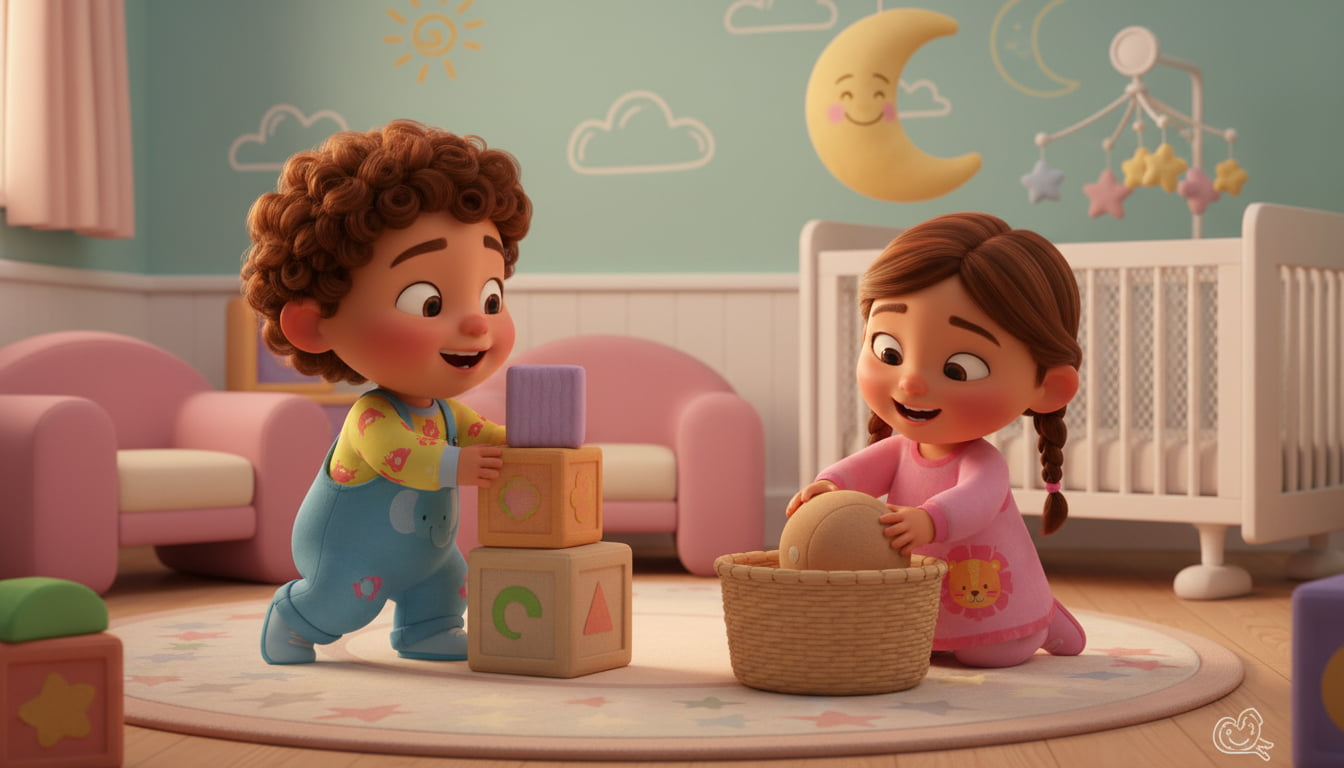
There’s also more problem-solving happening, even if it doesn’t always look intentional. Stacking blocks, figuring out how to reach something, or experimenting with cause and effect all reflect growing cognitive flexibility. Some children will start to sort objects by shape or color.
In general, you may notice more curiosity and persistence, along with frustration when something doesn’t work as expected or desired. Wanting to do more than they’re able to do is part of the process.
Motor milestones at 2 years
Physically, most children at this age are more confident movers. Walking becomes steadier, running starts to emerge, and climbing often becomes a favorite activity. Kids may be kicking a ball or pulling or pushing toys while moving.
Fine motor skills are still catching up. You may see attempts to use utensils, stack blocks (typically 4-6 or more at this stage), or scribble with a crayon, but precision is inconsistent 1. Spills, dropped objects, and uneven coordination are still very much part of the picture.
It’s common for physical confidence to outpace control, which is why this stage can feel both exciting and chaotic.
Social and emotional milestones at 2 years
This is often the most visible, and sometimes the most challenging, area of development.
Two-year-olds are beginning to assert independence while still relying heavily on caregivers for support. You may see strong preferences, frequent use of “no,” and emotional reactions that escalate quickly.
Play alongside other children (rather than fully with them) is typical. Emotional regulation is still developing, which means big feelings can show up before your child has the tools to manage them.
These patterns can feel intense, but they are closely tied to growth, not a sign that something is off. Sleep disruptions often accompany these emotional shifts – our guide on what’s really normal with baby sleep puts that in context.
A simple way to think about 2 year milestones
Milestones are often presented as lists, but that framing can make normal development feel more rigid than it actually is. Instead of viewing milestones as a checklist, it can help to think in three ways:
1. Development happens in clusters: Skills tend to grow together, but not always evenly. A child may make rapid progress in language while motor skills plateau temporarily, or vice versa.
2. Uneven development is typical: Being ahead in one area and slower in another is common. What matters more is overall progression, not perfect balance.
3. Consistency matters more than perfection: A skill that appears occasionally and becomes more consistent over time matters more than whether it shows up on a specific day.
This perspective shifts the question from “Are they doing everything?” to “Are they moving forward?”
This shift in perspective can make milestones feel less like a test and more like a pattern you’re learning to read.
What 2 year milestones look like in real life
In practice, development at this age rarely looks clean or predictable. A child might use short phrases one day and rely mostly on single words the next. They may follow instructions in one moment and ignore them in another. You might see a new skill appear briefly, disappear, and then return more consistently later.
Behavior can also feel more intense during periods of rapid development. As awareness grows faster than regulation, frustration, resistance, and emotional swings often increase.
This doesn’t mean development is off track. It often means something new is taking shape.
How to support your 2 year old’s development
At this stage, support doesn’t require specialized activities or structured teaching. It’s built into everyday interaction. What matters most is not doing more, but staying consistently engaged in small, responsive ways.
Some simple, effective approaches include:
- Talk throughout the day: narrate what you’re doing, label objects, expand on what your child says
- Read regularly: even short, repeated books support language and attention
- Encourage play: especially pretend play and open-ended toys
- Follow their lead: engagement tends to be stronger when it starts with their interest
- Create predictable routines: repetition helps skills solidify. If sleep is part of what you’re working on, our baby sleep schedule by age guide covers how routines shift as your child grows.
These small, consistent interactions often matter more than any specific activity.
Every toddler develops at their own pace
Get a personalized plan based on your child’s age, sleep patterns, and where they are right now.
Take the 3-Min Quiz →What’s typical variation vs what to watch
Some variation is not just normal, it’s expected. Differences in temperament, environment, and pace all shape how development unfolds.
It’s common for children to differ in how much they speak, how physically cautious or adventurous they are, and how socially outgoing they seem. It’s also typical for skills to appear inconsistently. A child may demonstrate an ability and then not use it again right away.
At the same time, there are certain patterns that may be worth a closer look.
A check-in with your pediatrician can be helpful if your child is not yet combining words into simple phrases, seems to have difficulty understanding basic directions, shows limited engagement with people, or has stopped using skills they previously had.
This kind of check-in is not about jumping to conclusions. It’s simply a way to get more information and, if needed, support earlier rather than later.
Do children need to hit every milestone at 2 years?
They don’t. Milestones are meant to describe a range, not set a standard every child must meet in the same way at the same time.
Most children will show a mix of strengths and slower-developing areas. One child may be very verbal but less coordinated. Another may be physically confident but take longer to combine words.
What tends to matter most is the overall trajectory. Are new skills emerging over time? Is your child engaging with their environment in some way? Is there movement, even if it’s uneven?
Looking at development this way allows for variation without losing sight of meaningful patterns.
When to talk to your pediatrician
If something feels unclear, it’s reasonable to ask.
You don’t need to wait until you’re certain there’s a concern. Pediatricians expect questions about development and can help you understand what falls within a typical range and what might benefit from further evaluation 2.
Framing it as a conversation rather than a conclusion can make it feel less overwhelming. Often, clarity itself is what parents are really looking for.
A quick reference: common 2 year milestones
Words are coming together
Combining two words into short phrases. Understanding simple directions.
Thinking through play
Pretend play emerges. Problem-solving through exploration and sorting.
Moving with confidence
Running, climbing, kicking a ball. Physical confidence is growing fast.
Hands are catching up
Stacking blocks, scribbling with crayons, early utensil use. Precision is still developing.
Big feelings, growing independence
Parallel play with other kids. Strong preferences. Emotions can escalate quickly.
Words are coming together
Combining two words into short phrases. Understanding simple directions.
Thinking through play
Pretend play emerges. Problem-solving through exploration and sorting.
Moving with confidence
Running, climbing, kicking a ball. Physical confidence is growing fast.
Hands are catching up
Stacking blocks, scribbling with crayons, early utensil use. Precision is still developing.
Big feelings, growing independence
Parallel play with other kids. Strong preferences. Emotions can escalate quickly.
Swipe to explore
This table reflects common patterns, not requirements. Many children will fall slightly above or below these ranges in one or more areas.
FAQ: 2 year milestones
What are the most important 2 year milestones?
There isn’t a single milestone that defines development at this age. What tends to give the clearest picture is how a child is progressing across a few key areas at once. Communication, social engagement, and interaction with their environment are the ones to watch. For example, a child who is beginning to use words or gestures, responds to others, and shows curiosity through play is typically on track. Some skills may still be emerging, and that’s expected. Rather than focusing on one specific milestone, it’s often more helpful to look at patterns. Is your child gaining new abilities over time? Are they connecting, exploring, and communicating in some way? Those broader signals tend to be more informative than any single benchmark.
How many words should a 2 year old say?
Many 2-year-olds use around 50 or more words and begin combining them into short phrases, but there is a wide range within what’s typical.
Some children speak less but understand a great deal of language. Others may use more words but with less clarity. Both patterns can fall within normal development.
The exact word count matters less than the direction things are moving. Is your child trying to communicate? Responding to language? Gradually adding new words or gestures? Those signals carry more weight. If expressive language is very limited and not progressing, it can be helpful to check in for additional guidance.
What if my 2 year old isn’t talking yet?
If your child isn’t yet using words or combining them, it helps to look at the broader picture. Communication includes more than speech. Are they pointing, gesturing, or showing you things? Do they understand simple directions? Do they attempt to interact in other ways?
Some children are late talkers and catch up naturally, particularly when understanding and social engagement are strong. In other cases, early support can make communication easier to build. A pediatrician may suggest a hearing check or a speech-language evaluation. These are supportive steps meant to provide clarity, not labels.
Are tantrums normal at 2 years?
Tantrums are a common part of development at this age. As independence grows, so do emotions, but the ability to regulate those emotions is still developing. This mismatch often shows up as frustration, resistance, or sudden shifts in mood. While it can feel intense, it’s closely tied to growth.
Over time, as language and regulation improve, children gain more ways to express themselves. If tantrums feel unusually intense, constant, or paired with other developmental concerns, it may be worth discussing further. Otherwise, they are generally a typical part of this stage.
Do 2 year milestones have to be exact?
They don’t. Milestones are designed to reflect ranges, not precise expectations. Children develop at different speeds, and it’s common to see variation across different areas. A child may meet some milestones early and others later without it indicating a problem.
What matters most is whether development is moving forward over time. Even gradual or uneven progress is still progress. Looking for patterns rather than perfection tends to give a clearer, more accurate picture.
2 Sources
- Centers for Disease Control and Prevention. (2022). Important Milestones: Your Child By Two Years. https://www.cdc.gov/act-early/milestones/2-years.html
- Lipkin, P.H., Macias, M.M. (2020). Promoting Optimal Development: Identifying Infants and Young Children With Developmental Disorders Through Developmental Surveillance and Screening. Pediatrics, 145(1), e20193449. https://pubmed.ncbi.nlm.nih.gov/31611379/