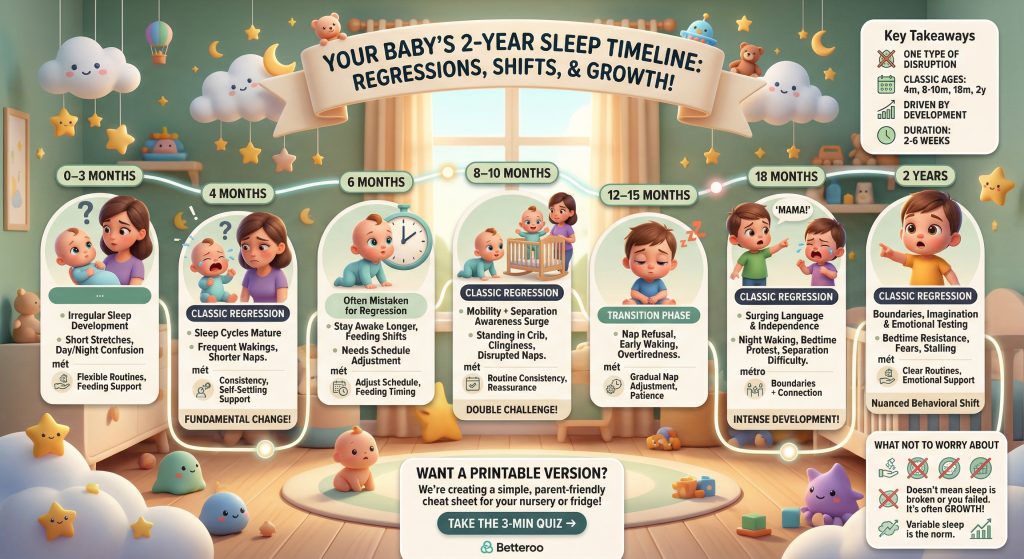
Sleep regression Ages most commonly occur around 4 months, 8–10 months, 18 months, and 2 years, but sleep disruptions can happen at many points in the first two years as your child’s brain, body, and schedule develop.
If your baby’s sleep suddenly feels unpredictable, you’re not alone. What often gets labeled as a “sleep regression” is usually part of a broader pattern of developmental change. Some of these shifts are well-known. Others are less talked about but just as common.
This guide gives you a clear, age-by-age timeline so you can understand what’s happening, and what’s likely temporary, without having to piece it together from multiple sources.
sleep regression ages timeline infographic
Table of Contents
Key Takeaways
Sleep regressions are only one type of sleep disruption in the first two years
The most commonly referenced regressions occur around 4 months, 8–10 months, 18 months, and 2 years
Many sleep changes are driven by development, not problems
Most disruptions last 2–6 weeks1, though timing and intensity vary
Not every sleep disruption requires intervention—context matters
Sleep Regression Ages: Timeline From 0–2 Years
This timeline includes both classic sleep regressions and other common developmental sleep disruptions that can look similar.
Sleep regression ages timeline from 0 to 2 years
Age
What’s happening
Type
Typical duration
What it looks like
What helps
0–3 months
Irregular sleep development
Developmental
Ongoing
Day/night confusion, short stretches
Flexible routines, feeding support
4 months
Sleep cycles mature
Classic regression
2–6 weeks
Frequent wakings, shorter naps
Consistency, supporting self-settling
6 months
Wake windows expand, feeding shifts
Schedule change
1–3 weeks
Night wakings, nap resistance
Adjust schedule, feeding timing
8–10 months
Mobility + separation awareness
Classic regression
2–6 weeks
Standing in crib, clinginess, disrupted naps
Routine consistency, reassurance
12 months
Nap transition begins
Transition phase
2–4 weeks
Nap refusal, early waking
Gradual nap adjustment
15 months
Nap consolidation (2 to 1 nap)
Transition
2–6 weeks
Overtiredness, uneven naps
Stable schedule, patience
18 months
Language + independence surge
Classic regression
2–6 weeks
Night waking, bedtime protest, separation difficulty
Sleep regression refers to a temporary period when a baby or toddler who was sleeping more predictably begins waking more often or resisting sleep. It’s typically linked to developmental changes, not something going “wrong”. Understanding sleep regression ages helps you anticipate what’s coming instead of being caught off guard. However, not every disruption is a regression.
Sleep can also shift due to:
Schedule mismatches (wake windows changing)
Nap transitions
Growth spurts or feeding changes
Illness or teething
Understanding the difference helps you respond appropriately instead of assuming every disruption needs the same fix.
Struggling with sleep regressions?
Get a personalized sleep and development plan built around your baby’s age, needs, and your family’s routine.
Sleep changes are usually tied to meaningful developmental progress.
Sleep cycle maturation: Around 4 months, babies transition to more adult-like sleep cycles. 4 This is a permanent shift, which is why this regression often feels more significant.
Physical milestones: Rolling, crawling, standing, and walking can temporarily disrupt sleep as babies practice new skills.
Cognitive and language development: As awareness increases, so does stimulation, and sometimes resistance to sleep.
Separation awareness: Babies begin to understand that you can leave, which can lead to increased night waking or difficulty settling.
Age-by-Age Breakdown: What’s Actually Happening
4 Months (Classic Sleep Regression)
This is the most widely recognized regression because it reflects a fundamental change in how sleep works.
Across most sleep regression ages, the typical duration is 2–6 weeks.1
Some phases resolve more quickly. Others, especially the 4-month shift, may last longer if new sleep patterns become established. The duration is typically impacted by the underlying cause (development vs schedule), how quickly routines adapt and individual temperament. Variation here is expected, not a sign you’re doing something wrong.
What’s Normal vs What Might Need More Support
Typically normal:
Increased night waking
Shorter or inconsistent naps
Temporary clinginess
Resistance to sleep
Consider checking in if:
Sleep disruption is prolonged beyond expected ranges
Feeding or growth is affected
Your child seems persistently uncomfortable
You feel overwhelmed or unsure how to proceed
Support isn’t only for extreme cases. It’s also for clarity.
Are Sleep Regressions Real?
Sleep regressions are not a formal medical diagnosis, but they are widely observed patterns tied to development. 2, 3 The sleep regression ages most parents reference are best understood as:
A helpful shorthand
Not a precise or universal schedule
A way to describe predictable, but variable, sleep disruptions
Some children move through these phases smoothly. Others experience more noticeable changes. Both are within the range of typical development.
What Actually Helps During Sleep Regressions
Rather than reacting to each disruption in isolation, it often helps to step back and look at the broader context. Common supportive approaches include maintaining consistent routines1, adjusting schedules as needed, supporting your child’s ability to settle and offering reassurance during periods of change. Some families explore structured approaches, including sleep training, while others take a more gradual or responsive path. What matters most is choosing an approach that feels sustainable and appropriate for your child and your family.
What Parents Often Expect vs What Actually Happens
Expectation: Sleep regressions follow exact timelines Reality: Timing varies significantly between children
Expectation: Each regression resolves cleanly Reality: Phases often overlap or blend together
Expectation: Something is wrong Reality: Development often looks like disruption before it looks like progress
How Betteroo Thinks About Baby Sleep
Betteroo’s State of Baby Sleep data shows that variability is the norm, not the exception.
Patterns like night waking, nap inconsistency, and temporary setbacks occur across a wide range of babies, even when development is on track. What matters most is understanding why sleep is changing, recognizing what is temporary and knowing when support could help. Sleep isn’t linear, but it can be more understandable.
FAQ: Sleep Regression Ages and Timing
Do all babies go through every sleep regression?
No. Some babies experience clear disruptions at typical ages, while others move through these phases more gradually or with minimal change. Sleep regressions are patterns, not requirements. A baby who doesn’t show a noticeable regression is not missing a developmental step, they may simply be integrating those changes more smoothly.
Can sleep regressions happen earlier or later than expected?
Yes. The ages listed are averages, not exact markers. Development doesn’t follow a strict schedule, so a regression may appear weeks earlier or later than expected, or blend into other changes like nap transitions or growth spurts.
Why does my baby’s sleep keep getting worse instead of better?
Sleep development isn’t linear. It often progresses in cycles of disruption and consolidation. What looks like “getting worse” is often your child working through multiple overlapping changes, physical, cognitive, and emotional. If the pattern feels prolonged or unclear, it can help to step back and assess whether it’s a regression, a schedule issue, or a transition.
Is this a sleep regression or something else?
A regression is usually tied to development and tends to resolve over time. If sleep issues persist without improvement, it may be worth considering schedule adjustments, environmental factors or feeding changes. If you’re unsure, checking in with a pediatrician or sleep specialist can provide clarity.
Should I change my approach during a sleep regression?
Not necessarily. In many cases, maintaining consistency helps your child move through the phase more smoothly. That said, some adjustments, like schedule tweaks or additional reassurance, can be helpful depending on what’s driving the change. There’s no single correct response. The goal is alignment, not perfection.
What age is the worst sleep regression?
The 4-month regression is often considered the most challenging because it reflects a permanent change in how your baby’s sleep cycles work. Unlike later regressions that tend to resolve as the developmental phase passes, the 4-month shift can require adjustments to routines and sleep habits. That said, every family experiences it differently – some find the 18-month or 2-year regression harder due to the added emotional and behavioral complexity.
Mindell, J.A., et al. (2006). Behavioral Treatment of Bedtime Problems and Night Wakings in Infants and Young Children. Sleep, 29(10), 1263–1276.https://pubmed.ncbi.nlm.nih.gov/17068979/
Galland, B.C., et al. (2012). Normal sleep patterns in infants and children: A systematic review. Sleep Medicine Reviews, 16(3), 213–222.https://pubmed.ncbi.nlm.nih.gov/21784676/
Hirshkowitz, M., et al. (2015). National Sleep Foundation’s sleep time duration recommendations. Sleep Health, 1(1), 40–43.https://pubmed.ncbi.nlm.nih.gov/29073412/
Henderson, J.M.T., et al. (2010). Sleeping through the night: the consolidation of self-regulated sleep across the first year of life. Pediatrics, 126(5), e1081–e1087.https://pubmed.ncbi.nlm.nih.gov/20956420/