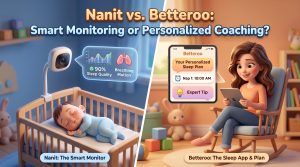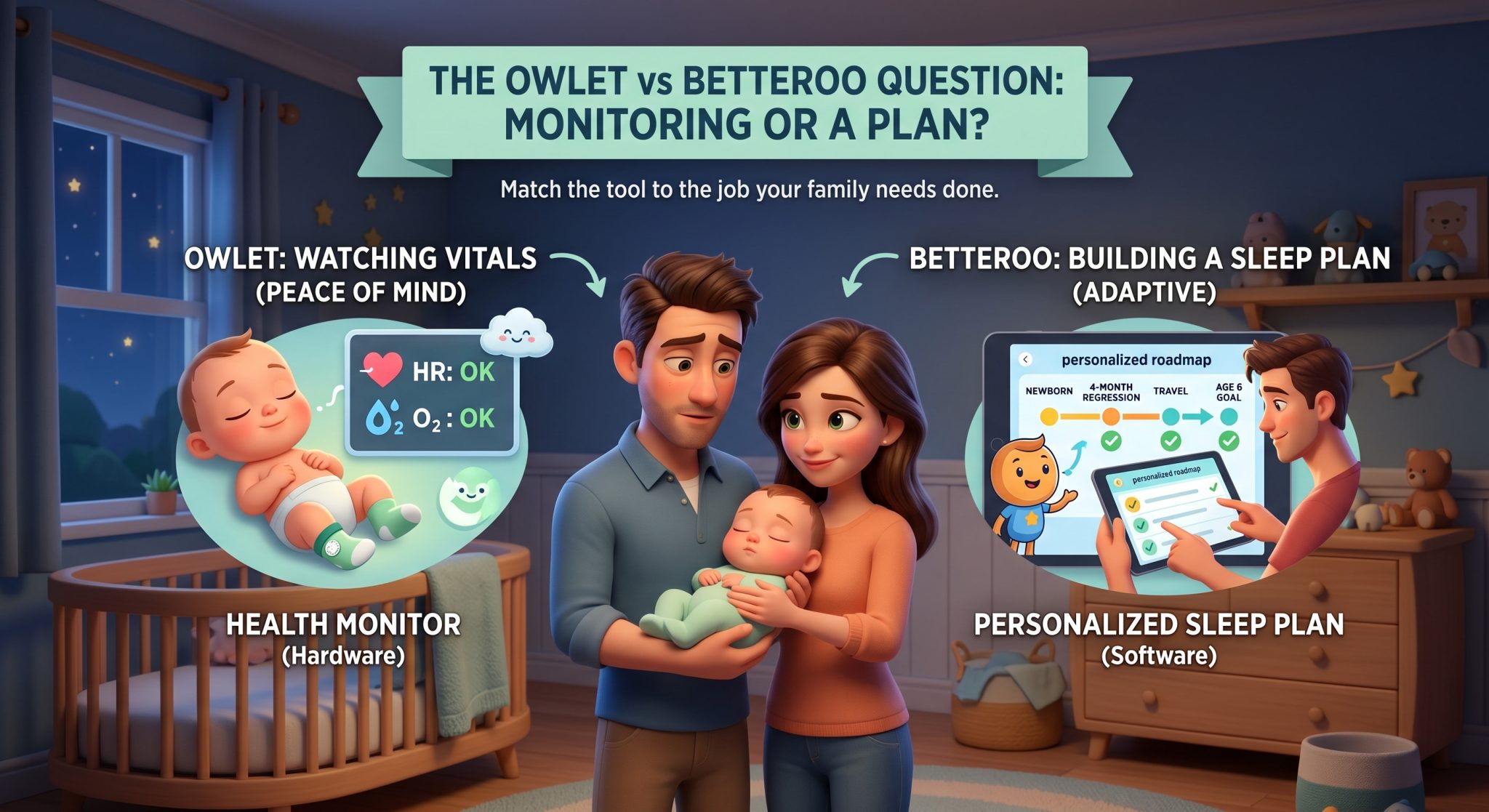

The Owlet vs Betteroo question is really about two different jobs. Owlet, best known for its Dream Sock, is a wearable baby monitor that tracks your baby’s heart rate, oxygen, and sleep, and alerts you if readings leave a healthy range. Betteroo is a personalized sleep app that builds an actual plan around your baby and you, and adapts it from the newborn stage through age 6.
We’ll be upfront: we build Betteroo, so we’re not neutral here. But this guide is written to give you a fair, useful look at both, where each one genuinely works well, where they differ, and how to decide what fits your family. Owlet has given a lot of anxious parents real peace of mind, and for some families that reassurance is worth a great deal. The goal here is fit, not a sale.
Table of Contents
Quick Answer
These two tools do not compete for the same job, which is the most useful thing to understand up front. Owlet watches your baby’s vital signs and tells you if something looks off. Betteroo takes the sleep problem you actually have and gives you a plan to change it. One is a health-monitoring device; the other is a guided, adaptive sleep plan.
- Choose Owlet if: you want a wearable that tracks heart rate and oxygen, alerts you to readings outside a healthy range, and gives you reassurance overnight.
- Choose Betteroo if: you want a personalized plan that tells you what to do about the sleep problem, adapts through regressions, and supports your child from newborn through age 6.
Feature Comparison
Owlet
A wearable sock that tracks vitals and sleep
Betteroo
A personalized plan that adapts from newborn to age 6
Owlet
A wearable sock that tracks vitals and sleep
Betteroo
A personalized plan that adapts from newborn to age 6
Swipe to compare
What Owlet Does Really Well
Owlet earned its following honestly. The Dream Sock slips onto the baby’s foot and tracks heart rate, oxygen, and sleep, sending readings to a base station and your phone. For parents who lie awake worrying, especially in the early months, having a wearable that quietly watches vital signs can be the difference between a sleepless night and an anxious mind finally settling.
It is also genuinely well designed for that purpose. The base station glows and chimes if readings move outside a preset healthy range, the sock is comfortable and wire-free, and newer models add a Predictive Sleep feature that suggests nap and bedtime windows. For families navigating real worry, that reassurance is the whole appeal, and Owlet delivers it.
- Vital-sign tracking. The Dream Sock monitors heart rate and oxygen and alerts you if readings leave a healthy range.
- Real reassurance. For anxious parents, a wearable quietly watching overnight can genuinely ease the early-months worry.
- Wire-free and comfortable. The sock design keeps tracking on the baby without wires, cuffs, or chest straps.
- Base station alerts. A glowing, chiming base station flags readings outside the set range without you needing to check a phone.
- Predictive sleep windows. Newer Owlet models suggest nap and bedtime timing alongside the health tracking.
Where Owlet Can Feel Limiting
None of this is a knock on what Owlet does well. These are the tradeoffs that come with a health-monitoring device, and they are worth knowing before you spend.
- It monitors health, it does not coach sleep. Owlet can tell you your baby woke and stirred. It does not tell you why, or what to change, or give you a plan to improve the sleep itself.
- It is not a medical device for healthy babies. Owlet is built for reassurance and wellness tracking, not diagnosis. It should never replace safe-sleep practices or your pediatrician’s guidance.
- The cost adds up. The Dream Sock is around $299, and the Predictive Sleep and history features sit behind an optional subscription.
- Data can raise anxiety. For some parents, a stream of overnight readings increases worry rather than easing it, especially without a plan to act on what they see.
- The window is short. Owlet is designed for roughly the first 18 months. After that, the core sleep challenges become behavioral, and a vitals monitor has little to offer.
What Betteroo Is Designed to Do Differently
Full transparency: Betteroo is our product, so we have included it here for comparison but encourage you to evaluate it alongside the other options. Here is what it is built to do differently from a health-monitoring sock.
It changes the sleep, it does not just watch it
Owlet is very good at watching your baby and reassuring you. Betteroo starts where that leaves off: it takes the sleep problem, frequent wakings, short naps, early rising, bedtime resistance, and builds a step-by-step plan to change it. Monitoring tells you the night happened; a plan changes how the next one goes.
The plan is built around your baby, and it lasts to age 6
Betteroo begins with a free 3-minute quiz about your baby’s age, temperament, feeding method, and sleep challenges, and about how you are doing, then builds a plan that is yours and keeps adapting it from the newborn stage through age 6, well past the window a sock covers. Our guides to the 4-month sleep regression and the baby sleep schedule by age cover the kinds of shifts it is built to handle.
It helps build sleep skills, gently
A vitals monitor cannot teach a baby to settle. Betteroo is designed to help your child build that skill. Behavioral sleep approaches have a solid evidence base, and Betteroo supports gradual methods, responsive settling, and approaches in between, so you choose what aligns with your values. Our guide to common sleep training methods walks through the options.
No hardware, and hands-free voice tracking
Betteroo is software, so there is nothing to strap on the baby and nothing to charge. It works with whatever sleep setup you already have. It also includes voice tracking, free in every plan, so you can log a feed or a nap just by talking instead of tapping through forms.
It is built around you, not just the baby
Betteroo was built with pediatric sleep specialists and developmental psychologists, and the quiz asks how you are doing, what your capacity is, and what your real schedule looks like, then builds the plan around that. A monitor adds another stream of readings to watch; Betteroo is designed to carry some of the load instead.
Where Betteroo May Not Be the Best Fit
We would rather you pick the right tool than the wrong subscription. Betteroo is not the best fit for everyone, and there are real situations where Owlet, or something else, is the better call.
- You want vital-sign monitoring. Betteroo is a plan, not a wearable. If tracking heart rate and oxygen is your priority, that is hardware Betteroo does not provide.
- Your need is reassurance, not sleep change. If your baby’s sleep is fine and what you want is peace of mind overnight, a monitor is a more direct answer.
- You have specific health worries. If there is a genuine medical concern, that is a conversation with your pediatrician first, and a monitor is a wellness tool, not a diagnosis.
- Your baby has medical sleep needs. For reflux, prematurity, or other medical situations, follow your pediatrician’s guidance first. Betteroo is designed to work alongside that, not replace it.
Pricing and Value Comparison
Owlet
A wearable to buy, with extras behind a subscription
Betteroo
From $1/day, a plan that lasts through age 6
Owlet
A wearable to buy, with extras behind a subscription
Betteroo
From $1/day, a plan that lasts through age 6
Swipe to compare
The honest framing is about what you are buying. Owlet is a hardware purchase plus an optional subscription for vital-sign monitoring and reassurance. Betteroo is a subscription for a guided sleep plan, with no hardware to buy. Neither is “better” on price alone, they are priced for different jobs: one to watch your baby’s vitals, one to change how your baby sleeps.
Owlet vs Betteroo: Which One Should You Choose?
It comes down to whether you want a wearable that watches your baby’s vital signs, or a plan that changes how your baby sleeps. Here is the clearest way to decide.
Choose Owlet if:
- You want overnight tracking of heart rate and oxygen.
- Reassurance and peace of mind in the early months are your priority.
- You want base station alerts on readings outside a healthy range.
- You are comfortable acting on the data yourself, without a plan.
Choose Betteroo if:
- You want a step-by-step plan for a specific sleep problem.
- You want the plan to adapt through regressions, transitions, travel, and illness.
- You want hands-free voice logging and predictions with no hardware.
- You want expert-built guidance and support that lasts through age 6.
If You’re Currently Using Owlet
If Owlet is working and what you wanted was reassurance and a window into your baby’s vitals, keep using it. It is doing the monitoring job it is built for, and peace of mind in the early months has real value.
The moment to think beyond the monitor is when the issue is the sleep itself, not your worry about it. If your baby is healthy but waking constantly, fighting bedtime, or stuck on short naps, a vitals monitor cannot move those numbers. That is the point where a guided, adaptive plan picks up where the sock leaves off, and many families run both: the monitor for reassurance, the plan for the sleep.
A Real-World Example
Picture a parent with a 5-month-old and an Owlet sock. The vitals look healthy every night, which is a genuine relief, but the baby is still waking every two hours. Owlet has done its job, it has reassured the parent that nothing is medically wrong, but it offers no answer for the wakings themselves, and the exhaustion keeps building.
With Betteroo, that same situation has a plan attached. The app takes the sleep history, identifies that the wakings are a behavioral pattern rather than a health issue, and walks the parent through a specific, values-aligned approach to work on it, then adapts as the next regression arrives. Same baby, same healthy vitals, but a path to actually fewer wake-ups.
How This Fits Into the Bigger Picture
A health monitor and a sleep plan are different categories of tool, and the real question is not which wins, it is which matches the problem you have. If your problem is worry, you want reassurance that your baby is okay, a monitor like Owlet is a direct answer. If your problem is the sleep itself, the wakings, the bedtime battles, the regressions, then a plan that diagnoses and adapts is built for that. For more on how app-based tools fit in, our look at whether sleep training apps actually work and our roundup of the best baby tracker apps are good next reads.
Frequently Asked Questions
Is Betteroo a replacement for Owlet?
Not exactly, because they do different jobs. Owlet is a wearable that tracks your baby’s heart rate, oxygen, and sleep for reassurance. Betteroo is an app that builds and adapts a personalized sleep plan. Betteroo will not monitor vitals, and Owlet will not give you a plan. Many families keep the monitor for peace of mind and add a plan for the sleep itself.
Can I use Owlet and Betteroo together?
Yes, and it is a sensible pairing. Owlet handles the health monitoring and reassurance, while Betteroo handles the plan, the guidance, and the adaptation through every stage. Using both means you can feel reassured about your baby’s vitals and still have a clear path to better sleep.
Does Owlet fix sleep problems?
Owlet monitors your baby’s vitals and sleep, but it does not fix sleep problems. It reports heart rate, oxygen, and wake-ups. Acting on sleep issues, deciding what to change and how, is left to you. A plan-based tool like Betteroo is built for that part: turning a sleep problem into a step-by-step approach.
Is Owlet or Betteroo better for newborns?
They help newborns in different ways. Owlet offers vital-sign tracking and reassurance in the early months. Betteroo supports newborns with tracking and a plan, and starts by asking how you are doing, not just how the baby slept. If you want peace of mind about vitals, Owlet fits; if you want a plan from day one, Betteroo fits.
Is Owlet a medical device?
Owlet’s consumer products are designed for wellness tracking and reassurance, not medical diagnosis. They should never replace safe-sleep practices or your pediatrician’s guidance. If you have a genuine health concern about your baby, that is a conversation with your doctor, not something any consumer monitor can answer.
Does Betteroo need a sock or special hardware?
No. Betteroo is a software app, so it works with whatever sleep setup you already have, with or without a monitor. There is nothing to strap on the baby. You take a free 3-minute quiz, get a personalized plan, and the app adapts it as your baby grows.
Do baby monitors actually improve sleep?
A monitor like Owlet can ease parental anxiety and, with predictive features, help with timing. What a monitor cannot do on its own is change the sleep, that requires acting on a consistent plan. A monitor helps you feel reassured; a plan-based app helps you actually improve how your baby sleeps.
Final Take: Match the Tool to the Job You Actually Need Done
There is no single winner in Owlet vs Betteroo, because they are built for different jobs. Owlet is a well-made wearable monitor that tracks vital signs and gives anxious parents real reassurance in the early months. Betteroo is a personalized app that diagnoses the sleep problem, builds a plan, adapts it through every stage to age 6, and backs it with expert support.
Ask yourself what job you need done. If it is reassurance that your baby is okay overnight, Owlet is a direct answer. If it is changing the sleep, the wakings, the bedtime battles, the regressions, then a plan that adapts is built for that. Plenty of families use both, the sock for peace of mind, the plan for the sleep. Either way, the win is the same: a baby who sleeps better and a parent who gets their life back.
Related Betteroo Guides
3 Sources
- Mindell, J.A., et al. (2006). Behavioral Treatment of Bedtime Problems and Night Wakings in Infants and Young Children. Sleep, 29(10), 1263-1276. https://pubmed.ncbi.nlm.nih.gov/17068979/
- Moon, R.Y., et al. (2022). Sleep-Related Infant Deaths: Updated 2022 Recommendations for Reducing Infant Deaths in the Sleep Environment. Pediatrics, 150(1). https://pubmed.ncbi.nlm.nih.gov/35726558/
- Betteroo. State of Parent & Baby Sleep 2026. Survey of 68,366 parents across 108 countries. https://betteroo.ai/state-of-baby-sleep/