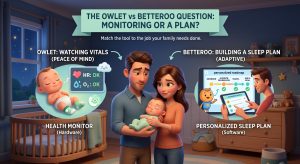

The Napper vs Betteroo question is really a question about two kinds of help. Napper is a baby sleep tracker that predicts your child’s next nap and bedtime windows from their natural sleep rhythms. Betteroo is a personalized sleep app that builds an actual plan around your baby and you, and adapts it from the newborn stage through age 6.
We’ll be upfront: we build Betteroo, so we’re not neutral here. But this guide is written to give you a fair, useful look at both, where each one genuinely works well, where they differ, and how to decide what fits your family. Napper is a well-made app that a lot of parents like, and for some families it is exactly the right tool. The goal here is fit, not a sale.
Table of Contents
Quick Answer
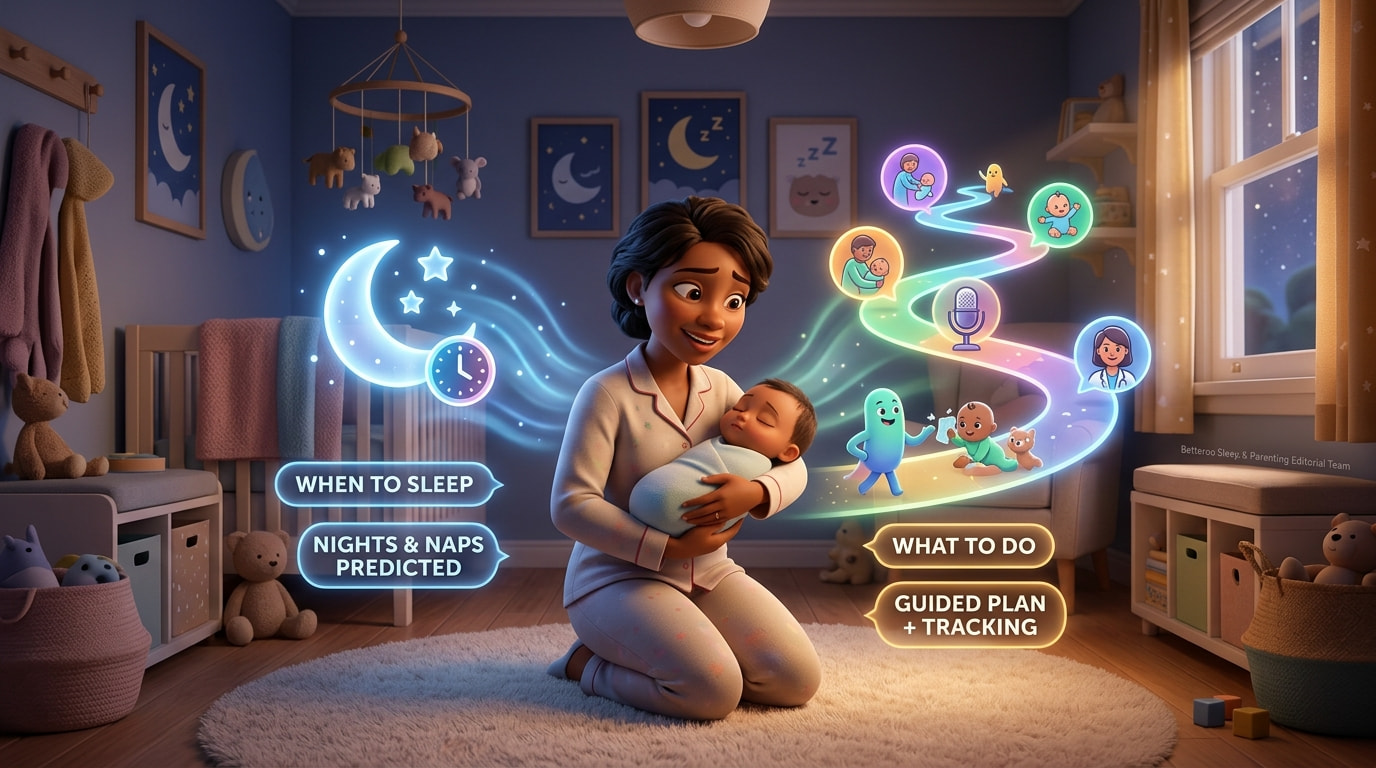
These two apps are not doing the same job, and that is the most useful thing to understand up front. Napper tells you when your baby is likely ready to sleep. Betteroo tells you what to do about the sleep problem you actually have, then adapts the plan as things change. One is a predictive tracker; the other is a guided, adaptive plan.
- Choose Napper if: you mainly want nap and bedtime predictions, simple tracking, and a library of sleep articles to read on your own, at a low monthly price.
- Choose Betteroo if: you want a personalized plan that adapts through regressions and every stage, hands-free voice tracking, and expert-built guidance and support from newborn through age 6.
Feature Comparison
Napper
An app that predicts nap and bedtime windows
Betteroo
A personalized plan that adapts from newborn to age 6
Napper
An app that predicts nap and bedtime windows
Betteroo
A personalized plan that adapts from newborn to age 6
Swipe to compare
What Napper Does Really Well
Napper has earned its following. It is a polished, friendly app built around one core idea: if you know your baby’s natural sleep rhythms, you can time naps and bedtime better and avoid the overtired spiral. It takes what you log and turns it into clear predictions for the next sleep window, which removes a lot of the guessing that makes early parenthood so draining.
It is also genuinely pleasant to use. The tracking is simple, the trend charts are easy to read, and the built-in sleep sounds and science-based article series mean you are not bouncing between five apps and a dozen browser tabs at 3 a.m. For a parent who mainly wants timing help and a tidy record, that is a real, well-executed package.
- Clear nap and bedtime predictions. Napper turns your logs into a forecast of the next sleep window, which helps you catch the timing before overtiredness sets in.
- Simple, friendly tracking. Logging feeds, diapers, and sleep is quick, and the trend charts make patterns easy to spot.
- A built-in article library. Napper includes a science-based series on sleep environment, settling, and routines, so reference material is in the same place as the tracker.
- Built-in sleep sounds. White noise and nature sounds are included, which is one less separate tool to manage.
- An accessible price. Napper is one of the lower-cost sleep apps, especially on an annual plan, which makes it easy to try.
Where Napper Can Feel Limiting
None of this is a knock on what Napper does well. These are the tradeoffs that come with a prediction-and-tracking app, and they are worth knowing before you settle in.
- It predicts timing, but it does not give you a plan. Napper tells you when the next nap window is likely. It does not hand you a step-by-step approach for the actual problem, like frequent night wakings or bedtime battles.
- Guidance is self-serve. The article library is good, but you are the one who has to read it, diagnose the issue, and decide what to apply. There is no plan built around your specific situation.
- It does not actively adapt to disruptions. When a regression, illness, or trip throws everything off, the schedule shifts with age but the app does not walk you through what changed or what to do next.
- The window narrows as your child grows. Napper is strongest in the nap-heavy months. Once your child is past the daily-nap stage, a prediction-focused app has less to offer.
- No hands-free logging. Tracking still means tapping through the app, which is harder than it sounds when you are holding a baby at 3 a.m.
What Betteroo Is Designed to Do Differently
Full transparency: Betteroo is our product, so we have included it here for comparison but encourage you to evaluate it alongside the other options. Here is what it is built to do differently from a prediction-and-tracking app.
It gives you a plan, not just a prediction
Napper tells you when your baby is likely ready to sleep. Betteroo starts from the problem you actually have, whether that is frequent night wakings, short naps, early rising, or bedtime resistance, and builds a step-by-step plan to work on it. It still does everything a tracker does, including feed, diaper, and sleep logging with predictions, but the prediction is the starting point, not the whole product.
The plan is built around your baby, and it lasts to age 6
Betteroo begins with a free 3-minute quiz about your baby’s age, temperament, feeding method, and sleep challenges, and about how you are doing, then builds a plan that is yours and keeps adapting it from the newborn stage through age 6. When a regression hits or a nap transition arrives, the plan adjusts instead of leaving you to interpret a chart on your own. Our guides to the 4-month sleep regression and the baby sleep schedule by age cover the kinds of shifts it is built to handle.
It helps build sleep skills, gently
Knowing the right nap window does not, by itself, teach a baby to settle. Betteroo is designed to help your child build that skill. Behavioral sleep approaches have a solid evidence base, and Betteroo supports gradual methods, responsive settling, and approaches in between, so you choose what aligns with your values. Our guide to common sleep training methods walks through the options.
Hands-free voice tracking, free in every plan
Betteroo includes voice tracking, free in every plan, so you can log a feed, a nap, or a whole day just by talking instead of tapping through forms. When you are holding a baby, that difference is not cosmetic. It is the difference between keeping an accurate record and giving up on logging by week three.
It is built around you, not just the baby
Betteroo was built with pediatric sleep specialists and developmental psychologists, and the quiz asks how you are doing, what your capacity is, and what your real schedule looks like, then builds the plan around that. Daily micro-supports take a few minutes, not hours, because the whole thing assumes you are depleted. A predictive tracker hands you data; Betteroo is designed to carry some of the load.
Where Betteroo May Not Be the Best Fit
We would rather you pick the right tool than the wrong subscription. Betteroo is not the best fit for everyone, and there are real situations where Napper, or something else, is the better call.
- You only want timing predictions. If your baby’s sleep is basically fine and you just want a nap-window forecast and a tidy log, Napper does that well at a lower price.
- You want the lowest-cost option. Napper is one of the more affordable sleep apps. If budget is the deciding factor, that is a fair point in its favor.
- You prefer to self-diagnose. If you like reading the research and building your own approach, a strong article library may be all the structure you want.
- Your baby has medical sleep needs. For reflux, prematurity, or other medical situations, follow your pediatrician’s guidance first. Betteroo is designed to work alongside that, not replace it.
Pricing and Value Comparison
Napper
An affordable predictive tracker subscription
Betteroo
From $1/day, a plan that lasts through age 6
Napper
An affordable predictive tracker subscription
Betteroo
From $1/day, a plan that lasts through age 6
Swipe to compare
On price alone, Napper is the cheaper app, and that is a real advantage if predictions and tracking are all you need. The honest framing is about what you are buying. Napper is a low-cost way to time sleep better. Betteroo costs more because it is a guided, adapting plan with expert support behind it, and it keeps working through the regressions and transitions that a prediction alone cannot solve. Neither is “better” on price; they are priced for different jobs.
Napper vs Betteroo: Which One Should You Choose?
It comes down to whether you want an app that predicts when your baby will sleep, or a plan that tells you what to do and adapts as things change. Here is the clearest way to decide.
Choose Napper if:
- You mainly want nap and bedtime window predictions.
- Your baby’s sleep is broadly okay and you want timing help, not a full plan.
- You are comfortable reading articles and applying advice yourself.
- A low monthly price is a deciding factor.
Choose Betteroo if:
- You want a step-by-step plan for a specific sleep problem, not just timing.
- You want the plan to adapt through regressions, transitions, travel, and illness.
- You want hands-free voice logging and predictions in one app.
- You want expert-built guidance and support that lasts through age 6.
If You’re Currently Using Napper
If Napper is working and your main need is timing, keep using it. Catching the right nap window is a real win, and there is no reason to switch tools if that is the problem you have.
The moment to reconsider is when the problem stops being timing. If you are getting the windows right and your baby is still waking repeatedly, fighting bedtime, or stuck on 30-minute naps, that is no longer a prediction problem, it is a plan problem. That is the point where a guided, adaptive plan picks up where a predictive tracker leaves off.
A Real-World Example
Picture a parent with a 6-month-old who is using Napper and following the predicted windows closely. The timing is right, naps go in on schedule, and yet the baby is still waking three times a night. With Napper, the next step is unclear: the app has done its job by predicting the window, but the night wakings are a different problem, and the parent is left reading articles and guessing which one applies.
With Betteroo, that same situation has a plan attached. The app takes the sleep picture, identifies that the issue is night wakings rather than timing, and walks the parent through a specific, values-aligned approach to work on it, then adapts as the next regression or nap transition arrives. Same baby, same data, but a path forward instead of another article.
How This Fits Into the Bigger Picture
Predictive trackers and adaptive plans are both real categories of sleep app, and the question is not which wins, it is which matches the problem you have. If your problem is timing, a predictive tracker like Napper is a direct, affordable answer. If your problem is the actual sleep, the wakings, the bedtime battles, the regressions, then a plan that diagnoses and adapts is built for that. For more on how these tools fit in, our look at whether sleep training apps actually work and our roundup of the best baby tracker apps are good next reads.
Frequently Asked Questions
Is Betteroo a replacement for Napper?
It can be, because Betteroo does what Napper does and more. Betteroo includes feed, diaper, and sleep tracking with predictions, so you do not lose the timing help. The difference is that Betteroo also builds an adaptive plan for the actual sleep problem. If all you want is prediction and tracking, Napper is enough; if you want a plan on top of that, Betteroo replaces the need for a separate tracker.
Is Napper or Betteroo better for newborns?
Both work from the newborn stage. Napper helps by predicting sleep windows and giving you a tidy log. Betteroo helps with tracking too, but starts by asking how you are doing, not just how the baby slept, and builds a plan around your family’s reality. If you want timing help, Napper fits; if you want a plan and support from day one, Betteroo fits.
Which is cheaper, Napper or Betteroo?
Napper is the lower-priced app, starting around $8.99 a month and cheaper on an annual plan. Betteroo starts from about $1 a day and includes a 30-day money-back guarantee. Napper costs less because it is a predictive tracker; Betteroo costs more because it is a guided, adapting plan with expert support. The right value depends on whether you need timing help or a full plan.
Does Napper tell you how to sleep train?
Napper provides a science-based article library covering sleep environment, settling, and routines, so the information is there. What it does not do is build a specific, step-by-step plan around your baby and walk you through it. You read and apply the guidance yourself. Betteroo is built the other way around: it diagnoses the issue and gives you a plan to follow, with support if it stops working.
Can I use Napper and Betteroo together?
You can, but there is a lot of overlap. Betteroo already includes tracking and sleep predictions, so running both mostly means paying for two apps that both forecast sleep windows. Most families pick one. If you mainly want timing, Napper alone is enough; if you want a plan and guidance, Betteroo covers the tracking too.
What age range does each app cover?
Napper is strongest in the nap-heavy months from newborn through toddlerhood, since its core feature is predicting daily sleep windows. Betteroo spans newborn through age 6, so it keeps working past the daily-nap stage into the toddler and preschool sleep challenges, like bedtime resistance and night-waking, that come later.
Do sleep prediction apps actually work?
They can help with one specific thing: timing. Catching the right nap window does reduce overtiredness, and a prediction app makes that easier. What predictions cannot do on their own is solve frequent night wakings or bedtime battles, which are behavioral, not timing, problems. A prediction app helps you time sleep; a plan-based app helps you change it.
Final Take: Match the Tool to the Problem You Actually Have
There is no single winner in Napper vs Betteroo, because they are built for different jobs. Napper is a polished, affordable predictive tracker that helps you time naps and bedtime and keep a tidy record, real value if timing is your main struggle. Betteroo is a personalized app that diagnoses the sleep problem, builds a plan, adapts it through every stage to age 6, and backs it with expert support.
Ask yourself what problem you actually have. If it is timing, Napper is a direct and budget-friendly answer. If it is the sleep itself, the wakings, the bedtime battles, the regressions, then a plan that adapts is built for that. Either way, the win is the same: a baby who sleeps better and a parent who gets their life back.
Related Betteroo Guides
3 Sources
- Mindell, J.A., et al. (2016). Development of Infant and Toddler Sleep Patterns: Real-World Data from a Mobile Application. Journal of Sleep Research, 25(5), 508-516. https://pubmed.ncbi.nlm.nih.gov/27070844/
- Mindell, J.A., et al. (2006). Behavioral Treatment of Bedtime Problems and Night Wakings in Infants and Young Children. Sleep, 29(10), 1263-1276. https://pubmed.ncbi.nlm.nih.gov/17068979/
- Betteroo. State of Parent & Baby Sleep 2026. Survey of 68,366 parents across 108 countries. https://betteroo.ai/state-of-baby-sleep/