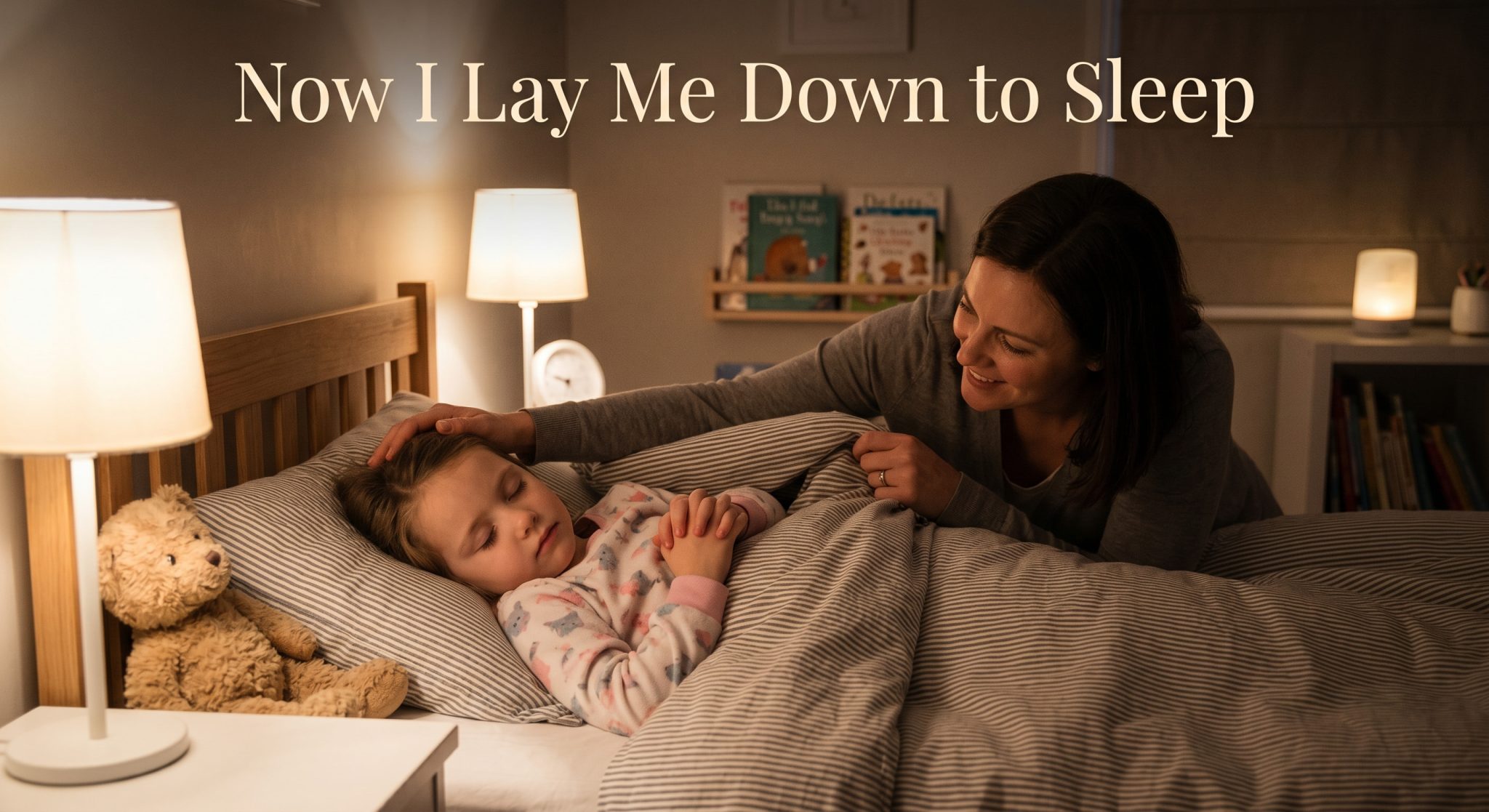
“Now I lay me down to sleep” is the bedtime prayer that millions of us learned as children and now whisper over children of our own. It is short enough for a two-year-old to memorize and old enough to have crossed three centuries. Below you will find the full prayer in every common version, gentler modern wordings, the Catholic form, the original 1700s text, and the story of where it came from.
If you are here at bedtime with a tired child beside you, scroll to the version that fits your family and read it together tonight. If you are here because the line “if I should die before I wake” gave you pause, you are not alone, and the gentle versions further down were written for exactly that reason.
The Prayer, in Full
Now I lay me down to sleep, I pray the Lord my soul to keep. May angels watch me through the night, And wake me with the morning light.
Table of Contents
The Most Common Modern Version
This is the wording most American families say today. It keeps the rhythm of the original but ends on a gentle, comforting note, which is why it has become the default for parents and Sunday school teachers alike.
Now I lay me down to sleep, I pray the Lord my soul to keep. May angels watch me through the night, And wake me with the morning light.Modern gentle version
The Original Version (“If I Should Die Before I Wake”)
This is the version many adults remember from their own childhood. It first appeared in print in The New England Primer in the 1700s, when child mortality was high and bedtime was a natural moment to commend a child’s soul to God. The “if I should die” line is the historical heart of the prayer, though many parents today choose a softer wording for young children.
Now I lay me down to sleep, I pray the Lord my soul to keep. If I should die before I wake, I pray the Lord my soul to take.Traditional, The New England Primer (1700s)
Gentle Versions for Young Children
If you would rather not introduce the idea of dying at bedtime, these reworded endings keep the opening lines intact and close on protection, morning, and love instead. Any of them works beautifully as a nightly habit.
Now I lay me down to sleep, I pray the Lord my soul to keep. Guide me safely through the night, And wake me with the morning light.Gentle version
Now I lay me down to sleep, I pray the Lord my soul to keep. Your love be with me through the night, And bless me with the morning light.Gentle version
Now I lay me down to rest, I pray the Lord to keep me blessed. Watch me, Lord, the whole night through, And wake me up to a day that’s new.Gentle version
The Catholic Version
Many Catholic families say the prayer with a closing line that asks for the blessing of the Holy Family, and often add a sign of the cross before and after.
Now I lay me down to sleep, I pray the Lord my soul to keep. If I should die before I wake, I pray the Lord my soul to take. And this I ask for Jesus’ sake.Catholic version
Now I lay me down to sleep, I pray the Lord my soul to keep. May God guard me through the night, And wake me with the morning light. Jesus, Mary, and Joseph, watch over me.Catholic gentle version
Longer Versions with Blessings
A favorite way to stretch the prayer into a small bedtime ritual is to add a line naming the people your child loves. Children often want to keep adding names, which is part of the charm and a gentle way to wind down.
Now I lay me down to sleep, I pray the Lord my soul to keep. May angels watch me through the night, And wake me with the morning light. God bless Mommy, God bless Daddy, and everyone I love. Amen.Extended family blessing
Now I lay me down to sleep, I pray the Lord my soul to keep. Thank you for the day so deep, for family, friends, and rest and sleep. Keep us safe till morning light. God bless us all. Good night.Extended gratitude version
The prayer is said. The lights are off. And they still won’t sleep.
A bedtime prayer is a beautiful way to close the day. When the wakings keep coming anyway, Betteroo builds a gentle, personalized sleep plan around your child and family, for less than a single consultant call. Take the free 3-minute quiz to find your starting point.
The earliest printed form of “Now I lay me down to sleep” appears in The New England Primer, the small schoolbook used to teach reading and religion in colonial America, with editions circulating from the 1730s onward. The four-line rhyme was simple enough for the youngest readers and doubled as a lesson in faith. A similar sentiment, “commending one’s soul to God before sleep,” reaches back much further into Christian evening prayer, but it was the Primer that fixed these particular words in the English-speaking world.
Over the centuries the ending softened. As bedtime moved from a solemn moment toward a comforting routine, families began trading “if I should die before I wake” for lines about angels, morning light, and God’s love. Both versions are still said today, often within the same family across generations, which is why you may remember one wording while your children learn another.
How to Make It a Bedtime Habit
The prayer works best as the last calm step of a predictable wind-down. Children settle more easily when the same things happen in the same order each night, and a short prayer is a natural closing cue. A simple sequence many families use: bath or wash-up, pajamas, two books, then the prayer with the lights already low, a hug, and goodnight. Saying it in the same soft voice each night, and letting your child say the lines they know, turns four short lines into a signal that the day is safely over and sleep is coming.
If you are saying the prayer every night and still up at 2am, the problem is not your faith or your effort. According to Betteroo’s State of Parent & Baby Sleep 2026, the largest dataset of its kind with 68,366 parents across 108 countries, broken nights are the norm for most families right now, not the exception.
55%
of babies wake 3+ times per night
The 2026 US national average
79%
of parents get under 6 hours of sleep a night
The 2026 US national average
Baby and parent sleep in 2026, from Betteroo’s State of Parent and Baby Sleep report
Metric
2026 US national average
Babies waking 3 or more times per night
55%
Parents getting under 6 hours of sleep
79%
A prayer for the night, and a plan for the nights after.
Betteroo builds a personalized, gentle sleep plan around your child and family, for $15 to $25 a month. Answer a few questions and see where to start.
What are the full words to “Now I lay me down to sleep”?
The most common modern version is: “Now I lay me down to sleep, I pray the Lord my soul to keep. May angels watch me through the night, and wake me with the morning light.” The traditional version replaces the last two lines with “If I should die before I wake, I pray the Lord my soul to take.”
What is the original version of the prayer?
The original, printed in The New England Primer in the 1700s, reads: “Now I lay me down to sleep, I pray the Lord my soul to keep. If I should die before I wake, I pray the Lord my soul to take.” This wording reflects an era of high child mortality, when commending a child’s soul to God at bedtime was common.
Why does the prayer mention dying?
The “if I should die before I wake” line dates to the 1700s, when death in childhood was far more common and faith framed sleep as a daily act of trust in God. Many modern parents prefer a gentler ending about angels and morning light, which carries the same comfort without introducing the idea of death to a young child. Both versions are widely used today.
Is there a version without “if I should die”?
Yes. A popular gentle ending is “May angels watch me through the night, and wake me with the morning light.” Other soft versions use “Guide me safely through the night” or “Your love be with me through the night.” Any of these keeps the opening lines and closes on protection rather than death.
Where did the prayer come from?
Its earliest printed form is in The New England Primer, the colonial American schoolbook used to teach reading and Christian faith, with editions circulating from the 1730s. The broader idea of commending oneself to God before sleep is much older and appears throughout Christian evening prayer.
What is the Catholic version of the prayer?
Catholic families often add a closing line such as “And this I ask for Jesus’ sake,” or end with “Jesus, Mary, and Joseph, watch over me,” frequently with a sign of the cross before and after. The opening lines remain the same.