

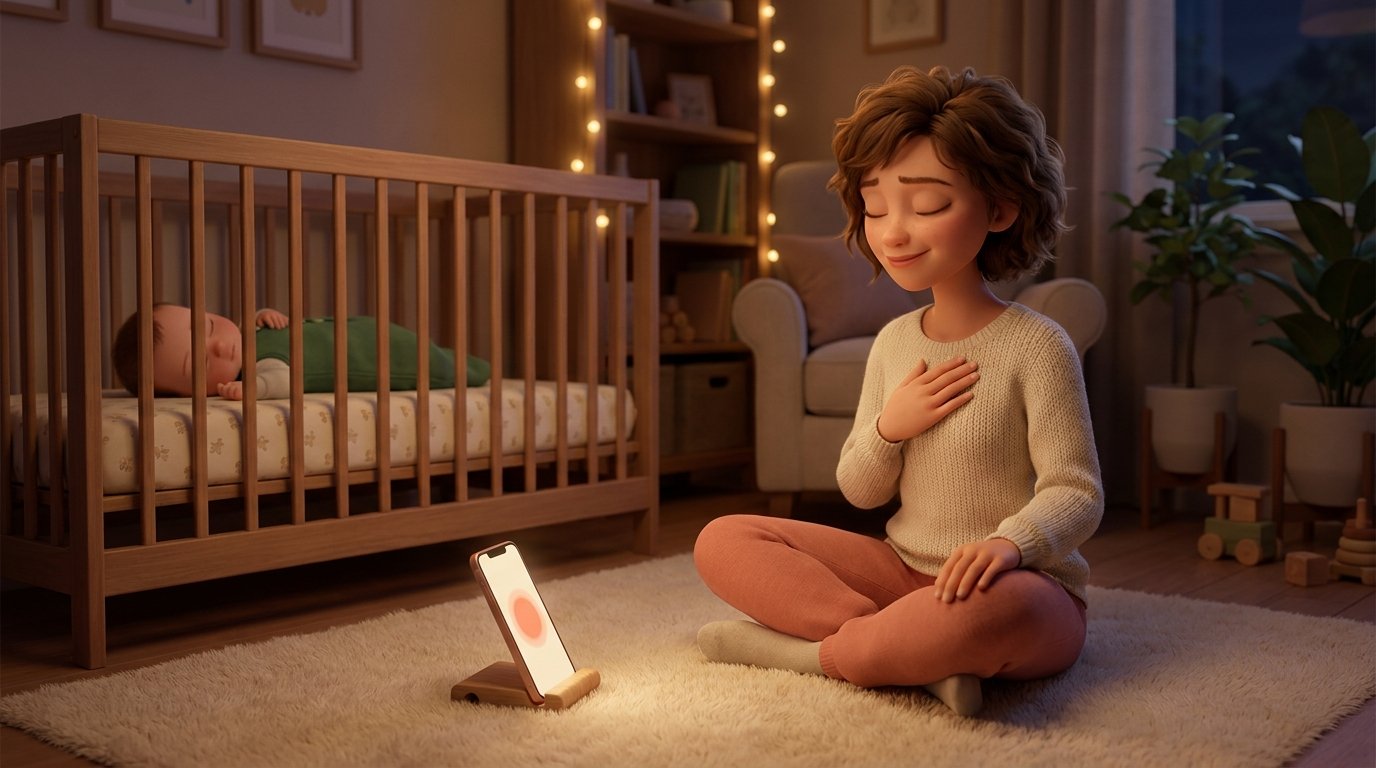
Mindfulness tools only work if you can reach them at 1am with one hand. The seven below run right here on this page – a breathing pacer, grounding walkthrough, worry release, body scan, noise generator, mood matcher, and a timer for doing nothing. No app, no signup, no audio course.
Key Takeaways
- The best mindfulness tools for moms are the ones with zero setup: every tool on this page works in under 10 seconds, one-handed.
- Mindfulness-based practices performed as well as established therapies for anxiety and depression in a 12,000-participant meta-analysis.
- Match the tool to the state: grounding for spiraling, paced breathing for anxiety, body scan for tension, noise for overstimulation.
- One to three minutes is a real dose. Consistency beats duration every time.
Table of Contents
Use a mindfulness tool right now
Each card opens a full-screen tool built for a depleted parent: big targets, slow pacing, nothing to configure, and you can leave at any second without losing anything. The state chips tell you which moment each one is built for. Tap one.
Breathing Pacer
Box breathing, 4-7-8, or coherent breathing – follow the circle, not your racing mind.
5-4-3-2-1 Grounding
A guided walk through your five senses. The classic technique, one tap at a time.
Worry Release
Type the thought that’s circling. Watch it drift away. Nothing is saved – on purpose.
Two-Minute Body Scan
Eight slow stops from toes to forehead. Find the tension you didn’t know you were holding.
The Shush
Brown, pink, or white noise, generated right here. For the baby – and honestly, for you.
Mood Match
Name how you actually feel and get one 60-second practice matched to exactly that.
The Pause Timer
Ninety seconds of officially sanctioned nothing. The ring fills; you don’t have to.
What each tool does (and the technique behind it)
1. Breathing Pacer – box breathing, 4-7-8, and coherent breathing
Box breathing (4 counts in, hold, out, hold) is the steady all-rounder. The 4-7-8 breathing pattern weights the exhale, which is why it’s the classic wind-down before sleep. Coherent breathing (5 in, 5 out) is the gentlest entry point if counting holds feels like work. The pacer animates each phase so you follow a circle instead of doing math at midnight.
2. 5-4-3-2-1 Grounding – the technique therapists teach first
Grounding techniques work because your senses only exist in the present – you cannot smell next Tuesday. The 5-4-3-2-1 method walks you through five things you see, four you hear, three you touch, two you smell, one you taste. Our version counts each find with a tap, which keeps a foggy brain on track.
3. Worry Release – write it, watch it go
Expressive writing helps offload looping thoughts, but a notes app full of 2am worries becomes its own anxiety museum. This tool inverts it: type the thought, release it, and it drifts off the screen. Nothing is stored anywhere – that’s the point, and it’s also why it’s safe to be honest.
4. Two-Minute Body Scan – find the tension you’re holding
A classic body scan meditation runs 20-45 minutes. This one runs two and a half, because that’s what a nap window allows. Eight timed stops from toes to forehead, each with one physical instruction – unclench, soften, drop. Most moms discover their shoulders have been at ear height since breakfast.
5. The Shush – brown noise, pink noise, and white noise
Brown noise is the deep, low rumble – ocean-in-a-shell territory – and the one most adults find calming. Pink sits in the middle; white is the brightest and the one most sound machines use. This generator synthesizes all three live in your browser. If you end up using it for the baby too, keep it gentle and at distance, the same rules as any sound machine.
6. Mood Match – when you don’t know where to start
Touched out, anxious, foggy, angry, weepy, or wired-but-tired: pick the one that’s true and get a single 60-second practice matched to that exact state, plus which tool on this page to use next. Naming the feeling is itself a regulation technique – affect labeling, if you want the term.
7. The Pause Timer – scheduled, guilt-free nothing
Ninety seconds, three minutes, or five. A ring slowly fills; your only job is to not do anything while it does. It sounds trivial until you realize how long it’s been since you last did nothing on purpose. Permission, externalized.
The deepest recharge tool is a baby who sleeps.
Get a personalized sleep plan built around your baby’s age, temperament, and your family’s reality.
Take the 3-Min Quiz →Why two minutes actually counts
The research on mindfulness is stronger than the wellness packaging suggests. A 2018 analysis of more than 12,000 participants found mindfulness-based approaches treated anxiety and depression about as well as established evidence-based therapies², according to research reviewed by the National Institutes of Health¹. A separate meta-analysis links the practice to meaningfully better sleep quality³ – which matters double when your nights are already broken by an infant who hasn’t read the first-year sleep expectations guide.
Importantly, the studied practices were not hour-long retreats. Short, repeated doses train the same skill: noticing where your attention went, and bringing it back. Betteroo’s State of Baby Sleep research shows how relentlessly parental sleep deprivation erodes daily functioning – which is exactly why these tools are sized in minutes, not sessions. Anchor one tool to one moment that already exists – the first nap, the pump, the kettle – and skip the streaks entirely.
“A tool a mom can open one-handed at 1am beats a perfect program she’ll start someday. Reachable wins.”
– Rachel Rothman, Chief Parenting Officer at Betteroo
Frequently asked questions
What are mindfulness tools?
Mindfulness tools are simple aids – timers, pacers, prompts, sounds – that guide your attention to the present moment without requiring formal meditation training. Examples include breathing pacers, the 5-4-3-2-1 grounding technique, body scans, and steady background noise.
What is the 5-4-3-2-1 grounding technique?
It’s a sensory grounding exercise: name 5 things you can see, 4 you can hear, 3 you can touch, 2 you can smell, and 1 you can taste. Because your senses only operate in the present, the sequence interrupts spiraling thoughts and anchors you back in the room.
Does box breathing actually work for anxiety?
Slow, paced breathing activates the parasympathetic nervous system – the body’s brake. Box breathing’s even 4-4-4-4 rhythm makes the pace easy to hold, and meta-analyses of mindfulness-based practices show meaningful reductions in anxiety symptoms². A few cycles is enough to feel the downshift.
What is the difference between brown noise, pink noise, and white noise?
All three are steady, full-spectrum sounds; they differ in how energy is distributed. White noise is even across frequencies and sounds brightest. Pink reduces high frequencies for a softer wash. Brown noise rolls off highs even more, leaving a deep rumble like surf – the one most adults find easiest to relax to.
How long do I need to use a mindfulness tool for it to help?
One to three minutes is a legitimate dose. Paced breathing begins engaging the relaxation response within about 90 seconds, and research finds consistency matters far more than session length³. Short and repeated beats long and abandoned.
Can I use these tools while holding my baby?
Yes – every tool on this page was designed for one-handed use with big tap targets. The breathing pacer, grounding walkthrough, and noise generator work especially well with a baby on your chest; nothing requires typing except the optional Worry Release.
Key takeaway
Mindfulness tools work for moms when they’re matched to the moment and reachable in seconds: grounding for spiraling, paced breathing for anxiety, a body scan for tension, steady noise for overstimulation, and a timer for permission to rest. One to three minutes, one-handed, no streaks. The tool you’ll actually open beats the practice you keep postponing.
Tools help you cope. Better nights fix the math.
Get a personalized sleep plan built for your baby’s age, temperament, and your family’s reality – in 3 minutes.
Get Personalized Sleep Help →3 Sources
- National Center for Complementary and Integrative Health (NIH). Meditation and Mindfulness: Effectiveness and Safety. https://www.nccih.nih.gov/health/meditation-and-mindfulness-effectiveness-and-safety
- Goldberg, S.B., et al. (2018). Mindfulness-based interventions for psychiatric disorders: a systematic review and meta-analysis. Clinical Psychology Review, 59, 52-60. https://pubmed.ncbi.nlm.nih.gov/29126747/
- Rusch, H.L., et al. (2019). The effect of mindfulness meditation on sleep quality: a systematic review and meta-analysis of randomized controlled trials. Annals of the New York Academy of Sciences, 1445(1), 5-16. https://pubmed.ncbi.nlm.nih.gov/30575050/
If faith is part of how you settle your own mind, these Bible verses about sleep and rest make a gentle companion to a bedtime mindfulness practice.