

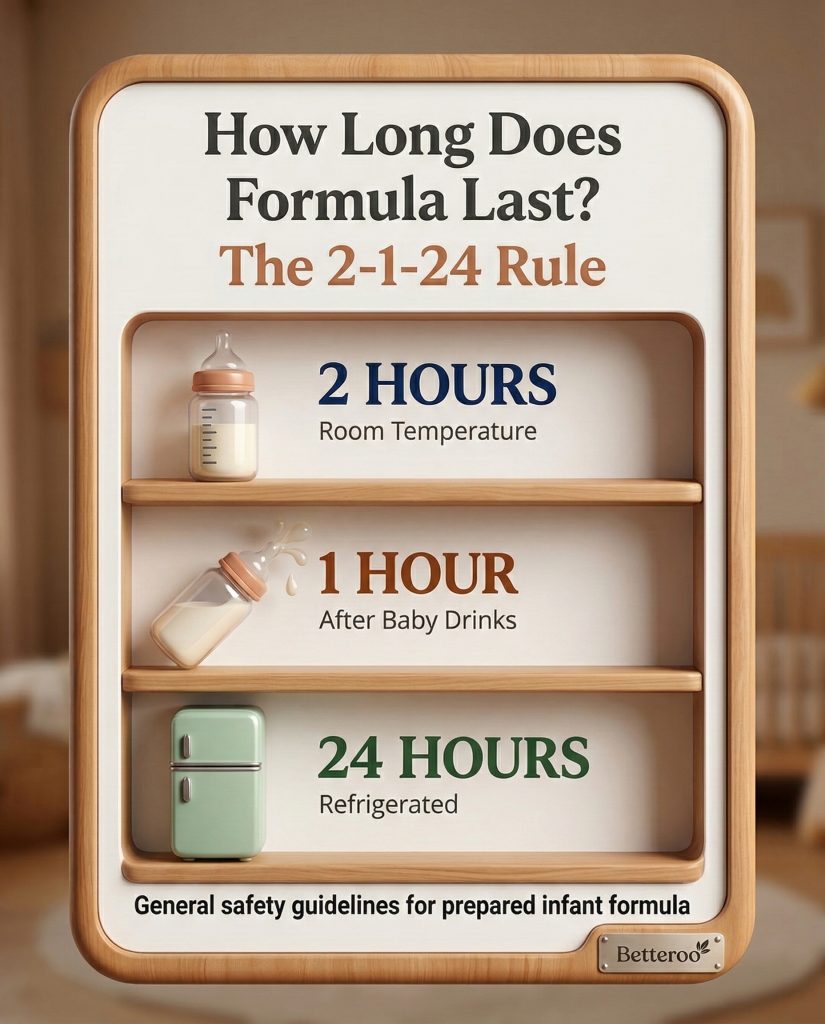
Prepared formula is safe for 2 hours at room temperature, 24 hours refrigerated, and 1 hour once a feeding has started. Those are the key windows, and once you know them, most of the day-to-day guesswork goes away.
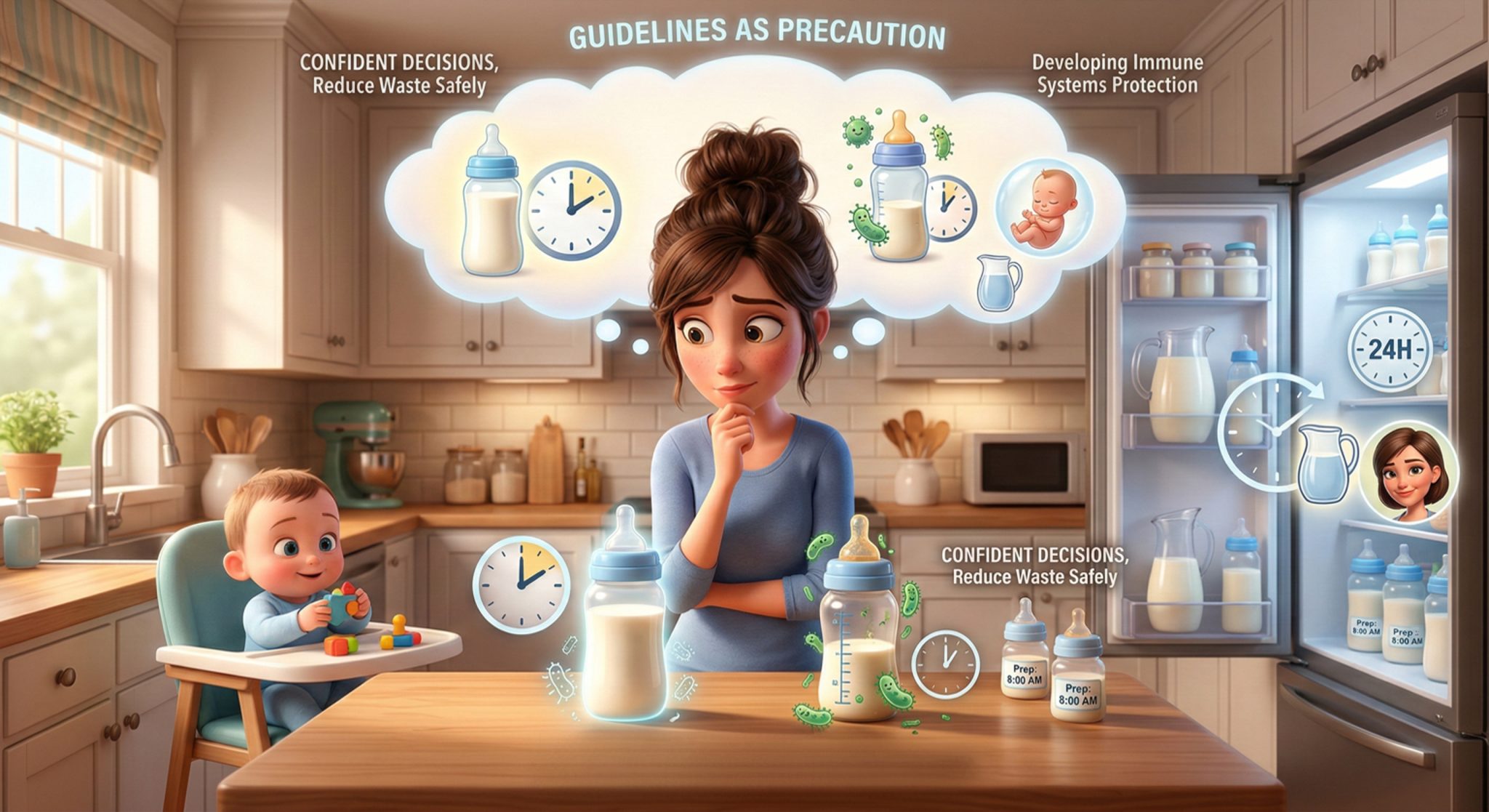
The reason the timelines differ comes down to bacteria. A sealed bottle in the fridge is a different environment than one your baby has been drinking from, and the safety windows reflect that. Understanding why each rule exists makes it easier to make confident decisions without second-guessing yourself.
Below is a clear breakdown of what matters, why it matters, and how to make practical decisions without overcorrecting.
Table of Contents
The Quick Safety Overview
Most pediatric and public health guidance aligns around the following timeframes:
- Prepared formula at room temperature (unused): up to 2 hours
- After a baby has started drinking from the bottle: use within 1 hour
- Prepared formula stored in the refrigerator (unused): up to 24 hours
- Opened powdered formula (dry): typically use within 30 days
- Unopened formula: safe until the expiration date on the container
If you cannot confidently track when a bottle was prepared or how long it has been sitting out, it is safest to discard it. These timeframes are consistent with guidelines from the CDC and FDA for safe preparation and storage of infant formula ¹ ².
These rules are not about perfection. They are about reducing predictable bacterial growth in a controllable way.
How Long Can Prepared Formula Sit Out?
Once powdered or concentrated formula is mixed with water, it should not sit at room temperature for more than two hours if it has not been used. After two hours, bacterial growth becomes more likely.
If your baby has already fed from the bottle, the timeframe shortens to one hour. That change often causes confusion. The reason is simple: bacteria from your baby’s mouth enter the bottle during feeding. That introduction is normal and unavoidable, but it changes the microbial environment inside the bottle.
The CDC specifically notes that the combination of infant formula and a baby’s saliva can cause bacteria to grow, which is why any formula remaining after a feeding should be discarded ¹.
Refrigeration slows bacterial growth but does not undo contamination after feeding. That is why the one-hour guideline remains consistent across pediatric recommendations.
If you are managing night feeds or partial bottles, offering smaller amounts and refilling as needed can reduce waste without bending safety guidance.
How Long Does Prepared Formula Last in the Fridge?
Prepared formula that has not yet been used can be stored in the refrigerator for up to 24 hours.
Temperature stability matters. Store bottles toward the back of the refrigerator rather than in the door, where temperature fluctuates. Keep containers sealed and labeled with the preparation time if possible.
If your baby has already started drinking from the bottle, refrigeration does not extend its safety beyond one hour from the start of feeding.
Can You Reuse Prepared Formula?
The answer depends on whether feeding has begun.
If a bottle was prepared but your baby did not drink from it, it may be refrigerated and used within 24 hours of preparation.
If your baby has already fed from the bottle, it should be discarded after one hour. This guideline applies even if the bottle was returned to the refrigerator.
Parents often ask this question because formula is expensive and waste feels frustrating. That concern is understandable. The safest approach is adjusting portion size rather than stretching timelines.
How Long Does Powdered Formula Last?
Unopened powdered formula remains safe until the expiration date printed on the container, assuming it has been stored properly.
Once opened, most manufacturers recommend using powdered formula within 30 days. The container should be kept tightly sealed in a cool, dry place. Refrigeration of dry powder is not recommended, as moisture exposure can affect quality.
Ready-to-feed and liquid concentrate formulas follow similar principles:
- Unopened: safe until the printed expiration date
- Opened but unused: refrigerate immediately and use within 48 hours (check your specific label)
- After feeding begins: use within one hour
Always defer to the instructions on your specific formula brand if they differ slightly.
Powdered infant formula is not sterile and may contain bacteria such as Cronobacter, which can cause serious infections in young infants. The CDC recommends extra precautions for babies under 2 months, those born prematurely, or those with weakened immune systems ⁴.
How to Tell If Formula Has Gone Bad
Formula does not always show obvious signs of spoilage, which is why timing matters more than visual inspection. Still, discard formula if you notice:
- A sour or unusual smell
- Significant color changes
- Clumping that does not dissolve with shaking
- Unusual separation
If your baby refuses a bottle they would normally accept, that can also be a cue to reassess freshness.
When timing is uncertain, making a new bottle is the safer choice.
Why Formula Has Strict Time Limits
Unlike breast milk, formula does not contain natural antibodies that help suppress bacterial growth. Breast milk contains secretory IgA and other immune-active proteins that actively protect against pathogens in the infant’s gut ³. Formula, once mixed, lacks these protective factors – making proper storage and timing especially important. Once mixed with water, it provides carbohydrates, protein, and moisture – conditions that support microbial multiplication if bacteria are introduced.
The time limits are conservative and designed for population-level safety. They do not imply that formula instantly becomes harmful at the exact two-hour mark, but they reflect predictable growth patterns under typical room temperatures.
Understanding this distinction can help parents follow guidance without feeling that minor deviations automatically result in harm.
Reducing Waste Without Compromising Safety
Practical adjustments can make a difference:
- Prepare smaller bottles and increase volume only if your baby finishes consistently
- Use a pitcher method to batch-mix formula for the day and refrigerate immediately, using within 24 hours
- Label preparation times during busy stretches
- Prepare night bottles in advance and store refrigerated to limit room-temperature exposure
These strategies support safety while acknowledging real-world feeding rhythms. The FDA also recommends throwing away any formula remaining after a feeding, as bacteria from a baby’s saliva can multiply even in refrigerated leftover formula ².
When to Check With Your Pediatrician
If your baby develops vomiting, diarrhea, unusual lethargy, or persistent fussiness after a feeding and you are concerned about formula freshness, contacting your pediatrician is appropriate.
Premature infants or babies with underlying health conditions may require stricter preparation practices, and your pediatrician can provide individualized guidance.
Most healthy, full-term infants tolerate routine feeding variation without issue when general storage guidelines are followed.
FAQs
How long does formula last before it goes bad if it’s left out overnight?
If prepared formula has been left at room temperature for more than two hours — or more than one hour after your baby began drinking — it should be discarded. Overnight room-temperature storage increases bacterial growth risk. Even if the bottle looks or smells normal, timing rather than appearance determines safety. If overnight feeds are common in your household, preparing refrigerated bottles in advance can reduce uncertainty.
Can you reuse prepared formula if your baby only took a few sips?
Once your baby has started drinking, the one-hour guideline applies regardless of how much was consumed. Bacteria are introduced early in the feeding process, not only after finishing the bottle. Offering smaller initial volumes and refilling as needed is the most reliable way to reduce waste without extending timelines.
Does formula spoil faster in warm weather?
Yes. Higher ambient temperatures can accelerate bacterial growth. The standard two-hour rule assumes typical room temperature conditions. In hotter environments, particularly above 90°F (32°C), formula should generally not be left out for more than one hour. Using insulated coolers with ice packs during travel can help maintain safe temperatures.
How long does formula last in the fridge after mixing?
Prepared formula that has not been used can be refrigerated for up to 24 hours. After feeding has begun, refrigeration does not extend its safety beyond one hour from the start of feeding. Labeling bottles with preparation times can prevent confusion during busy periods.
What happens if a baby drinks formula that has gone bad?
Symptoms may include vomiting, diarrhea, abdominal discomfort, or increased fussiness. Most healthy infants recover quickly from mild gastrointestinal upset, but persistent symptoms, signs of dehydration, or unusual lethargy warrant medical attention. If you suspect your baby consumed spoiled formula and symptoms develop, contacting your pediatrician is appropriate.
Are these formula storage guidelines different for premature babies?
For premature infants or babies with compromised immune systems, stricter preparation protocols may be recommended, including careful sterilization and minimizing storage time. Always follow your pediatrician’s guidance in those situations. For healthy, full-term infants, standard storage guidelines are generally sufficient.
The WHO recommends reconstituting powdered formula with water heated to at least 70°C (158°F) for high-risk infants to reduce the risk of Cronobacter contamination ⁵.
5 Sources
- Centers for Disease Control and Prevention. (2024). Infant Formula Preparation and Storage. https://www.cdc.gov/infant-toddler-nutrition/formula-feeding/preparation-and-storage.html
- U.S. Food and Drug Administration. Handling Infant Formula Safely: What You Need to Know. https://www.fda.gov/food/buy-store-serve-safe-food/handling-infant-formula-safely-what-you-need-know
- American Academy of Pediatrics. Breastfeeding Benefits Your Baby’s Immune System. HealthyChildren.org. https://www.healthychildren.org/English/ages-stages/baby/breastfeeding/Pages/Breastfeeding-Benefits-Your-Babys-Immune-System.aspx
- Centers for Disease Control and Prevention. (2025). Preventing Cronobacter in Infants. https://www.cdc.gov/cronobacter/prevention/index.html
- World Health Organization & Food and Agriculture Organization. (2007). Safe Preparation, Storage and Handling of Powdered Infant Formula: Guidelines. https://www.who.int/publications/i/item/9789241595414