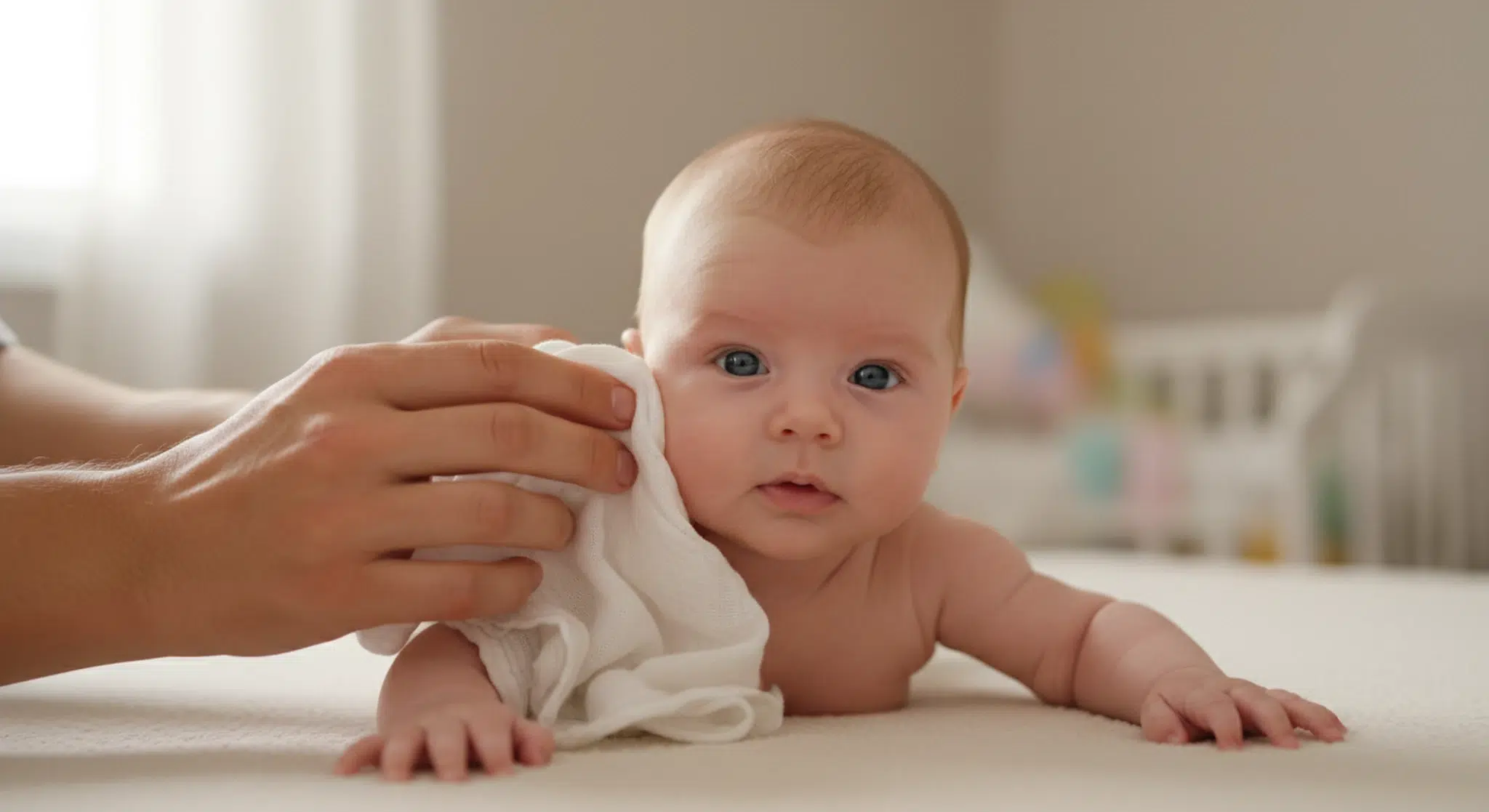


Dab a little breast milk on it. It is the most repeated piece of newborn skincare advice there is, and almost nobody explains what it is actually based on.
Here is the short version, before the long one. Breast milk contains real antimicrobial and anti-inflammatory components, so using it on baby acne is not superstition. But there is no clinical trial supporting it for this rash, and neonatal acne clears by itself in nearly every baby within a few weeks to a few months. That combination means the remedy will almost always look like it worked.
There is also one specific reason to be careful with it, which almost no article mentions, and it has to do with what actually causes most baby acne. This guide covers what the rash is, what the evidence says about breast milk, when to skip it, what dermatologists recommend instead, and how to tell baby acne apart from the rashes that get mistaken for it.
Key Takeaways
- Baby acne affects around one in five newborns, usually appears at 2 to 6 weeks, and clears on its own by about 3 months.
- No controlled trial has tested breast milk for baby acne. The evidence people cite comes from studies on eczema, nipple pain, and cord care.
- Many cases are driven by Malassezia yeast, which feeds on fats and oils, so leaving oily or fatty products on the skin can make it worse.
- Dabbing a small amount of fresh breast milk on and patting it dry is unlikely to harm, but do not leave it on and do not combine it with oils.
- Plain warm water once a day, no lotions or oils, no squeezing, and keeping milk and drool off the face is what dermatologists actually advise.
- Call your pediatrician if the rash appears after 6 weeks, persists past 3 months, blisters or crusts, or comes with fever.
Table of Contents
What Baby Acne Actually Is
Baby acne, which clinicians usually call neonatal acne or neonatal cephalic pustulosis, is a rash of small red or white bumps that shows up on a newborn’s cheeks, nose, forehead, and sometimes the chin, scalp, neck, and upper chest. It typically appears somewhere between two and six weeks of age, affects roughly one in five newborns, and then fades on its own.
Two things drive it. The first is hormonal: maternal hormones cross the placenta late in pregnancy and briefly stimulate a newborn’s oil glands. The second, which is the part most parents have never heard, is a yeast that lives normally on skin. Researchers have repeatedly found Malassezia species on the skin of babies with this rash, and the current view is that many cases are an inflammatory reaction to that yeast rather than true acne at all. That detail matters a great deal for the breast milk question, and we will come back to it.
Quick Answer
Where the Breast Milk Remedy Comes From
The advice is everywhere, it is passed between parents constantly, and it is not pulled out of thin air. Breast milk is a genuinely bioactive fluid. It contains secretory IgA, lactoferrin, lysozyme, and a range of fatty acids including lauric acid, which has documented antimicrobial activity in a laboratory setting. It also contains growth factors involved in skin repair. On paper, that is a plausible-sounding topical treatment.
There is also a small amount of real research on breast milk applied to skin, which is probably the origin of the idea. Studies have looked at topical breast milk for sore nipples, for umbilical cord separation, for diaper rash, and, in a frequently cited small trial, for infant eczema, where breast milk performed comparably to a low-strength hydrocortisone ointment. Those are real findings. They are also all about different conditions on different skin, in small studies, with mixed quality.
What does not exist is a controlled trial of breast milk for neonatal acne. Not a weak one, not a small one. The recommendation travels on plausibility and on the fact that the rash goes away, which it was always going to do.
Why It Looks Like It Works
Neonatal acne is self-limiting. The overwhelming majority of cases clear within one to three months without any treatment at all, as the maternal hormones wash out of the baby’s system and the skin barrier matures. That is a textbook setup for any remedy to look effective.
- The rash peaks and then declines on its own schedule. Most parents start trying remedies at the peak, which is precisely when the rash was about to improve anyway.
- It waxes and wanes day to day. Heat, crying, saliva, spit-up, and fabric friction all make it look worse for a few hours. A good day after a bad one reads as progress.
- You are almost certainly also washing the face more. Gentle cleansing with water removes the milk, saliva, and residue that irritate the rash, and that alone helps.
- Nobody writes about the times it did not work. The remedy gets credit when the rash clears and gets quietly dropped when it does not.
None of this means the parents who swear by it are being foolish. It means the evidence cannot tell the difference between breast milk working and time passing, and when a condition resolves on its own in almost every baby, time passing is the more economical explanation.
Apps can show you the data. A plan tells you what to do with it.
Our free two-minute quiz builds a gentle, personalized sleep plan for your child’s age and temperament.
The One Real Reason to Be Cautious
If a meaningful share of baby acne is an inflammatory response to Malassezia yeast, then the treatment logic flips. Malassezia is lipid-dependent: it feeds on fats and oils. That is why dermatologists tell parents not to put oils, ointments, petroleum jelly, or rich lotions on a newborn’s face when this rash is present, and why oil-based products sometimes make it visibly worse.
Breast milk is not an oil, but it does contain fat, and it leaves a film that traps moisture against the skin if you let it dry there and leave it. That is the plausible downside. It is not dangerous, and it is not a reason for alarm if you have already tried it, but it is a reason not to treat it as a daily routine and not to leave milk sitting on the skin.
- Do not use it on broken or weeping skin. If the skin is cracked, oozing, crusted yellow, or blistered, that is not baby acne and it needs a doctor, not a home remedy.
- Do not leave it on. If you try it, dab a small amount with a clean finger or soft cloth, leave it a few minutes, then pat the face dry.
- Do not combine it with oils. Coconut oil, olive oil, and breast milk together is the combination most likely to feed a yeast-driven rash.
- Do not use expressed milk that has been sitting out. Room-temperature milk grows bacteria. Fresh or properly refrigerated only.
- Stop if it worsens. Two or three days of visible worsening is your answer.
What Dermatologists Recommend Instead
The published guidance from the American Academy of Dermatology and the American Academy of Pediatrics is short, unglamorous, and effective, which is probably why it loses to home remedies online.
- Wash the face once a day with plain warm water. A soft cloth, no scrubbing. A mild fragrance-free baby cleanser a few times a week is fine if the skin is also greasy.
- Pat dry. Do not rub. Friction is a genuine aggravator on newborn cheeks.
- Skip lotions, oils, and ointments on the affected area. Including the ones marketed for babies.
- Never use acne products meant for teens or adults. Benzoyl peroxide, salicylic acid, and retinoids are not appropriate for newborn skin and can cause chemical burns.
- Do not squeeze or pick. It causes scarring in a condition that otherwise scars almost never.
- Keep milk, spit-up, and drool off the face. Wipe gently after feeds. This is the single highest-yield habit.
- Wash anything that touches the face. Muslins, crib sheets, your shoulder. Fragrance-free detergent.
If the rash is persistent and clearly yeast-driven, a pediatrician can prescribe a topical antifungal such as ketoconazole cream, which resolves it quickly. That is a prescription decision, not a home one, and most babies never need it.
Is It Baby Acne, Or Something Else?
A surprising number of newborn face rashes get called baby acne when they are something else, and the something else sometimes changes what you should do. Here is how the common ones differ.
| Rash | What it looks like | Timing | What helps |
|---|---|---|---|
| Neonatal acne | Red bumps and small pustules on cheeks, nose, forehead | 2 to 6 weeks, clears by 3 months | Water, patience, no oils |
| Milia | Tiny firm white pearls, no redness | From birth, gone in weeks | Nothing, do not squeeze |
| Erythema toxicum | Blotchy red patches with a pale center, moves around the body | First few days of life | Nothing, resolves in a week |
| Baby eczema | Dry, rough, scaly, itchy patches on cheeks and joints | Usually after 2 to 3 months | Fragrance-free moisturizer, doctor input |
| Heat rash | Tiny clear or red bumps in skin folds and covered areas | Any time, after overheating | Cool down, lighter layers |
| Cradle cap | Greasy yellow scale on scalp, can spread to face | 2 weeks to a few months | Gentle washing, soft brush |
| Infantile acne | True acne with blackheads, after 6 weeks, can last months | 6 weeks to 1 year | See a doctor, may need treatment |
The distinction between eczema and acne matters most, because the treatments are opposite. Acne skin does better left dry and bare. Eczema skin needs moisturizer. If the patches are dry and rough rather than bumpy and red, you are probably in eczema territory, and that is worth a conversation with your pediatrician.
When to Call the Pediatrician
Baby acne is benign, and the vast majority of cases need nothing more than time. Call your pediatrician if any of the following are true.
- The rash is still there, or is worsening, after three months of age, or appears for the first time after six weeks. True infantile acne can last a year and is sometimes treated.
- There are open sores, crusting, yellow discharge, or blisters, which suggest infection rather than acne.
- Your baby has a fever, is feeding poorly, or seems unwell in any way alongside the rash.
- The rash spreads rapidly across the body or involves the eyes or mouth.
- You are not sure whether it is acne or eczema, and the skin looks dry and irritated rather than bumpy.
- Deep bumps or cysts develop, which can scar and should be assessed.
One reassurance worth holding onto: baby acne says nothing about whether your child will have acne as a teenager, nothing about your diet if you are breastfeeding, and nothing about your skincare. It is a normal newborn phase with a very high spontaneous cure rate.
Related Betteroo Guides
- Baby acne: what it is and how long it lasts
- Diaper rash vs yeast infection
- Baby congestion: causes and relief
- Newborn hiccups and when to worry
Living With It While It Lasts
The hardest part of baby acne is almost never medical. It is that it peaks right around the newborn photo session, right when relatives start visiting, and right when you are already running on no sleep and second-guessing everything. It is worth saying plainly: the rash does not hurt your baby, does not itch, and will not be visible in three months.
Photograph your baby anyway. Newborn skin in the first two months is a moving target, and the version of your baby you have now is worth having pictures of. If you want the rash less visible, shoot in soft indirect light rather than hard flash, which flattens redness.
And if your nights are rough on top of everything else, that is not separate from the skin question. Overtired babies cry more, sweat more, and rub their faces more, which does not cause the rash but does aggravate it. Sorting out sleep, at whatever pace works for your family, tends to make the whole picture calmer.
Frequently Asked Questions
Does breast milk get rid of baby acne?
There is no clinical trial showing that it does. Breast milk contains antimicrobial and anti-inflammatory components, and small studies support topical breast milk for other conditions such as infant eczema and nipple soreness, but none have tested it on neonatal acne. Baby acne clears on its own in nearly every baby within a few weeks to a few months, so any remedy applied during that window tends to get the credit.
How long should I leave breast milk on baby acne?
If you try it, a few minutes is plenty, and then pat the face dry with a soft cloth. Do not leave milk sitting on the skin to dry and stay there. Many cases of baby acne involve Malassezia yeast, which feeds on fats, so a fatty film left on the face is the one plausible way this remedy could backfire.
What is the fastest way to clear baby acne?
There is no fast fix, and that is genuinely the honest answer. Wash the face once a day with plain warm water, pat dry rather than rub, keep milk and spit-up wiped off, skip all oils and lotions on the affected skin, and do not squeeze anything. If the rash is stubborn and yeast-driven, a pediatrician can prescribe a topical antifungal, which works quickly.
Can breast milk make baby acne worse?
It can, in one specific way. Breast milk contains fat, and if it is left on the skin it leaves a film that traps moisture and provides lipids that Malassezia yeast can use. That is the same reason dermatologists advise against oils and ointments on a newborn’s face during this rash. If you notice the rash worsening over two or three days of trying it, stop.
Is baby acne caused by something in my diet?
No. Neonatal acne is driven by maternal hormones that crossed the placenta before birth, plus a common skin yeast, and neither is affected by what you eat while breastfeeding. It also says nothing about whether your child will have acne as a teenager. Cutting foods out of your own diet will not change it and is not recommended.
Calmer bedtimes, better nights.
Betteroo builds a personalized sleep plan for your child. Take the free two-minute quiz to get started tonight.
5 Sources
- American Academy of Dermatology. How to treat baby acne.
https://www.aad.org/public/diseases/acne/really-acne/baby-acne - American Academy of Pediatrics, HealthyChildren.org. Your newborn’s skin: birthmarks and rashes.
https://www.healthychildren.org/English/ages-stages/baby/bathing-skin-care/Pages/Your-Newborns-Skin-Birthmarks-and-Rashes.aspx - StatPearls, National Library of Medicine. Neonatal acne.
https://www.ncbi.nlm.nih.gov/books/NBK576386/ - MedlinePlus, National Library of Medicine. Baby acne.
https://medlineplus.gov/ency/article/001453.htm - Seattle Children’s Hospital. Newborn rashes and birthmarks.
https://www.seattlechildrens.org/conditions/a-z/newborn-rashes-and-birthmarks/