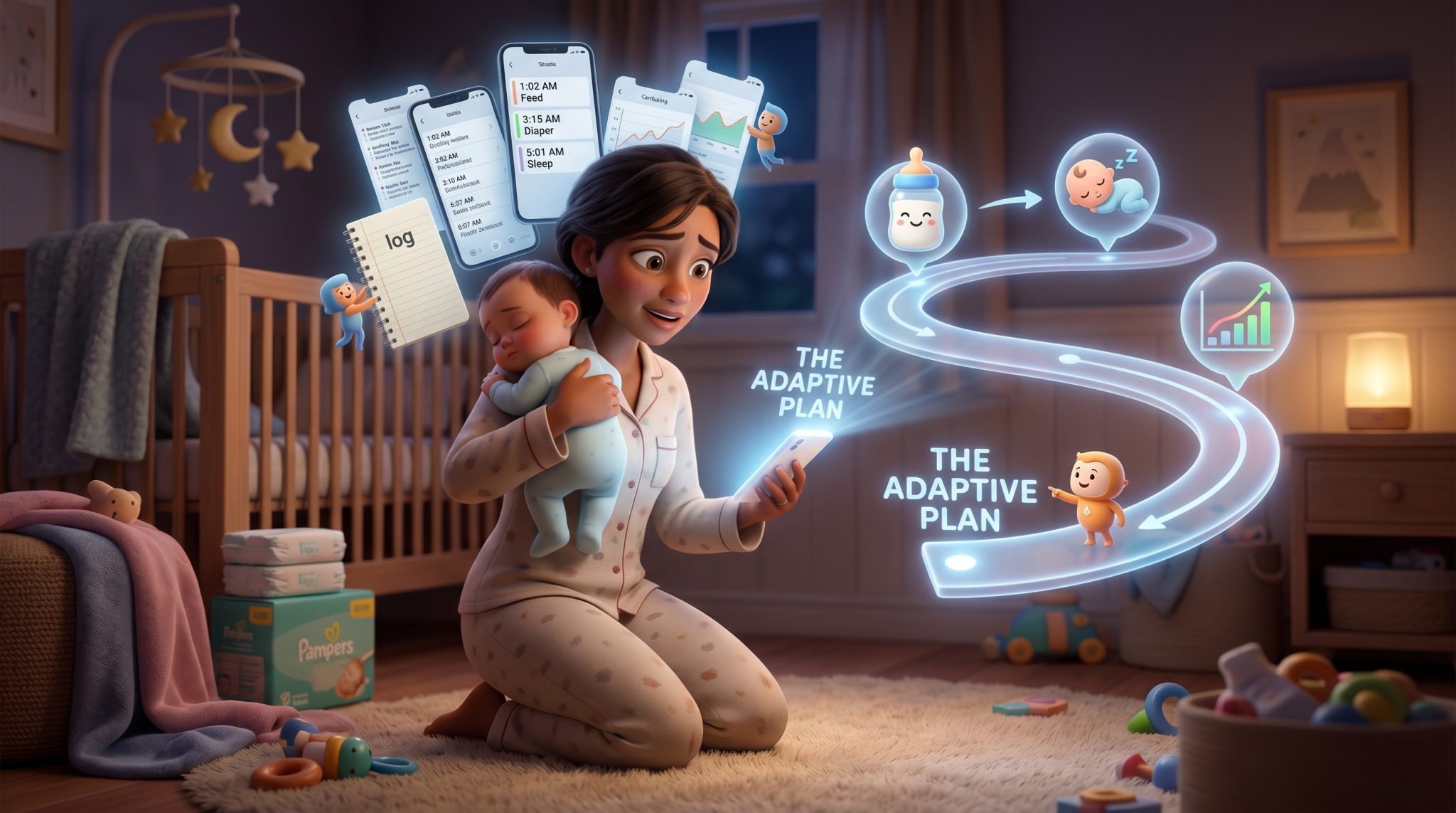
The best feeding tracker apps in 2026 do not all do the same thing: some just log feeds, some predict the next one, and a few go further and turn feeding data into a plan you can actually act on.
If you have spent a 3am feed scrolling the app store, you already know the problem. Every feeding tracker promises to “make logging easy,” but easy logging is not the same as a calmer day. Some apps are fast loggers and nothing more. Some bolt feeding onto a sleep tool. The one that helps most is the one that reduces what you have to carry, not just what you have to type.
We compared the feeding trackers parents actually use in 2026, checked current pricing and platforms against each product’s own listings, and ranked them by who they genuinely fit, not by who markets the loudest.
Key Takeaways
Feeding trackers fall into three groups: fast manual loggers, sleep apps with feeding built in, and tools that turn feeding data into an adaptive plan.
Betteroo is best for parents who want feeding logging plus a plan that adapts. Huckleberry is best for sleep prediction. Baby Daybook is best for a detailed shared log. Nara Baby is best for a genuinely free option.
There is no single best feeding tracker for every family. It depends on whether you want data, predictions, or guidance.
The right app should lighten your mental load. If logging feeds is adding stress instead of removing it, the tool is working against you.
Table of Contents
The Short Version: Best Feeding Tracker App Picks
Best for tracking plus a plan that adapts:Betteroo
Best for hands-free logging: Betteroo (free voice tracking in every plan)
Best for sleep prediction alongside feeds: Huckleberry
Best for a detailed shared daily log: Baby Daybook
Best free feeding tracker: Nara Baby
Best for growth charts and insights: Glow Baby
Best simple no-frills logger: Baby Tracker by Nighp
How We Evaluated Feeding Tracker Apps
Ease of logging. A feeding tracker you have to fight at 3am is a feeding tracker you abandon by week three. We looked at how fast a single feed gets logged, and whether the app offers anything faster than tapping through forms.
Pricing transparency. We verified every price and tier against each product’s own site or app store listing. Free tiers that quietly cap your history are noted as such.
What it does with the data. Some apps just store feeds. Some predict the next one. A few turn feeding patterns into something you can act on. We weighted apps that reduce decisions, not just record them.
Caregiver sharing. Feeds are rarely logged by one person. We checked whether partners and caregivers can sync to the same baby profile without paying twice.
Honesty about limits. We noted where each app stops, because feeding data on its own does not solve a feeding or sleep problem. Interpretation does.
We also looked at several ad-supported free trackers and left them out, because an app interrupting you mid-feed with a banner is not one we can recommend.
What to Look for in the Best Feeding Tracker App
Speed over completeness. A tracker with twenty fields you never fill in is slower than one with the four that matter. The best feeding tracker app captures a feed in seconds, because consistency beats detail when you are exhausted.
A hands-free option. Tapping through a form one-handed while holding a baby is the part parents quietly hate. Voice logging, where you log a feed just by talking, removes that friction entirely, and it is still rare enough to be a real differentiator.
Patterns, not just entries. Logging is the input. What you want back is the picture: cluster feeds, the stretch between feeds, how feeding ties into naps. An app that surfaces patterns saves you from doing the math at 4am.
If feeding and sleep feel tangled together, that is normal at this stage, and a feeding log alone will not untangle it. Our guide to baby feeding and sleep schedules walks through how the two connect.
What Most Feeding Trackers Miss: You
Almost every feeding tracker treats the parent as the operator: the person who feeds the data in. The app records, charts, and hands the numbers back, and the work of figuring out what the numbers mean stays entirely on you.
That gap matters more than it sounds. Newborn feeding patterns vary widely between families1, so a chart of your baby’s feeds does not come with a built-in answer. You are still left asking whether a short stretch is cluster feeding or a problem, whether to wake for a feed, whether today was actually fine. The tool logged everything and decided nothing.
The feeding trackers worth your time are the ones that account for the parent holding the phone: how depleted you are, how much capacity you have today, and how much interpretation you can realistically do on no sleep. A log is not support. Support is something doing part of the thinking with you.
Best Feeding Tracker Apps for Babies, Compared
Feeding Tracker Apps in 2026: Feature Comparison
App
Best For
Pricing
Platforms
Feed, diaper and sleep logging
Voice tracking, log by talking
Feeding and sleep predictions
Personalized plan that adapts
Expert support
Betteroo
Tracking plus a plan that adapts
Free 3-minute quiz, then plans start at $1/day
Web, iOS, Android
Yes
Yes, free in all plans
Yes
Yes
Yes
Huckleberry
Sleep prediction alongside feeds
Free tier, Plus $11.99/mo or $68.88/yr, Premium $14.99/mo
iOS, Android
Yes
No
Yes, on paid tiers
Partial, paid sleep plans
No
Baby Daybook
Detailed shared daily log
Free tier, Premium $4.99/mo or $34.99 lifetime
iOS, Android
Yes
No
Partial, paid sleep predictions
No
No
Nara Baby
A genuinely free tracker
Free, ad-free, no premium tier
iOS, Android
Yes
No
No
No
No
Glow Baby
Growth charts and insights
Free tier, Premium around $59.99/yr or $79.99 lifetime
Full transparency: Betteroo is our product, so we’ve included it here for comparison but encourage you to evaluate it alongside the other options.
Betteroo is a full tracker. It logs feeds, diapers and sleep, and it surfaces feeding and sleep predictions the same way the other apps on this list do. The difference is what sits on top: a personalized plan, built from a free 3-minute quiz about your baby and about you, that adapts as your baby grows and as regressions, teething, illness and travel blow up the routine. You are not stitching together a logger, a separate plan, and a consultant. It is one tool.
Betteroo also includes voice tracking, free in every package and every plan. Instead of tapping through a form one-handed, you can log a full day just by talking, which is the part of manual tracking parents most often quietly give up on. Every other app in this roundup is tap-to-log only, so this is a genuine point of difference. When a pattern needs a real answer, expert-backed support is there too, rather than leaving you alone with a chart.
Where it falls short: Betteroo is a subscription, so it is not the pick if you want something completely free, and its center of gravity is the first couple of years of feeding and sleep rather than long-term milestone scrapbooking. If you only want a bare feed log with nothing layered on top, a free tracker will feel lighter.
Best for: parents who want feeds tracked and also want a plan that interprets the data and adapts as the baby grows, with expert support on hand.
What to know: it is a paid subscription rather than a free logger, and it is built around the feeding and sleep years, not long-term milestone tracking.
Tired of logging feeds and still not knowing what they mean?
Betteroo turns your baby’s feeding and sleep patterns into a personalized plan that adapts as they grow, and you can log it all just by talking.
Free tier · Plus $11.99/mo or $68.88/yr · Premium $14.99/mo
✓ Feed, diaper and sleep logging
✗ Voice tracking, log by talking
! Feeding and sleep predictions (SweetSpot on paid tiers)
! Personalized plan that adapts (paid sleep plans)
✗ Expert-backed support
Huckleberry (Sleep-First Tracking)
Huckleberry is a feeding, diaper and sleep tracker that is best known for its sleep side. Its SweetSpot feature predicts nap and bedtime windows, and that is the reason most parents pick it up. Feeding logging is solid and the free tier covers basic feed, sleep and diaper tracking, though it limits how much history you can see.
The catch is that the features parents most want sit behind the paywall. SweetSpot predictions and customized sleep plans are on the Plus and Premium tiers, and at $14.99/mo for Premium it is the most expensive option here. New users get a 14-day Premium trial, so you can see the paid features before committing. If your main question is sleep and you do not mind the price, it earns its reputation. If you mostly want feeding tracking, you are paying for a sleep tool.
Best for: parents whose main concern is sleep timing and who want feeding logged alongside nap and bedtime predictions.
What to know: the most useful features are paid, Premium is the priciest option in this roundup, and there is no hands-free voice logging.
Baby Daybook
Best for a detailed shared daily log
Free tier · Premium $4.99/mo or $34.99 lifetime
✓ Feed, diaper and sleep logging
✗ Voice tracking, log by talking
! Feeding and sleep predictions (predictions on Premium)
✗ Personalized plan that adapts
✗ Expert-backed support
Baby Daybook (Detailed Logging)
Baby Daybook is for the parent who wants the full picture written down. It logs breast and bottle feeds, solids, pumping, diapers and sleep in detail, and caregivers connected to a shared baby profile get the same Premium features without paying again, which is a fair approach to family use.
Premium adds sleep predictions, charts, growth tracking and exportable logs, and at $4.99/mo, or $34.99 once for lifetime, it is one of the better-value paid trackers. There is a 7-day trial. What it does not do is interpret the data for you. It is a very good logbook, but it is still a logbook, and the thinking stays on you.
Best for: parents who want a thorough, shareable daily record and like having charts and exports to bring to pediatrician visits.
What to know: it records and charts well but does not turn the data into guidance, and there is no voice logging.
Nara Baby
Best free feeding tracker
Free · ad-free, no premium tier
✓ Feed, diaper and sleep logging
✗ Voice tracking, log by talking
✗ Feeding and sleep predictions
✗ Personalized plan that adapts
✗ Expert-backed support
Nara Baby (Free and Simple)
Nara Baby is the pick when you want a clean feeding tracker and nothing else to think about. It covers feedings, naps, diapers and pumping, syncs across caregivers, and it is free and ad-free, which is genuinely rare. There is no premium tier nudging you to upgrade.
The trade-off is that it stays a logger. No predictions, no plan, no interpretation. For many parents in the early weeks that is exactly enough, and there is something to be said for a tool that does one job without asking for a card number. If you later want the data to do more, you would move to a different app.
Best for: parents who want a free, ad-free, no-pressure way to log feeds and diapers and share with a partner.
What to know: it logs and shares but does not predict, plan or interpret, so the analysis is all yours.
Glow Baby
Best for growth charts and insights
Free tier · Premium around $59.99/yr or $79.99 lifetime
✓ Feed, diaper and sleep logging
✗ Voice tracking, log by talking
! Feeding and sleep predictions (forecasts on Premium)
✗ Personalized plan that adapts
✗ Expert-backed support
Glow Baby (Charts and Forecasts)
Glow Baby logs feeding, diapers, sleep, growth and milestones, and the free version is usable on its own. It leans toward the data-curious parent who likes seeing charts and trends laid out clearly.
Premium, at around $59.99/yr or $79.99 for lifetime, unlocks comparative insights, personalized charts and forecasts for the next feed or nap. It is a capable tracker with good visualizations. As with the others here, though, the forecasts are predictions, not a plan, and it does not adjust to your specific situation or check in on how you are doing.
Best for: parents who like detailed charts, trends and growth tracking and want forecasts layered on top.
What to know: the better insights are paid, and it forecasts patterns rather than giving you a plan that adapts.
Baby Tracker by Nighp
Best simple no-frills logger
Free · free to download
✓ Feed, diaper and sleep logging
✗ Voice tracking, log by talking
✗ Feeding and sleep predictions
✗ Personalized plan that adapts
✗ Expert-backed support
Baby Tracker by Nighp (No-Frills Logging)
Baby Tracker by Nighp is a long-running, well-liked free logger. It handles feeding, sleep, diapers, pumping and growth charts with breastfeeding and sleep timers, and a recent version 5 redesign refreshed the interface. It is straightforward and free to download.
It is squarely a tracker. There are no predictions and no guidance, and it sticks to recording what happened. For parents who just want a dependable, no-cost log and nothing more, it does that job well, but if you want the data interpreted you will outgrow it.
Best for: parents who want a reliable, free, no-frills logger with good timers and charts.
What to know: it records but does not predict, plan or interpret, and there is no voice logging.
So Which Is the Best Feeding Tracker App for Your Family?
There is no single best feeding tracker for every family. It depends on what you are actually trying to solve.
If you want feeds tracked and a plan that adapts:Betteroo. It is the only option here that logs, predicts, and turns the data into guidance that changes as your baby does, with voice logging free in every plan.
If your main worry is sleep timing:Huckleberry. SweetSpot predictions are its strength, as long as the paid price works for you.
If you want a detailed shared logbook:Baby Daybook. Thorough, good value, and fair on caregiver sharing.
If you want free with no upsell:Nara Baby, or Baby Tracker by Nighp if you want timers and charts.
If you love charts and trends:Glow Baby. Strong visualizations, with the best insights on the paid tier.
You May Not Need a Feeding Tracker App If…
Plenty of parents do fine without one. If feeding is going smoothly, your baby is gaining weight, and your pediatrician is not worried, a daily app may just be one more thing to keep up with.
There is also a real cost to over-tracking. If checking the app is making you more anxious rather than less, or you find yourself logging for the app’s sake instead of your own, a notebook or nothing at all may serve you better. Tracking is a tool, not a requirement, and behavioral and feeding routines work best when they fit the family rather than the other way around.
Where a tracker does earn its place is when something feels off and you cannot see the pattern, when two caregivers need to stay in sync, or when you want to bring real data to a pediatrician visit. If none of those apply right now, it is genuinely fine to skip it.
What Matters More Than the Tracker Itself
No feeding tracker feeds the baby. Whatever you pick, the outcomes come from consistency, your own judgment, and support around you, not from the app. A few things worth keeping in front of mind:
Your read on your baby matters more than any chart. The app informs your judgment, it does not replace it.
Consistency beats detail. A few fields logged every time tells you more than every field logged sometimes.
Feeding and sleep are connected, so a feeding question is often partly a schedule question.
If tracking is adding stress, that is a signal to track less, not more.
The best feeding tracker app, in the end, is the one that quietly makes your day lighter. If logging feeds has started to feel like a second job, that is the app telling you it is the wrong fit. For more on how tracking and guidance fit together, our guide on whether sleep and tracking apps actually work is a good next read.
Frequently Asked Questions
What is the best free feeding tracker app?+
Nara Baby is the standout free option, because it is genuinely free and ad-free with no premium tier pushing you to upgrade. Baby Tracker by Nighp is another solid free choice if you want timers and growth charts. Both cover feeding, diapers and sleep, but neither predicts patterns or builds a plan.
Do feeding tracker apps actually help?+
They help most when something feels off and you cannot see the pattern, or when two caregivers need to stay in sync. A tracker gives you a clear record to bring to a pediatrician. What a plain logger does not do is interpret the data, so the thinking still falls to you unless the app layers guidance on top.
Is Huckleberry better than Baby Daybook?+
It depends on what you want. Huckleberry is stronger on sleep, with SweetSpot nap and bedtime predictions, but its useful features are paid and Premium runs $14.99/mo. Baby Daybook is a more detailed logger at a lower price, $4.99/mo or $34.99 lifetime, but it does not predict as much. Pick Huckleberry for sleep timing, Baby Daybook for a thorough shared record.
Can I use more than one feeding tracker app?+
You can, but it usually backfires. Logging the same feeds in two apps doubles the work and splits your data, so neither app sees the full picture. It is better to pick one tool that covers what you need. If you want logging plus a plan, choose something that does both rather than running a logger and a separate guidance app side by side.
When should I start using a feeding tracker?+
Many parents start in the newborn weeks, when feeds are frequent and it is hard to remember which side or how long ago. It is also fine to start later, or not at all, if feeding is going smoothly. There is no wrong time, and there is no rule that you have to track at all.
Are feeding tracker apps worth paying for?+
If you only want to record feeds, a free app like Nara Baby is enough and paying adds little. Paying is worth it when you want more than a log: predictions, a plan that adapts, or expert support. That is the line to weigh. Are you paying for a nicer logbook, or for the app to do part of the thinking with you?
Which feeding tracker is best if I am too exhausted to tap through forms?+
Betteroo includes voice tracking, free in every plan, so you can log a full day just by talking instead of tapping through a form one-handed. The other apps in this roundup are tap-to-log only. If the friction of manual logging is the thing making you give up on tracking, a hands-free option is the feature that matters most.
Final Take: The Right Tracker Should Make Things Lighter, Not Heavier
The best feeding tracker app is not the one with the most fields or the slickest charts. It is the one that reduces what you have to carry. For some families that is a fast, free logger that just remembers which side and when. For others it is a tool that takes the feeding and sleep data and hands back a plan, so the interpreting is not one more thing on an exhausted parent’s list.
There is no universal winner here. Nara Baby and Baby Tracker by Nighp are excellent if free and simple is the goal. Huckleberry, Baby Daybook and Glow Baby each do logging and prediction well. Betteroo is the pick if you want the tracker and the plan and the support in one place, with voice logging free in every plan so the logging itself stops being a chore. The better question is not “which app logs feeds the fastest” but “which app actually reduces what I have to carry”.
Still not sure which feeding tracker fits your family?
Betteroo’s free 3-minute quiz builds a personalized plan based on your baby’s age, temperament, feeding patterns and your real situation, and you can log it all just by talking.
Casiday, R.E., Wright, C.M., Panter-Brick, C., et al. (2004). Do early infant feeding patterns relate to breast-feeding continuation and weight gain? Data from a longitudinal cohort study. European Journal of Clinical Nutrition, 58, 1290-1296.https://pubmed.ncbi.nlm.nih.gov/15054405/