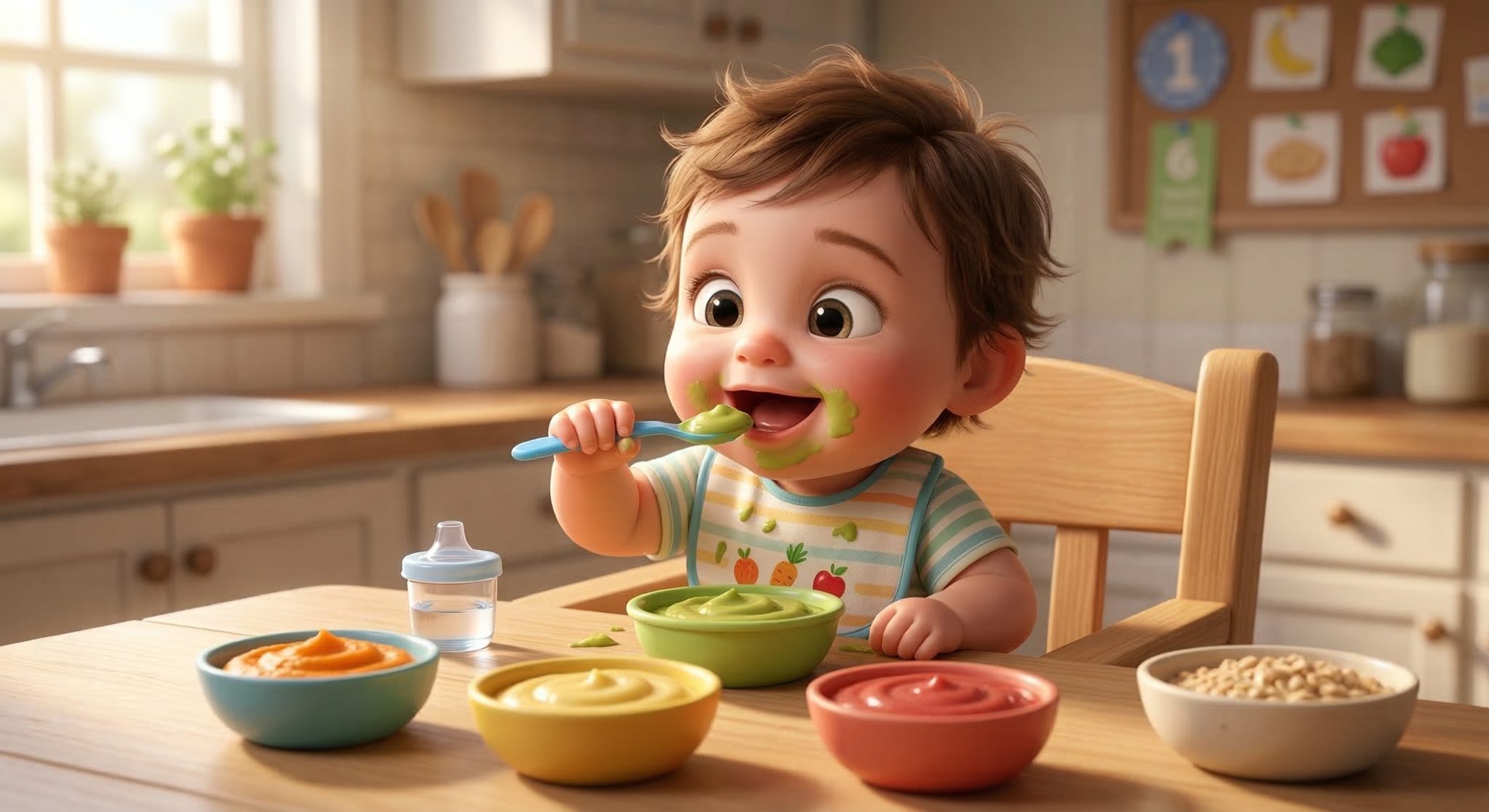


Baby purees are one common way families introduce solid foods. Many babies begin exploring pureed foods around 6 months of age, when they are developmentally ready for solids and can sit with support, hold their head steady, and show interest in food 1,2.
This guide covers everything you need to know about starting purees — which foods to try first, how much to offer, how to progress textures, and what to do if your baby isn’t interested. Whether you plan to use purees exclusively or combine them with baby-led weaning, the readiness signs and nutrition basics are the same.
If you’re comparing approaches, our guide to baby-led weaning walks through the differences and how families often combine them.
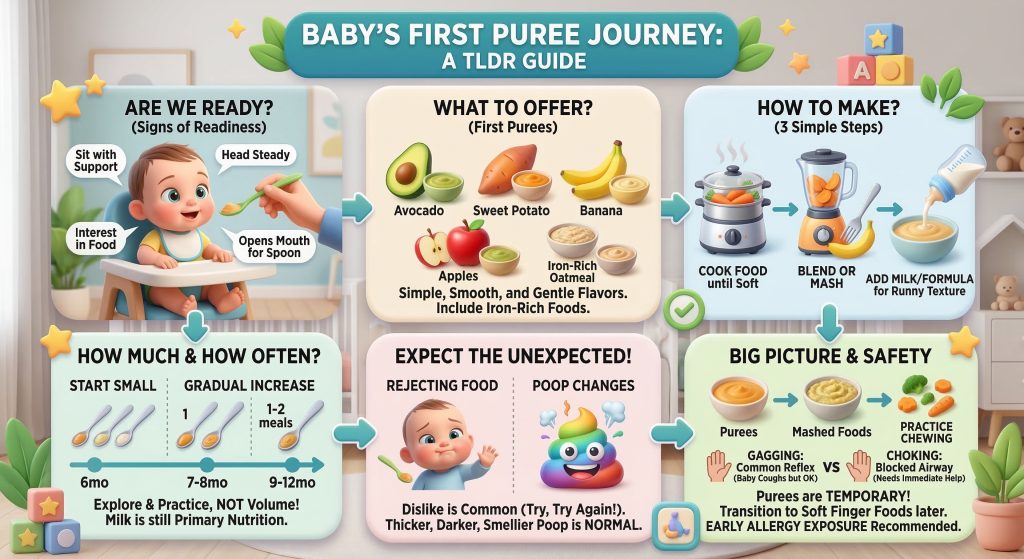
Table of Contents
When Can Babies Start Purees?
According to guidance from the American Academy of Pediatrics, babies are typically ready to begin solids around six months when developmental readiness signs appear rather than strictly based on age alone ¹.
Most babies are ready to begin solids, including purees, around six months of age. At this stage, several developmental changes usually occur that make solid feeding safer and more successful.
Babies are often able to sit upright with support, control their head and neck, and show interest when others are eating. Many will reach for food or open their mouths when offered a spoon.
Before this stage, babies rely entirely on breast milk or infant formula, which provide all the calories and nutrients they need. Introducing solids too early can make feeding more difficult because babies may not yet have the coordination required to swallow safely.
Waiting until signs of readiness appear helps ensure that feeding experiences are positive rather than frustrating.
Signs Your Baby Is Ready for Purees
Rather than focusing on a specific birthday, pediatricians encourage parents to look for developmental readiness signs.
Many babies are ready for purees when they can:
- sit upright with minimal support
- hold their head steady
- show curiosity about food
- open their mouth when food approaches
- swallow food instead of pushing it back out with the tongue.
These skills help babies move food safely from the front of the mouth toward swallowing.
Best First Purees for Babies
There is no single “correct” first food. Many families begin with simple fruits, vegetables, or iron-rich foods that blend smoothly.
Common first purees include:
Avocado
Naturally soft, no cooking needed
Healthy fatsSweet potato
Mild flavor, smooth texture
Vitamin ABanana
Easy to mash, naturally sweet
PotassiumCarrots
Blend smoothly when cooked
Beta-caroteneApples
Familiar taste, gentle on digestion
FiberOatmeal cereal
Blends easily, often iron-fortified
IronPureed lentils
Soft when cooked, mild flavor
Iron + proteinPureed chicken
Blends smooth with liquid added
Iron + zincAvocado
Naturally soft, no cooking needed
Healthy fatsSweet potato
Mild flavor, smooth texture
Vitamin ABanana
Easy to mash, naturally sweet
PotassiumCarrots
Blend smoothly when cooked
Beta-caroteneApples
Familiar taste, gentle on digestion
FiberOatmeal cereal
Blends easily, often iron-fortified
IronPureed lentils
Soft when cooked, mild flavor
Iron + proteinPureed chicken
Blends smooth with liquid added
Iron + zincSwipe to explore
Many pediatric experts encourage including iron-rich foods early, since babies’ natural iron stores begin to decrease around six months ³.
How to Make Baby Purees
Homemade purees are often simpler to prepare than parents expect. Most fruits and vegetables can be softened by steaming, roasting, or boiling before blending.
The basic process usually looks like this:
- Cook the food until soft.
- Blend or mash until smooth.
- Add breast milk, formula, or water if needed to adjust texture.
In the earliest stages, purees are usually very smooth and slightly runny. As babies gain experience with solids, textures can gradually become thicker and more varied.
Store-Bought vs Homemade Baby Purees
Both store-bought and homemade purees can be healthy options. Many families use a combination of both depending on time, convenience, and preference.
Store-bought baby foods are designed to meet safety and nutritional standards and can be especially convenient when traveling or managing busy schedules.
Homemade purees allow parents to prepare foods already in their kitchen and control the ingredients directly.
In practice, the most important factor is simply offering babies a variety of nutritious foods over time, regardless of how they are prepared.
How Much Puree Should a Baby Eat?
One of the most common surprises for parents is how little babies initially eat.
Early solid feeding often begins with just a few teaspoons once per day. Babies may take a few small bites and then lose interest, which is completely normal.
During the first year:
- breast milk or formula remains the primary source of nutrition
- solids gradually increase in quantity
- appetite may vary widely from day to day.
Some babies eagerly try new foods, while others take longer to warm up to them. Both patterns fall within the range of normal development.
Need help building a daily routine around feeding and naps?
Our free quiz creates a personalized schedule based on your baby’s age, sleep patterns, and feeding stage.
Take the 3-Min Quiz →What to Expect With Baby Poop When Starting Solids
One of the first things many parents notice after starting solids is that their baby’s stools change.
Breastfed or formula-fed babies often have soft, mild-smelling stools. Once solid foods are introduced, stools may become thicker, darker, or more varied in color depending on what the baby eats.
Parents may also notice that:
- stools sometimes look similar to recently eaten foods
- bowel movements become slightly less frequent
- the smell becomes stronger.
Some babies may experience mild constipation as their bodies adjust to solids. Offering fiber-rich foods such as fruits and vegetables and continuing regular milk feedings often helps support digestion.
If stools become very hard, painful, or accompanied by persistent discomfort, checking with a pediatrician can help rule out feeding or hydration concerns.
These changes are usually nothing to worry about, but if your baby seems uncomfortable or you’re unsure what’s normal, your pediatrician can help.
A Simple Puree Feeding Rhythm
As babies become more comfortable with solids, families often gradually increase the number of meals offered each day.
First tastes
Building comfort
Exploring textures
Joining family meals
First tastes
Building comfort
Exploring textures
Joining family meals
Swipe to compare
These patterns vary widely. The goal is not strict scheduling but simply creating opportunities for babies to practice eating.
What If Your Baby Doesn’t Like Purees?
It is very common for babies to reject new foods initially. Some babies need multiple exposures before they accept a flavor or texture.
Babies may also make faces, spit food out, or push the spoon away while they learn how eating works. These responses are part of the learning process rather than signs that something is wrong.
Offering the food again another day, keeping mealtimes relaxed, and allowing babies to explore at their own pace often leads to gradual acceptance.
Every baby’s feeding journey looks a little different
Get personalized guidance on feeding, sleep, and daily routines — tailored to your baby’s age and stage.
Take the 3-Min Quiz →How Long Do Babies Eat Purees?
The puree stage is usually temporary. As babies grow, they begin practicing chewing and handling thicker textures.
Many babies start transitioning toward mashed and soft finger foods between 8 and 10 months, although timing varies.
Purees can still remain part of meals while babies develop new feeding skills. Over time, foods gradually become more textured as babies become more comfortable eating.
Safety Tips When Starting Purees
Beginning solids is also a time to learn about feeding safety.
Two concepts parents often hear about are gagging and choking. Gagging is a common protective reflex as babies learn to move food around their mouths. It can look dramatic but usually resolves quickly.
Choking, on the other hand, occurs when food blocks the airway and requires immediate attention. Offering smooth purees and appropriately soft foods can help reduce this risk.
Some families use purees as their primary feeding method, while others combine purees with self-feeding approaches as babies grow. Both paths can support healthy eating development when babies are offered a variety of foods and allowed to explore eating at their own pace.
Introducing allergenic foods—such as peanut, egg, or dairy—during the first year is now widely recommended because early exposure may help reduce allergy risk ⁴. Parents can discuss specific timing with their pediatrician.
Frequently Asked Questions
What are the best first purees for babies?
Many families begin with mild, smooth foods that are easy to blend. Avocado, sweet potato, banana, apples, and oatmeal cereal are commonly used because they are naturally soft and gentle in flavor.
Iron-rich foods are also encouraged early in the solids journey, since babies’ iron stores begin to decline around six months. Foods like iron-fortified cereals, lentils, or pureed meats can support nutritional needs as babies grow.
Rather than focusing on a perfect first food, it is often more helpful to think in terms of gradual variety. Introducing different flavors, colors, and nutrients over time helps babies develop familiarity with a wide range of foods.
Does my baby need water when starting purees?
Once babies begin eating solid foods around six months, small sips of water can be offered alongside meals. At this stage, water helps babies practice drinking from a cup and supports digestion as new foods are introduced.
However, breast milk or formula should still provide most of a baby’s hydration during the first year. Many babies only take a few small sips of water at first, which is completely normal.
Parents sometimes worry about dehydration when solids begin, but milk feedings typically continue to meet most hydration needs. Water gradually becomes more important as babies eat larger amounts of solid food later in the first year. If you’d like a deeper look at hydration during the first year, our guide on when babies can drink water explains when to introduce it and how much babies typically need.
Can babies start with fruit purees?
Yes. Babies can safely start with fruit or vegetable purees. Earlier advice sometimes suggested starting with vegetables first to prevent babies from preferring sweet foods, but current research does not strongly support this concern. Babies are naturally drawn to sweet flavors because breast milk itself is slightly sweet. What matters more is continuing to offer a variety of foods over time so babies experience different tastes and textures.
Do purees delay baby-led weaning?
No. Starting with purees does not prevent babies from later transitioning to self-feeding or baby-led weaning styles. Many families combine approaches, beginning with purees and gradually introducing soft finger foods as babies develop the coordination needed to grasp and chew. The overall goal is helping babies become comfortable with eating, regardless of the exact feeding style used.
How thick should baby purees be?
Early purees are usually very smooth and slightly runny so babies can swallow them easily. As babies gain more experience with solids, textures can gradually become thicker.
Over time, foods may progress from smooth purees to mashed textures and eventually to small, soft pieces of food that babies can pick up and chew. This gradual progression helps babies build oral motor skills safely.
4 Sources
- American Academy of Pediatrics. (2024). Starting Solid Foods. https://www.healthychildren.org/English/ages-stages/baby/feeding-nutrition/Pages/Starting-Solid-Foods.aspx
- Centers for Disease Control and Prevention. (2025). When, What, and How to Introduce Solid Foods. https://www.cdc.gov/infant-toddler-nutrition/foods-and-drinks/when-what-and-how-to-introduce-solid-foods.html
- Fewtrell, M., et al. (2017). Complementary Feeding: A Position Paper by the European Society for Paediatric Gastroenterology, Hepatology, and Nutrition (ESPGHAN). Journal of Pediatric Gastroenterology and Nutrition, 64(1), 119–132. https://pubmed.ncbi.nlm.nih.gov/28027215/
- Togias, A., et al. (2017). Addendum Guidelines for the Prevention of Peanut Allergy in the United States. Journal of Allergy and Clinical Immunology, 139(1), 29–44. https://pubmed.ncbi.nlm.nih.gov/28065278/