



A well-structured 7-8 month old feeding schedule helps babies transition from mostly milk to a balanced mix of breastmilk or formula and solid foods. At this stage, many babies are ready to explore new textures, enjoy two to three solid meals a day, and continue getting essential nutrition from milk feeds. Understanding a healthy 7–8 month old feeding schedule can help parents plan meals, manage milk intake, and introduce a variety of nutrient-rich foods that support growth, energy, and development.
Table of Contents
How Much Should a 7–8 Month Old Eat?
Before anything else — here are the numbers.
Daily Milk Totals
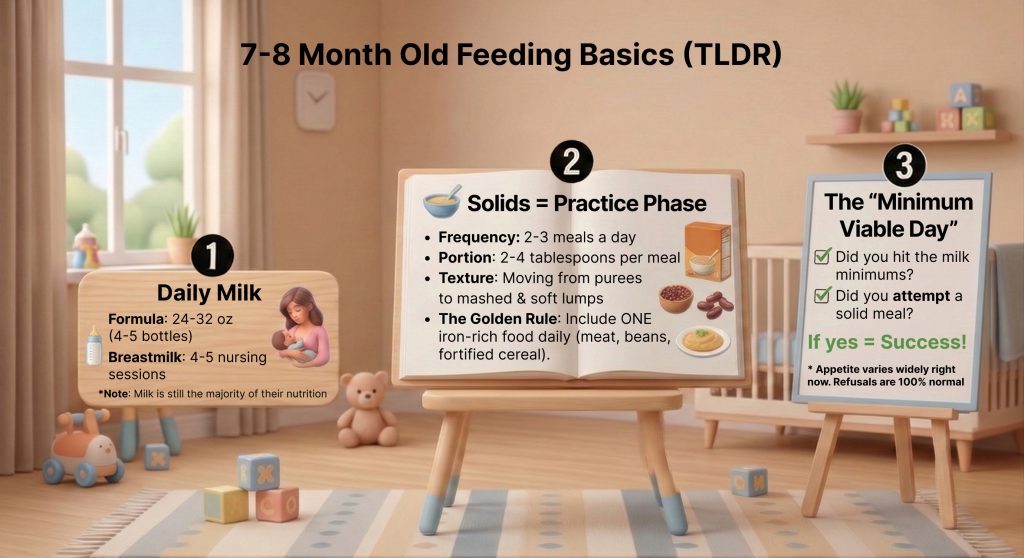
Formula-fed babies: 24–32 oz per day, spread across 4–5 bottles. The AAP advises that babies should take in roughly 2.5 ounces of formula per day for every pound of body weight, with a maximum of 32 ounces in 24 hours ¹.
Breastfed babies: 4–5 nursing sessions per day. Duration varies widely — some babies this age feed efficiently in under 10 minutes total. You can’t measure ounces, and you don’t need to — frequency and output signals matter more (covered below).
These ranges hold for most of this two-month window. If your baby is consistently at the low end but growing and producing wet diapers, that’s still adequate.
Solid Food Amounts Per Meal
- 2–4 tablespoons per meal
- 2–3 meals per day
- Total daily solids: roughly 4–12 tablespoons, depending on the baby and the day
That range looks wide because it genuinely is. A baby who eats 2 tablespoons at lunch one day and 5 tablespoons the next is behaving normally — not inconsistently. Appetite variation at this stage is the rule, not the exception.
If your baby takes 2 tablespoons and turns away, that’s a complete meal. There’s no need to push for more. A 7-8 month old feeding schedule is meant to create opportunities for eating, not pressure to finish.
7 Months vs. 8 Months — Does Anything Change?
The progression is real but gradual. There’s no hard deadline where everything shifts overnight.
| 7 Months | 8 Months | |
|---|---|---|
| Meals per day | 2 (working toward 3) | 2–3 consistently |
| Portion range per meal | 2–3 tablespoons | 3–4 tablespoons |
| Texture | Smooth purees, some mashed | Mashed, soft lumps, thicker textures |
| Milk feeds | 4–5 sessions/bottles | 4–5 sessions/bottles (same) |
| Feeding order | Milk first most meals | Solids first at one meal is fine |
The shift is gradual, not a hard deadline. At 8 months, you’re building on what 7 months established — not starting over.
Sample 7-8 Month Old Feeding Schedule
These are templates, not prescriptions. Adjust timing to match your baby’s wake windows and nap schedule.
Formula-Fed Schedule (Sample Day)
| Time | Feed |
|---|---|
| 7:00 AM | Wake + bottle (6–8 oz) |
| 8:00 AM | Solid meal #1 (2–4 tbsp iron-rich food + fruit or vegetable) |
| 11:00 AM | Bottle (6–8 oz) |
| 12:30 PM | Solid meal #2 (2–4 tbsp — mix of textures) |
| 3:00 PM | Bottle (6–8 oz) |
| 5:30 PM | Solid meal #3 (optional at 7 months; 2–3 tbsp at 8 months) |
| 6:30 PM | Bottle (6–8 oz) |
| Night | 1 bottle if waking (4–6 oz), as needed |
Daily formula total: 24–32 oz. If your baby is consistently hitting 24 oz and gaining weight, you’re in range.
Breastfed Schedule (Sample Day)
| Time | Feed |
|---|---|
| 7:00 AM | Wake + nurse |
| 8:00 AM | Solid meal #1 (2–4 tbsp) |
| 10:30 AM | Nurse |
| 12:30 PM | Solid meal #2 (2–4 tbsp) |
| 2:30 PM | Nurse |
| 5:30 PM | Solid meal #3 (optional at 7 months; small serving at 8 months) |
| 7:00 PM | Nurse before bed |
| Night | Nurse once if waking, as needed |
Daily nursing total: 4–5 sessions. Some breastfed babies this age still wake once at night — that session counts toward the daily total.
Feeding Order: Milk First or Solids First?
Use this decision rule rather than a blanket recommendation:
Offer milk first if:
- Your baby is 7 months and solids are newly introduced
- You’re concerned about milk supply
- Your baby is not yet interested in solids
Rationale: Milk is still the primary nutrition source. Protecting intake matters most when solids are in early stages.
Offering solids first at one meal is fine if:
- Solids are establishing well (baby is accepting food regularly)
- Milk supply is stable
- Your baby is 8 months and showing strong interest in food
Rationale: A baby who is genuinely hungry may engage better with solids before the edge comes off with milk.
You don’t have to pick one approach for every meal. Many families offer milk first in the morning and solids first at lunch. That’s not wrong — it’s practical.
Milk Feeds at This Age — What Changes, What Doesn’t
Milk Is Still the Primary Nutrition Source
At 7–8 months, solids are practice, exposure, and gradual introduction — not a replacement for milk’s nutrition. The majority of calories, fat, protein, and nutrients still come from breastmilk or formula at this stage. The AAP recommends that breastmilk or formula remain the primary source of nutrition throughout the first year, with solid foods serving as a complement rather than a replacement ².
This framing matters because it takes the pressure off solid meal outcomes. A refused meal is not a nutritional crisis. Milk is still doing most of the work. For a timeline on when that balance shifts, see our guide on when babies stop drinking formula.
How Milk Feeds Reduce as Solids Increase
Here’s what most sources miss: the reduction in milk feeds is mostly baby-led, not parent-managed.
The mechanism is straightforward — as babies eat more solid food, they naturally take slightly less milk at each feed. They self-regulate. Most parents don’t need to actively drop a feed at this stage; the feeds shorten or consolidate on their own as solid intake increases.
The distinction that matters:
- Baby-led reduction: Your baby nurses for less time or leaves formula in the bottle. This is normal. Follow the baby’s lead.
- Intentional feed dropping: Deciding to offer one fewer bottle or nursing session on a schedule. Most babies don’t need a feed dropped intentionally at this stage — self-regulation typically handles the gradual shift. If you’re considering changing the feed structure, that’s a good question to bring to your pediatrician.
If your baby is still taking the same amount of milk at 8 months as they did at 6 months, that’s also fine. Every baby integrates solids at a different pace, and a 7-8 month old feeding schedule should reflect that flexibility.
Night Feedings at 7–8 Months
Night feeds are still common and normal at this age. There’s no hard rule on dropping them.
Some 7–8 month olds sleep through the night. Many don’t. Both are within the normal range.
One specific thing worth knowing: if night waking increases after you start solids, that’s common and usually temporary. The digestive adjustment, new flavors, and changes to the feeding rhythm can temporarily disrupt sleep. It typically settles within a few weeks as the routine stabilizes.
Solid Foods at 7–8 Months — What to Offer and How Much
Food Textures at This Stage
Texture matters as much as quantity — and the two are connected.
- Smooth purees: Larger volume per meal is typical; babies can eat more when textures are thin
- Mashed foods: Slightly smaller volumes; more work per swallow
- Soft lumps: Smallest volumes, most effort — don’t be surprised if meal size drops when you move textures up
Progression: Smooth purees → mashed → soft lumps with some texture. Most 7-month-olds are in the puree-to-mash phase. Most 8-month-olds are ready for soft lumps and more varied textures. If you’re still in the early stages of solids, our guide to baby purees covers how to start before moving to more textured foods. The CDC recommends progressing from strained or pureed foods to mashed or lumpy textures, and then to small chopped pieces as your baby’s eating skills develop ⁴.
If your baby seems to eat less when you introduce a thicker texture, that’s the texture doing its job — not a feeding problem.
Iron-Rich Foods — Where They Fit in the Schedule
At one meal per day, prioritize iron. This is the most important nutritional guidance for this stage, and it belongs inside your feeding plan, not as a separate task.
Iron-rich options to rotate through:
- Pureed or minced meat (beef, chicken, turkey)
- Pureed lentils or beans
- Iron-fortified infant cereal (mixed into puree or with milk)
- Tofu (soft, mashed)
Why it matters: Breastmilk is low in iron. For most full-term babies, the iron stores accumulated during pregnancy begin to deplete around 4 to 6 months, and breastmilk alone can no longer meet the infant’s iron requirements ³. The AAP recommends introducing iron-rich complementary foods – such as iron-fortified cereals and pureed meats – starting at around 6 months. One iron-rich serving per day – even a small one – makes a meaningful difference.
Practical approach: make breakfast or lunch your consistent iron meal. If it gets refused on a given day, that’s fine. Consistency over the week matters more than perfection at every meal.
Purees vs. Baby-Led Weaning — Does the Schedule Change?
No. The method affects texture and form — not timing or total daily milk.
Whether you’re spoon-feeding purees, offering soft finger foods, or doing a combination, the schedule structure stays the same: 2–3 meal attempts per day, milk feeds maintained at 4–5 sessions or 24–32 oz.
Baby-led weaning babies may appear to eat very little in early weeks — that’s expected. Intake picks up as their skills improve. Milk coverage is especially important to maintain during this phase.
Meal Ideas by Texture Level
Smooth purees:
- Pureed sweet potato with breastmilk or formula
- Pureed chicken with butternut squash
- Pureed lentils with carrot
- Apple or pear puree
Mashed:
- Mashed banana
- Mashed avocado
- Mashed soft-cooked carrot with a little butter
- Well-mashed egg yolk
Soft lumps (8 months+):
- Small pieces of soft-cooked broccoli
- Flaked salmon
- Small cubes of soft tofu
- Ripe mango pieces (skin removed)
What a Normal Feeding Day Actually Looks Like (Including the Hard Days)
The Transition Period Is Supposed to Feel Inconsistent
7–8 months is the most variable phase of the milk-to-solids transition. This is worth saying plainly because most feeding content skips it.
One day your baby eats enthusiastically. The next day they refuse everything. A week in, they suddenly want to nurse constantly. Two days later, they take a full solid meal without fuss.
If your baby’s intake varies day to day, that is the phase, not a problem you created.
The instability isn’t a sign that you’re doing something wrong or that your baby isn’t progressing. It’s the normal texture of what this learning process looks like from the inside.
When Your Baby Eats Almost Nothing at a Meal
It happens. Here’s what to do:
- Offer the remaining milk feed. If a solid meal is refused, move to the milk feed calmly. The meal still counts as an attempt.
- Don’t retry the same food immediately. Offering it again 20 minutes later rarely works and can increase aversion.
- Move on without comment. Neutral reactions to refusal — no anxiety, no coaxing, no celebration — keep food from becoming charged.
One low-intake meal does not require intervention. It requires waiting for the next meal.
The “Minimum Viable Feeding Day” Benchmark
When the day has gone sideways — nap schedule thrown off, two refused meals, baby fussier than usual — here’s the actual floor:
A nutritionally adequate day looks like:
- Milk minimums met (24 oz formula OR 4–5 nursing sessions)
- Solids attempted at least once, even if refused
That’s it. If those two things happened, your baby’s nutritional needs for that day are covered.
Solids don’t need to be finished. They don’t need to be enthusiastically received. Exposure counts. The day is not a failure because a meal was skipped or refused.
How to Tell If Your Baby Is Eating Enough
For Formula-Fed Babies — Counting Ounces
This is straightforward: if your baby is consistently hitting 24 oz per day and weight gain is tracking at checkups, intake is adequate.
If bottles are regularly leaving more than 1–2 oz behind and your baby seems satisfied, that’s self-regulation — not a problem.
If your baby is consistently below 24 oz and seems hungry, lethargic, or isn’t gaining weight, that warrants a call to your pediatrician.
For Breastfed Babies — Proxies When You Can’t Count Ounces
You can’t measure breastmilk intake directly. Use these signals instead:
- Wet diapers: 6 or more per day is a useful signal, though once solids and water are introduced, counts can vary — it’s most helpful as one indicator among several.
- Contentment after feeds: A baby who nurses and then seems settled (not immediately rooting or crying) is likely getting enough
- Steady weight gain: Tracked at well-child visits — your pediatrician is watching this
- Energy and alertness: A well-fed baby has periods of alertness and engagement between feeds
No single signal is definitive on its own. If 2–3 of these look good, intake is almost certainly fine. These adequacy signals align with guidance from Johns Hopkins Medicine and other pediatric institutions for assessing whether milk intake is sufficient during the first year ⁶.
“Not Eating Much” vs. “Not Eating Enough” — The Actual Difference
These get conflated constantly, and they’re not the same thing.
Not eating much (common, usually fine):
- Refusing one or two meals
- Taking 2 tablespoons instead of 4
- Having low-appetite days during illness or teething
- Eating more milk and less solids on some days
Not eating enough (rare, specific signs):
- Consistently below 24 oz formula per day for several days in a row
- Fewer than 6 wet diapers per day
- Losing weight or failing to gain over a month
- Lethargic, not alert, not engaging between feeds
- Consistently refusing both milk and solids
Most parents who think their baby isn’t eating enough are in the first category. Genuine inadequate intake has specific, observable signs — and most babies with good milk intake are nutritionally covered even on low-solid days.
When to Call Your Pediatrician — Specific Thresholds
Call your pediatrician if you observe any of the following:
- Consistently refuses all solids after 8 months (multiple meals per day, multiple days per week)
- Formula intake drops below ~24 oz per day and doesn’t recover within a day or two
- Baby is losing weight or not gaining at regular checkups
- Fewer than 6 wet diapers per day for more than one day
- Extreme fatigue or unusual lethargy between feeds
- Repeated choking episodes — not gagging, which is common and normal — warrant a prompt call rather than a routine check-in
This list is meant to be calming, not alarming. Most feeding concerns at 7–8 months don’t meet these thresholds. But if they do, calling is the right move — and your pediatrician expects these questions.
Troubleshooting: Three Common Problems at This Stage
Baby Refuses All Solids
First: normalize the timeline. Some babies don’t accept solids readily until 8–9 months. Refusal at 7 months is very common.
Practical steps:
- Keep offering — once or twice per day, without pressure. Exposure matters even when nothing is eaten.
- Try different textures and temperatures. Some babies who refuse purees accept soft finger foods. Some prefer warmer food.
- Let them touch and explore the food before a spoon is involved. Familiarity reduces refusal over time.
Do not stop offering solids because of refusal. Continued neutral exposure is the strategy.
Baby Drops a Bottle or Breast Feed After Starting Solids
First, identify whether this is self-regulated or a sharp drop:
- Gradual reduction (taking slightly less per feed): This is normal self-regulation. Follow the baby’s lead. Don’t push extra milk if they’re not interested.
- Sudden drop in total daily intake (e.g., going from 28 oz to 16 oz in a week): This warrants attention. Check whether teething, illness, or a feeding aversion is involved. If it persists more than 2–3 days, call your pediatrician.
As a general rule: before 9 months, milk feeds shouldn’t be dropping to fewer than 4 per day. If that’s happening, monitor closely.
Baby Wakes More at Night After Increasing Solids
This is one of the most common surprises parents encounter at this stage, and it has a straightforward explanation.
Introducing solids changes digestion, gut bacteria, and feeding rhythms. The adjustment can temporarily disrupt sleep — even if the baby was sleeping well before. It usually resolves within 2–4 weeks as the digestive system adapts.
What doesn’t help: pulling back on solids to try to restore sleep. The disruption happens during the adjustment period regardless.
What does help: maintain your daytime milk feeds, keep the bedtime nursing or bottle in place, and wait it out. The sleep usually stabilizes once solids are more established.
Managing the Feeding Schedule at Daycare
Feeding schedules across two environments are harder to sync than most advice acknowledges. Here’s a practical approach.
What to communicate to caregivers:
- Daily milk totals and bottle sizes (e.g., “three 7-oz bottles while in your care”)
- Solid meal timing and approximate amounts (“2–3 tablespoons at lunch, iron-rich food if possible”)
- Your baby’s refusal signals — how they indicate they’re done
- Any foods not yet introduced (to avoid first exposures happening at daycare)
What flexibility is acceptable:
Timing will shift. A daycare schedule runs on a group rhythm, not your baby’s individual one. A meal that happens at 11:30 instead of noon is fine. A bottle offered 30 minutes early because of nap timing is fine. The totals matter more than the exact clock.
One practical note: Ask your daycare provider to log intake when possible. Even rough notes (“took about half the food, finished the bottle”) help you track patterns across the week and adjust your home schedule accordingly.
The goal isn’t a perfect mirror of your home 7-8 month old feeding schedule — it’s consistent milk minimums met across the day and solids offered regularly in both environments.
7-8 Month Old Feeding Schedule FAQ
How many times a day should a 7–8 month old eat solids?
Most 7–8 month olds eat solids 2–3 times per day. At 7 months, 2 solid meals is typical. By 8 months, most babies are ready for 3 smaller meals. Start with 2 and add a third when your baby shows consistent interest and tolerance.
Can a 7–8 month old eat 3 meals a day?
Yes — especially at 8 months. Three meals per day is appropriate as long as milk feeds are maintained at 4–5 sessions or 24–32 oz formula daily. Keep solid portions small (2–4 tablespoons per meal) and don’t reduce milk to accommodate the extra meal.
Should I offer solids before or after milk?
It depends on where you are in the transition. If solids are newly introduced or milk supply is a concern, offer milk first. If solids are establishing well and supply is stable, offering solids first at one meal per day is fine. You don’t need to apply the same rule to every meal.
Does my 7–8 month old need water?
Small amounts of water are appropriate once solids are introduced — small sips offered with meals, often somewhere in the range of 2–4 oz, though your pediatrician may guide this based on your baby’s intake and other factors. Water at this age is for practice and hydration support, not replacing milk. Don’t offer water before milk or solids.
The AAP recommends that babies under 6 months should not be given water, and that once solids begin, small amounts — up to 4 to 8 ounces per day — can be offered in a cup to build drinking skills, not to replace milk ⁵.
Is it okay if my baby eats different amounts every day?
Yes. Day-to-day variation in solid intake is completely normal at this stage. Teething, sleep disruptions, illness, developmental leaps, and simple preference all affect appetite. As long as milk minimums are met and solids are being offered, a variable intake is not a sign of a problem.
When do I drop a milk feed?
Most babies naturally reduce milk feeds between 9–12 months as solid intake increases. At 7–8 months, you generally don’t need to drop a feed intentionally — your baby’s self-regulation will handle the gradual reduction. If feeds are dropping on their own and your baby seems satisfied and is growing well, follow the baby’s lead. If drops feel sudden or sharp, check in with your pediatrician.
6 Sources
- American Academy of Pediatrics. Amount and Schedule of Baby Formula Feedings. HealthyChildren.org. https://www.healthychildren.org/English/ages-stages/baby/formula-feeding/Pages/amount-and-schedule-of-formula-feedings.aspx
- American Academy of Pediatrics. Starting Solid Foods. HealthyChildren.org. https://www.healthychildren.org/English/ages-stages/baby/feeding-nutrition/Pages/Starting-Solid-Foods.aspx
- Baker, R.D., Greer, F.R., et al. (2010). Diagnosis and Prevention of Iron Deficiency and Iron-Deficiency Anemia in Infants and Young Children (0–3 Years of Age). Pediatrics, 126(5), 1040–1050. https://pubmed.ncbi.nlm.nih.gov/20923825/
- Centers for Disease Control and Prevention. (2025). When, What, and How to Introduce Solid Foods. https://www.cdc.gov/infant-toddler-nutrition/foods-and-drinks/when-what-and-how-to-introduce-solid-foods.html
- American Academy of Pediatrics. Recommended Drinks for Children Age 5 & Younger. HealthyChildren.org. https://www.healthychildren.org/English/healthy-living/nutrition/Pages/recommended-drinks-for-young-children-ages-0-5.aspx
- Johns Hopkins Medicine. Feeding Guide for the First Year. https://www.hopkinsmedicine.org/health/wellness-and-prevention/feeding-guide-for-the-first-year