


Nighttime potty training usually happens later than daytime potty training — and that catches many parents off guard. Staying dry overnight depends on physical development, not just learned habits, which means it unfolds on its own timeline.
Many children begin staying dry at night sometime between ages 3 and 5, though some take longer. Bedwetting can still be completely normal in 5- to 7-year-olds because overnight dryness requires bladder growth, mature sleep patterns, and the body’s nighttime hormone signals to come together 1.
There are practical strategies that can support the process, but nighttime dryness usually arrives more gradually than parents expect. This guide covers what’s actually happening, what helps, and when to check with your pediatrician.
Key Takeaways
- Nighttime dryness depends on physical development — bladder growth, hormone regulation, and sleep maturity — not just habits.
- Most children stay dry at night between ages 3 and 5, but bedwetting can still be normal up to age 7.
- Daytime potty training and nighttime dryness are different processes — being trained during the day doesn’t mean nights will follow quickly.
- Supportive habits like a bathroom trip before bed and shifting fluids earlier can help, but nighttime dryness can’t be forced.
- Talk to your pediatrician if your child starts wetting again after months of dryness, has pain, snores heavily, or is still wetting regularly after age 7.
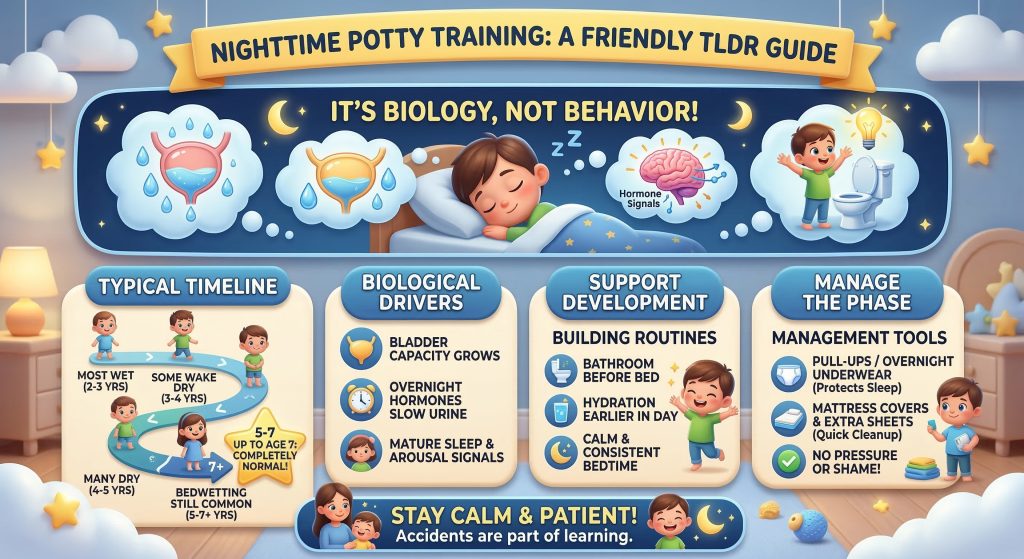
Table of Contents
Nighttime Dryness By Age
| Age | What Is Common |
|---|---|
| 2–3 years | Most children still wet overnight |
| 3-4 years | Some children begin waking dry |
| 4-5 years | Many children stay dry most nights |
| 5-7 years | Bedwetting still occurs for some children |
These ranges vary widely, and occasional accidents may still happen during illness, travel, or periods of stress.
Why Nighttime Potty Training Is Different From Daytime Training
Daytime potty training mostly involves learning routines and recognizing body signals. Children practice noticing when they need to go and getting to the bathroom in time.
Nighttime dryness works differently. Staying dry overnight depends largely on physical development that unfolds gradually as children grow.
Two biological systems play a role:
Bladder capacity. As children grow, their bladder becomes able to hold urine for longer stretches during sleep.
Hormone regulation. During sleep, the body releases a hormone called antidiuretic hormone (ADH), which slows urine production overnight. Younger children may not yet produce enough of this hormone at night, meaning the body continues making urine while they sleep 2.
Because these systems mature at different rates, many children stay dry during the day before their bodies are ready to stay dry overnight.
Signs a Child May Be Getting Closer to Nighttime Dryness
While every child develops at their own pace, certain patterns can suggest that nighttime dryness may be approaching.
A child may be getting closer when they wake up dry several mornings in a row or stay dry for long stretches during the day. Some children also begin showing awareness of needing to use the bathroom right before bed or early in the morning.
These signs do not guarantee that accidents will stop immediately, but they often indicate that the body is beginning to regulate nighttime bladder control.
Practical Tips That Can Support Nighttime Potty Training
Nighttime dryness cannot be forced, but a few simple habits can make the transition easier as a child’s body matures. Bedwetting during the preschool years is common and usually reflects normal development rather than a problem.
Nighttime Potty Training: Key Tips and Strategies
Understand readiness
Nighttime dryness often comes later than daytime potty training. Many children need more time for their bladder, sleep patterns, and nighttime hormone cycle to mature.
Bathroom before bed
Make using the toilet one of the last predictable steps in the bedtime routine.
Shift fluids earlier
Encourage most hydration earlier in the day and evening rather than loading up on drinks right before bed. Avoid overly strict fluid restriction.
Consider a late-evening bathroom trip
Some families find this reduces wet nights in the short term, but it usually works more as a management strategy than something that creates independent nighttime dryness.
Set up the environment
A nightlight, easy path to the bathroom, and a nearby potty can make nighttime bathroom trips feel easier and less disruptive.
Use overnight protection
Mattress covers, absorbent pads, pull-ups, or overnight underwear are logistics tools — not signs that something is going wrong.
Stay calm about accidents
Nighttime wetting is a normal developmental phase. A relaxed response helps children feel supported rather than embarrassed. Most children naturally grow out of it as their bodies mature.
Talk to your pediatrician if:
Your child starts wetting again after being dry for months, has pain with urination, snores heavily, seems unusually thirsty, has constipation concerns, or is still wetting the bed regularly after age 7.
If your child is also transitioning out of a crib, the timing matters – our guide on when to transition to a toddler bed can help you decide whether to tackle both at once or space them out.
What Actually Helps vs What Mainly Manages the Phase
Habits that work with the body’s rhythm
Tools that help while the body matures
Habits that work with the body’s rhythm
Tools that help while the body matures
Swipe to compare
Parents often hear many strategies for nighttime potty training, but it helps to understand which approaches support development and which simply make the process easier to manage.
Bathroom routines before bed and healthy hydration during the day may support the body’s natural rhythm.
Other tools—like pull-ups, mattress covers, or scheduled nighttime wake-ups—mostly help manage accidents while the body matures. For families also working on sleep, our guide to common sleep training methods covers gentle approaches that pair well with this transition.
Understanding the difference can help parents focus less on “training” and more on supporting the transition.
Potty training and sleep challenges often overlap
Get a personalized sleep and routine plan based on your child’s age, stage, and your family’s schedule.
Take the 3-Min Quiz →Should You Wake Your Child to Use the Bathroom?
Some parents try waking their child late in the evening to use the bathroom in hopes of preventing accidents.
This strategy may reduce wet nights temporarily, but it does not necessarily help children develop independent nighttime awareness. For some families, waking a child to use the bathroom becomes a short-term management strategy rather than a long-term solution.
If waking your child disrupts their sleep significantly, it may not be helpful. Many pediatric experts recommend focusing on consistent bedtime routines and allowing the body’s natural development to guide nighttime dryness. If nighttime disruptions are also affecting your child’s overall sleep quality, Betteroo’s personalized sleep plans can help.
What If My Child Sleeps Through Wet Pajamas?
Some children sleep so deeply that they do not wake when an accident occurs overnight. Parents may discover wet pajamas or bedding only in the morning.
This pattern can feel confusing, but it usually reflects deep sleep patterns rather than a behavioral issue. Young children often sleep very soundly and may not notice bladder signals until their nervous system becomes more responsive during sleep.
As children grow and sleep patterns evolve, many begin waking more easily when their bladder is full.
Are Pull-Ups Helpful or Harmful?
Pull-ups are often used during the transition to nighttime dryness because they simplify cleanup and help protect sleep.
Some families prefer using them for convenience, especially while a child is still having frequent nighttime accidents. Others choose to switch to underwear once their child begins waking dry more consistently.
Nighttime dryness depends largely on physical development rather than specific training methods. Whether a child wears pull-ups or underwear overnight does not appear to determine when the body becomes ready to stay dry.
For many families, the most helpful approach is simply the one that keeps the process calm and manageable.
When Bedwetting Is Still Normal
Bedwetting is extremely common in early childhood.
Many children become consistently dry overnight sometime between ages four and seven ³, though the timeline can vary. Some children develop nighttime dryness earlier, while others take longer as their bladder capacity and hormone regulation mature.
Occasional accidents can also appear during times of illness, travel, developmental change, or emotional stress. Potty training readiness is just one of many changes happening around this age – our 2 year milestones guide covers the full developmental picture.
Because nighttime dryness depends largely on physical development, it is rarely something children can fully control through effort alone.
Need help with bedtime routines or sleep regressions?
Our free quiz builds a personalized plan for your child’s sleep — tailored to their age, temperament, and your family’s reality.
Take the 3-Min Quiz →When to Check With a Pediatrician
While bedwetting is common, there are situations where checking with a pediatrician can be helpful.
Parents may want to seek guidance if a child:
- begins bedwetting after being dry for several months
- experiences pain while urinating
- snores heavily or has disrupted sleep
- shows extreme thirst or frequent urination
- continues frequent bedwetting well into elementary school ⁴.
A pediatrician can help determine whether additional support or evaluation might be useful.
Frequently Asked Questions
What age do kids typically stay dry at night?
Nighttime dryness often develops later than daytime potty training. Many children become consistently dry overnight sometime between ages four and seven, though there is a wide range of normal development.
Some children stay dry shortly after daytime training, while others continue to have occasional nighttime accidents for several years. Genetics, sleep patterns, bladder growth, and hormone development all influence this timeline.
Because these systems mature gradually, nighttime dryness usually improves naturally over time rather than through rapid training.
Should I limit water before bedtime during nighttime potty training?
It can be helpful to encourage most daily hydration earlier in the evening rather than right before bed. Offering a bathroom visit as part of the bedtime routine can also help ensure the bladder starts the night empty.
However, strict fluid restriction is usually unnecessary. Children still need adequate hydration throughout the day, and limiting water too aggressively can make bedtime uncomfortable if they feel thirsty.
Because nighttime dryness is largely driven by biological development, adjusting fluid timing may reduce some accidents but does not usually determine when a child becomes consistently dry overnight.
Why did my child start bedwetting again after being dry?
Sometimes children begin having nighttime accidents again after a period of dryness. This can happen for several reasons.
Illness, constipation, sleep disruptions, emotional stress, travel, or major routine changes can temporarily affect bladder control. In many cases, these regressions resolve once the underlying situation stabilizes.
If bedwetting continues for an extended period after a child had previously been dry, checking with a pediatrician can help determine whether additional support may be helpful.
Does genetics affect bedwetting?
Genetics appear to influence several biological factors involved in nighttime dryness. Researchers believe family patterns may affect bladder capacity, the timing of nighttime hormone production, and how easily a child wakes when their bladder becomes full. For example, some children begin producing the hormone that reduces nighttime urine earlier than others.
If one or both parents experienced bedwetting during childhood, their child may follow a similar developmental timeline. This does not mean bedwetting will continue indefinitely, but it may explain why nighttime dryness arrives later for some children.
Is nighttime potty training possible at age 2 or 3?
Some children begin staying dry overnight at this age, but many are not yet physically ready. Overnight dryness depends on bladder development and hormone regulation, which mature at different times for different children. It is common for nighttime accidents to continue for several years after daytime potty training.
How long does nighttime potty training take?
Nighttime dryness is not something that happens over a set number of days or weeks the way daytime potty training often does. Because it depends on biological development — including bladder growth, hormone regulation, and sleep maturity — the timeline varies widely from child to child.
Some children become dry at night within a few months of daytime training. Others take a year or more. Occasional setbacks during illness, travel, or routine changes are also common and do not mean progress has been lost.
Is bedwetting a sign of a deeper problem?
In most cases, bedwetting in children under seven is a normal part of development and not a sign of a medical or emotional issue. The body simply needs more time to develop the systems that control nighttime bladder function.
However, it is worth checking with a pediatrician if a child begins wetting again after being dry for several months, has pain during urination, snores heavily, shows unusual thirst, or is still wetting frequently after age seven. These patterns can occasionally point to something that benefits from evaluation.
Sleep and potty training don’t have to be a battle
Betteroo builds a personalized plan around your child’s age, sleep patterns, and what your family is navigating right now.
Take the Free Sleep Quiz →- Related: how to potty train during the day
Related Betteroo Guides
- when to start potty training
- Potty Training Tips for Toddlers
- Potty Training Regression
- Potty Training Boys: A Gentle Guide
- Related reading: potty training girls
4 Sources
- American Academy of Pediatrics. (2024). Bedwetting in Children & Teens: Nocturnal Enuresis. https://www.healthychildren.org/English/health-issues/conditions/genitourinary-tract/Pages/Nocturnal-Enuresis-in-Teens.aspx
- Vande Walle, J., et al. (2017). Enuresis: Practical Guidelines for Primary Care. British Journal of General Practice, 67(660), 328–329. https://pubmed.ncbi.nlm.nih.gov/28663417/
- Maternik, M., et al. (2022). Enuresis in Children: Common Questions and Answers. American Family Physician, 106(5), 535–542. https://www.aafp.org/pubs/afp/issues/2022/1100/enuresis-children.html
- National Institute for Health and Care Excellence. (2010). Nocturnal Enuresis: The Management of Bedwetting in Children and Young People (CG111). https://pubmed.ncbi.nlm.nih.gov/21542543/