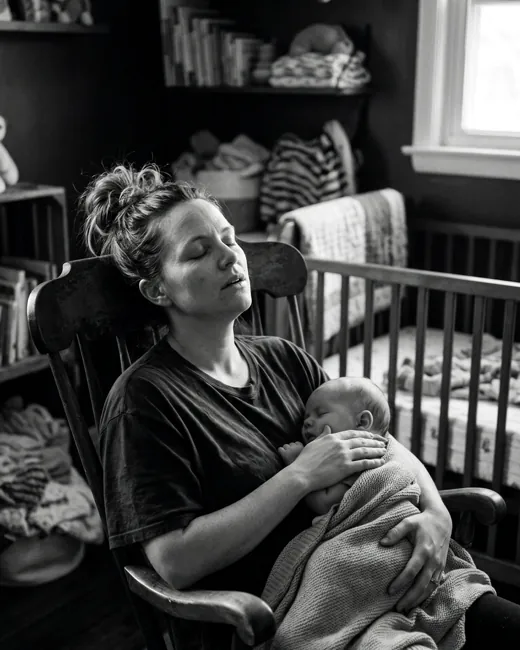

If you’re searching for a 6 month old sleep schedule, chances are sleep feels different again. Just as things may have started to settle after the four-month shift, your baby is now rolling, babbling, possibly tasting solids, and waking at 3 a.m. like it’s a brand-new phase.
At six months, sleep changes because development is accelerating. Mobility increases and awareness sharpens. Wake windows stretch. Some babies begin transitioning from three naps to two. None of this means you broke sleep, it means your baby is growing.

This guide will walk through how much sleep most six-month-olds need, what a realistic 6 month baby sleep schedule looks like, how wake windows shift, what’s behind common night waking, and how to approach this stage with clarity instead of pressure.
Table of Contents
How Much Should a 6 Month Old Sleep?
Most six-month-olds need 12–15 total hours of sleep in a 24-hour period. The American Academy of Sleep Medicine recommends that infants aged 4–12 months sleep 12 to 16 hours per 24 hours (including naps) to promote optimal health — a guideline endorsed by the AAP ¹.
That typically breaks down into:
- 10–12 hours overnight
- 2–3 hours of daytime naps
Some babies cluster more sleep at night. Others still wake once to feed. Some are solidly on two naps. Others still need three shorter ones. Variation remains normal at this age.
Here’s a quick reference:
| Sleep Type | Typical Range |
| Total Sleep | 12-15 hours |
| Night Sleep | 10-12 hours |
| Day Naps | 2-3 hours total |
| Wake Windows | 2-3 hours |
Numbers above are to offer orientation, not as a grading system. A 6 month old sleep schedule works best when it supports your baby’s rhythms rather than chasing perfect alignment with a chart.
6 Month Wake Windows Explained
At six months, wake windows lengthen compared to earlier months.
Most babies tolerate 2–2.5 hours in the morning and 2.5–3 hours before bedtime.
Wake windows matter more now because sleep pressure builds more predictably. That’s why getting your 6 month old sleep schedule right often comes down to wake windows more than clock times. When they’re too short, naps may be refused. When they’re too long, overtiredness can build quickly.
Overtired vs Undertired at 6 Months
This is where many parents feel stuck. Overtired patterns often look like:
- Short 30–45 minute naps
- Early morning waking
- Increased night waking
- Difficulty settling even when clearly tired
Undertired patterns may look like:
- Playing or chatting at bedtime
- Split nights (awake happily in the middle of the night)
- Taking a long time to fall asleep
- Refusing a nap despite appearing alert
Understanding the difference can help you adjust gradually rather than making reactive changes.
A Sample 6 Month Old Sleep Schedule
Schedules at this age are frameworks, not scripts. They provide structure without requiring clock-level perfection.
Option A: 3-Nap Schedule (Common Early 6 Months)
- 7:00 a.m. — Wake
- 9:15/9:30 a.m. — Nap 1
- 12:30/1:00 p.m. — Nap 2
- 4:00 p.m. — Short catnap
- 7:00 p.m. — Bedtime
This schedule works well if naps are still shorter or wake windows haven’t stretched fully.
Option B: 2-Nap Transition Schedule (More Common Closer to 7 Months)
- 7:00 a.m. — Wake
- 9:30 a.m. — Nap 1
- 1:30 p.m. — Nap 2
- 7:00 p.m. — Bedtime
In a 2-nap structure, naps typically lengthen and wake windows stretch toward the 2.5–3 hour range.
Here’s how they compare:
| 3 Naps | 2 Naps |
| Shorter wake windows | Longer wake windows |
| Often needed earlier in month | More common later in month |
| May include short catnap | Naps consolidate into two longer stretches |
Both are normal at six months.
Is Your Baby Ready to Drop to 2 Naps?
This is one of the biggest questions at this age.
Signs your baby may be ready:
- Consistently fighting the third nap
- Third nap pushing bedtime too late
- First two naps lengthening naturally
- Tolerating 2.5–3 hour wake windows without overtiredness
Signs to wait:
- Frequent early morning waking
- First nap under 45 minutes
- Difficulty tolerating longer wake windows
- Increased fussiness when stretching timing
If you trial two naps, give it 1–2 weeks before deciding it “isn’t working.” Transitions can feel bumpy before they smooth out.
Dropping the third nap too early is one of the most common reasons for night waking at this stage. As your baby approaches seven months, feeding routines evolve alongside sleep — our 7-8 month feeding schedule covers how to navigate both.
6 Month Baby Developmental Milestones
Sleep disturbances at 6 months are often developmental, not behavioral. At this age, babies are doing a lot — rolling both ways, sitting with support, babbling more intentionally, becoming more aware of caregivers and starting to show early separation sensitivity.
Research in Pediatric Research confirms that the onsets of sitting, crawling, and other motor milestones lead to increased night awakenings, and that these sleep alterations are a normal part of the developmental process ². The AAP notes that separation anxiety typically begins around 8–9 months, though early signs can emerge around 6 months ³.
A baby who just learned to roll may practice in the crib. A baby who recognizes you more clearly may protest when you leave the room. A brain that is rapidly wiring language pathways may simply wake more often.
These shifts are temporary. While they can certainly be frustrating, it may be helpful to remind yourself the sleep instability reflects growth, not regression.
These milestones align with Mayo Clinic’s developmental timeline for 4–6 month olds, which notes that most babies at this age are rolling over, beginning to sit, and showing improved hand-eye coordination ⁵.
Is There a 6 Month Sleep Regression?
You’ll often hear about a “sleep regression 6 months” milestone, but it’s not a universal developmental shift in the same way the four-month progression is.
At six months, sleep disruption usually stems from:
- Milestone stacking
- Wake window shifts
- Nap transitions
- Increased awareness
- Solids introduction changing digestion patterns – if you’re just beginning, our guide to introducing purees covers what to expect
For some families, the wobble lasts a couple of weeks. For others, it blends quietly into the background.
Rather than labeling it immediately as a regression, it can be helpful to ask: is this development, schedule drift, or overtiredness?
Why is My 6 Month Old Waking at Night?
In Betteroo’s State of Parent & Baby Sleep 2026 Report, based on 32,000 parents, 64.5% of babies aged 6 months were still waking 3 or more times per night. If your baby is waking frequently at this age, you’re in the majority, not the exception.
Night waking at six months can have multiple layers.
- Development: Increased awareness means babies are more conscious between sleep cycles.
- Hunger: Some babies still need one nighttime feed. Introducing solids does not automatically eliminate night waking. If you’re wondering about the longer-term feeding timeline, our guide on when babies stop drinking formula covers what to expect.
- Schedule imbalance: Too much or too little daytime sleep can fragment nights.
- Nap transition: Dropping to two naps prematurely can increase early waking.
- Environment: At this age, babies are more sensitive to light and sound changes. Blackout blinds can help keep naps consistent, especially during longer summer days.
Takeaway here is that waking at night at six months is common. It does not automatically signal a problem.
Is 6 Months a Good Time for Sleep Training?
Six months is often when families consider sleep learning more seriously. Pediatric guidance generally supports exploring structured sleep teaching anytime after four to six months, depending on readiness.
Signs your baby may be ready:
- Predictable bedtime routine
- Consistent wake windows
- Growing well and feeding adequately
- Ability to self-soothe occasionally
Signs you may want to wait:
- Active milestone leap
- Ongoing illness
- Major schedule transition
There is no requirement to sleep train at six months. Some families choose gentle independent settling strategies, while others continue providing hands-on support.
Consistency tends to matter more than method. Research supports this: a study published in Sleep found that a consistent nightly bedtime routine alone led to significant improvements in sleep onset, night wakings, and sleep continuity in infants and toddlers ⁴.
Common 6 Month Sleep Problems (And What Helps)
Short Naps
Thirty-minute naps remain common. Often this reflects one sleep cycle. Ensuring wake windows are appropriate and allowing a brief pause before intervening can sometimes help babies link cycles.
Early Morning Waking
If your baby wakes at 5:00 or 5:30 a.m., consider:
- Was bedtime too late?
- Was daytime sleep too short or too long?
- Is the room dark enough?
Small adjustments over several days tend to work better than dramatic shifts.
Bedtime Getting Later
When the third nap drifts too late, bedtime can slide. This often signals readiness to gradually consolidate into two naps.
Waking Every 2 Hours
Frequent waking may reflect overtiredness, developmental bursts, or strong sleep associations. Rather than immediately changing everything, observe patterns over several days.
Understanding patterns matters more than reacting to a single rough night. A baby tracker app can help you spot trends over several days.
When to Talk to A Pediatrician
While variability is expected, consider checking in if your baby:
- Snores loudly or has breathing pauses
- Seems persistently uncomfortable when lying flat
- Sleeps significantly less than 12 hours consistently
- Shows feeding or growth concerns
- Triggers your intuition that something feels off
Parental instinct is valid data.
6 Month Old Sleep Schedule FAQ
How many naps should a 6 month old take?
Most six-month-olds take two or three naps. Early in the month, three naps is common — two longer ones plus a short late-afternoon catnap. Closer to seven months, many babies naturally drop the third nap as wake windows stretch toward 2.5–3 hours. The transition isn’t always clean — you may have some two-nap days and some three-nap days for a few weeks. That’s normal and not a sign something is wrong.
What is a good bedtime for a 6 month old?
Typically between 6:30 and 8:00 p.m., depending on how naps went that day. If naps were short or the last nap was skipped, an earlier bedtime helps prevent overtiredness. If naps went well and your baby seems content, bedtime can fall closer to 7:30 or 8:00. The best bedtime is one that’s responsive to your baby’s day rather than fixed to the same minute every night.
Why is my 6 month old waking every 2 hours?
Frequent night waking at six months usually has multiple contributors — developmental leaps, wake window imbalance, nap transitions, or strong sleep associations can all play a role. It’s rarely a single cause. Before making changes, observe patterns over 3–5 days to see whether the waking is consistent or tied to specific days. If overtiredness seems likely, try slightly earlier bedtimes for a few nights. If the pattern persists, a personalized sleep plan can help identify what’s driving it.
Is 6 months too early for sleep training?
No – six months is generally considered an appropriate age to explore sleep learning if your family is ready. Most pediatric guidance supports gentle sleep teaching methods from around four to six months onward. That said, sleep training is never required. Some families prefer to continue responsive settling and find that sleep improves naturally as development stabilizes. What matters most is choosing an approach that feels sustainable for you. Our guide to common sleep training methods explains how the main approaches differ.
How much should a 6 month old sleep?
Most six-month-olds need 12–15 total hours across 24 hours, with about 10–12 hours overnight and 2–3 hours spread across daytime naps. Some babies fall on the higher end, others the lower end — both are normal. If your baby seems alert, content during wake windows, and growing along their curve, sleep is likely sufficient even if the numbers don’t match a chart exactly.
Should I wake my 6 month old from a nap?
Sometimes. If a nap is running so long that it would push bedtime too late or cut into nighttime sleep, it’s usually fine to gently wake your baby. A common guideline is to cap any single nap at about 2 hours and to make sure the last nap of the day ends early enough to preserve an appropriate wake window before bed.
Can starting solids help my 6 month old sleep through the night?
This is one of the most common expectations, but introducing solids does not automatically eliminate night waking. At 6 months, most night waking is driven by developmental changes, sleep associations, or schedule imbalance — not hunger alone. Betteroo’s State of Parent & Baby Sleep 2026 Report found that frequent waking remained common across feeding methods. If you’re just getting started with food, our baby led weaning guide walks through the basics.
How do I know if my 6 month old is overtired or undertired?
Overtired babies tend to take short naps, wake frequently at night, and have difficulty settling even when clearly tired. Undertired babies look different — they may chat or play at bedtime, take a long time to fall asleep, or wake happily in the middle of the night (split nights). Watching your baby’s cues alongside wake window timing is the best way to tell which pattern you’re dealing with.
A Grounding Takeaway
A 6 month old sleep schedule doesn’t need perfection – it needs understanding.
Your baby is more mobile, more aware, and more socially engaged than they were even a few weeks ago. Sleep may wobble as development surges. Schedules may shift from three naps to two. Night waking may resurface briefly.
That doesn’t mean you’re behind. It means growth is happening. A flexible framework, responsive adjustments, and gentle consistency tend to carry families through this stage more effectively than rigid optimization. If sleep is working well now, enjoy it – many families notice another shift around the 8 month sleep regression, when crawling, pulling to stand, and separation awareness can disrupt nights again.
If you’d like help identifying patterns in your baby’s sleep rhythm, not just following a generic schedule, Betteroo is designed to support you through stages like this with data-informed, parent-friendly guidance.
You don’t need a perfect day, you need a pattern that fits your baby and you.
5 Sources
- Paruthi, S., et al. (2016). Recommended Amount of Sleep for Pediatric Populations: A Consensus Statement of the American Academy of Sleep Medicine. Journal of Clinical Sleep Medicine, 12(6), 785–786. https://pmc.ncbi.nlm.nih.gov/articles/PMC4877308/
- Sleep and infant development in the first year. Pediatric Research (2026). https://www.nature.com/articles/s41390-026-04780-4
- American Academy of Pediatrics. How to Ease Your Child’s Separation Anxiety. HealthyChildren.org. https://www.healthychildren.org/English/ages-stages/toddler/Pages/Soothing-Your-Childs-Separation-Anxiety.aspx
- Mindell, J.A., Telofski, L.S., Wiegand, B., & Kurtz, E.S. (2009). A Nightly Bedtime Routine: Impact on Sleep in Young Children and Maternal Mood. Sleep, 32(5), 599–606. https://pubmed.ncbi.nlm.nih.gov/19480226/
- Mayo Clinic. Infant development: Milestones from 4 to 6 months. https://www.mayoclinic.org/healthy-lifestyle/infant-and-toddler-health/in-depth/infant-development/art-20048178