
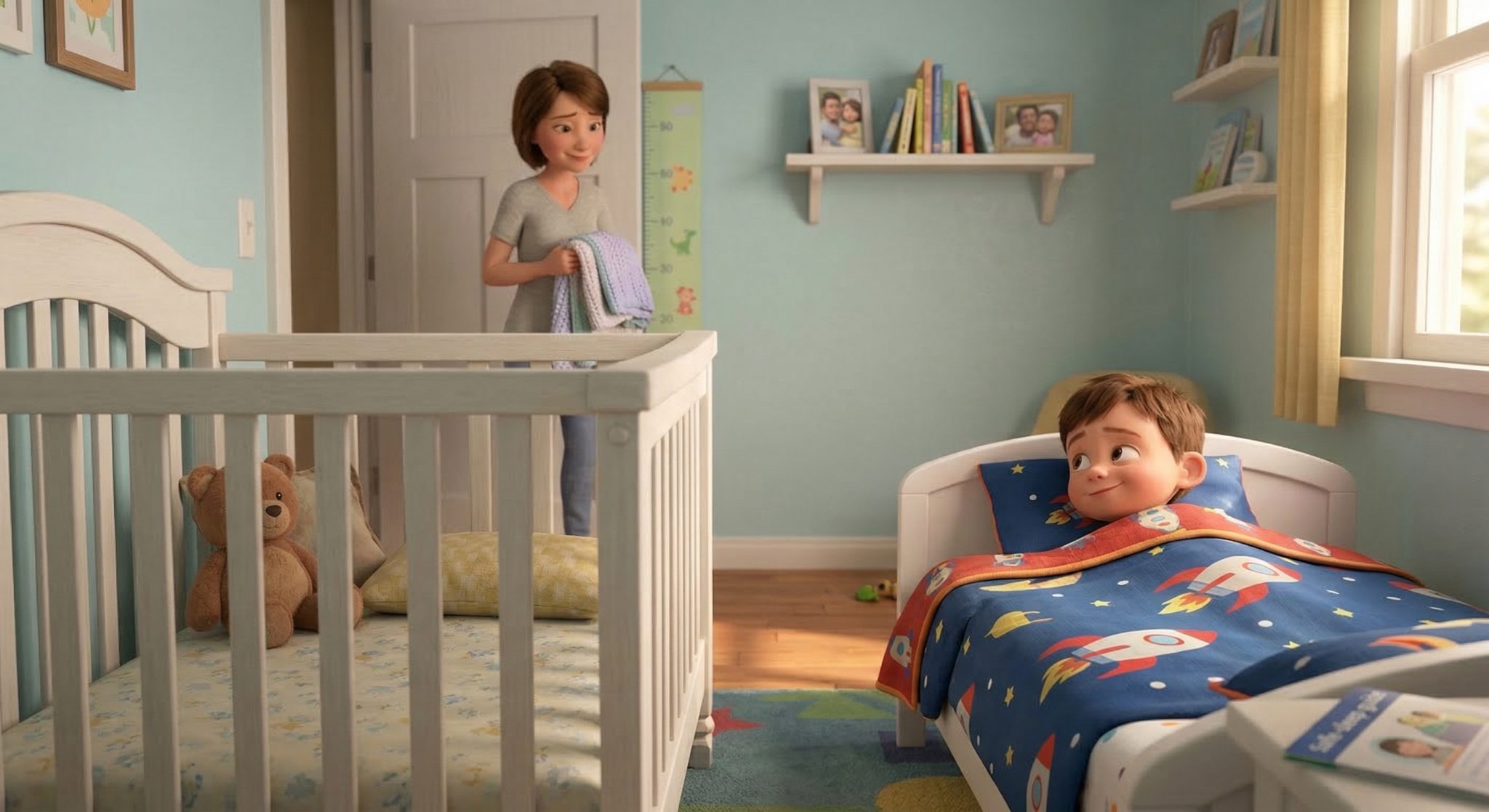


Most children transition from a crib to a toddler bed sometime between ages 2 and 3, though many parents wonder when to transition to toddler bed since the timing can vary widely. Some toddlers move earlier if they begin climbing out of the crib, while others remain safely in a crib closer to age 3 or even a little beyond.
Unlike many developmental milestones, there is rarely a reason to rush this transition. In fact, many pediatric sleep specialists recommend keeping children in a crib as long as it remains safe. Cribs provide a clear physical boundary that helps toddlers understand when it is time to sleep, and removing that boundary too early can sometimes lead to bedtime struggles.
Understanding when the transition is truly necessary, and when it can comfortably wait, can help families approach the change with less stress and more confidence.
Quick Answer
Most children transition from a crib to a toddler bed between ages 2 and 3. The most common trigger is climbing out of the crib, which makes the crib unsafe. If your child sleeps well and isn’t climbing, there’s usually no rush — waiting can actually make the transition smoother.
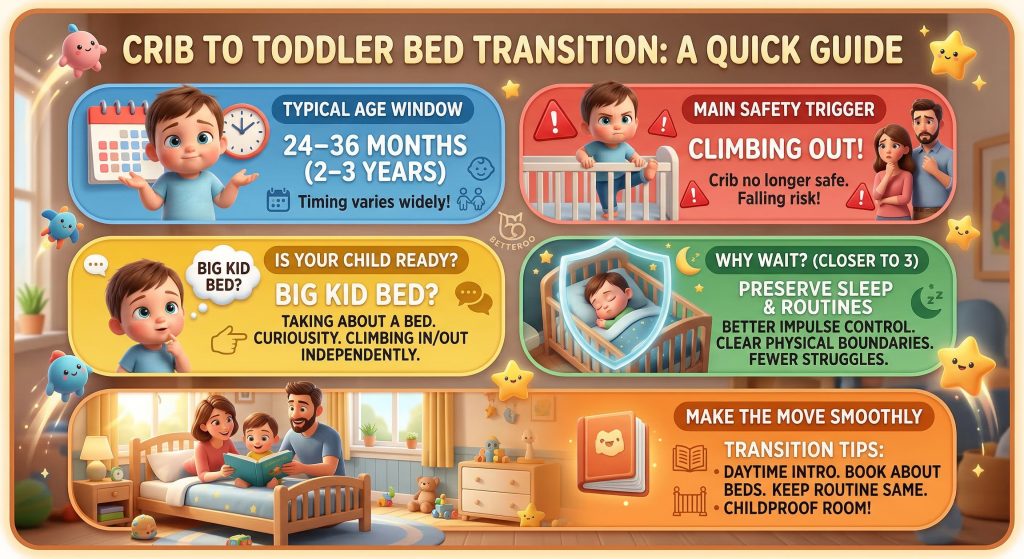
Table of Contents
Typical Age: When to Transition to Toddler Bed
There is no single “correct” age for moving from a crib to a toddler bed. Many families make the change sometime between 24 and 36 months, but the range of normal is broader than many parents expect.
Some toddlers become curious about sleeping in a “big kid bed” shortly after their second birthday, while others remain perfectly content in their crib well into their third year. If a child sleeps well in the crib, does not attempt to climb out, and seems comfortable in their sleep environment, there is usually no developmental need to make the transition early.
In many cases, waiting until closer to age three can actually make the transition smoother. By that point, toddlers often have slightly better impulse control and are more able to understand bedtime boundaries.
The Main Reason Families Transition: Safety
The most common reason families move from a crib to a toddler bed is safety related to climbing.
Once a toddler can climb over the crib rail, the crib no longer functions as a safe sleep space 1,3. This is often the point when parents start wondering when to transition to toddler bed, since falling from that height can lead to injury. A toddler bed that allows the child to get in and out safely becomes the better and safer option at this stage.
Climbing does not usually happen suddenly. Parents may begin to notice warning signs such as their child repeatedly attempting to pull themselves over the rail, leaning far over the edge, or swinging a leg up onto the crib side.
When these behaviors begin, transitioning to a toddler bed is typically safer than trying to prevent climbing with constant supervision or temporary adjustments.
Signs a Child May Be Ready for a Toddler Bed
While safety concerns often drive the transition, some toddlers also show developmental signs that they may handle the change well.
A child might start talking about wanting a “big kid bed,” show curiosity about other beds in the house, or begin climbing into and out of their crib independently. Some toddlers also demonstrate greater understanding of bedtime routines and expectations, which can make it easier for them to stay in bed once the physical crib barrier is gone.
These signs are not required for the transition, but they can indicate that a toddler may be developmentally ready to manage the extra independence that comes with sleeping in a bed.
Why Waiting Can Sometimes Help Sleep
One reason pediatric sleep experts often recommend delaying the crib-to-bed transition is that cribs provide a clear and consistent sleep boundary.
For toddlers, physical boundaries help reinforce routines 2. When a child is in a crib, the expectation is simple: bedtime means staying in that space until morning. Once that boundary disappears, toddlers may suddenly realize they can leave the bed whenever they want.
This can lead to new bedtime behaviors such as repeatedly getting out of bed, wandering the room, or calling parents back into the bedroom multiple times. These behaviors are not unusual; they simply reflect a toddler exploring new independence.
For children who are already sleeping well in their crib, keeping that structure in place a little longer can help preserve sleep routines during a stage when many other developmental changes are already happening.
How to Make the Transition to Toddler Bed Easier
When the time does come to move to a toddler bed, many parents start thinking about when to transition to toddler bed and how to make the change smoothly. A thoughtful transition can help minimize sleep disruption and make the new sleep space feel safe and comfortable for your child.
Many families find it helpful to introduce the idea gradually. Talking about the new bed during the day, reading books about “big kid beds,” or letting a child explore the bed during playtime can make the change feel exciting rather than intimidating.
Keeping the bedtime routine exactly the same can also help maintain a sense of stability, especially for parents deciding when to transition to toddler bed 2. The familiar sequence, bath, pajamas, stories, lights out, continues to signal that it is time to sleep even though the sleep space itself has changed.
It is also important to think about safety once toddlers can leave their bed independently. Childproofing the bedroom becomes more important, including securing furniture to the wall, covering outlets, and ensuring that the path to the bathroom or door is safe.
For many families, the transition works best when it is treated as a normal developmental step rather than a dramatic change.
Common Challenges After the Move
It is common for toddlers to test the new freedom that comes with sleeping in a bed.
Some children repeatedly get out of bed after lights-out, ask for additional drinks or stories, or wander the room during the night. These behaviors are usually temporary and reflect curiosity rather than resistance.
Responding calmly and consistently often helps toddlers learn the new expectations. Many families simply guide the child back to bed each time they get up, keeping interactions brief and predictable.
Over time, most toddlers adjust to the new sleep boundaries and settle back into their regular sleep patterns.
Not sure when to transition to toddler bed?
Get personalized sleep guidance based on your toddler’s age, routines, and sleep patterns — in just 3 minutes
Take the 3-Min Quiz →When to Check With Your Pediatrician
Most crib-to-bed transitions are purely developmental and do not require medical guidance.
However, parents who are unsure when to transition to toddler bed may find it helpful to talk with a pediatrician, especially if sleep disruptions become severe or prolonged, if a child repeatedly leaves the room despite consistent routines and safety measures, or if climbing behavior creates ongoing safety concerns.
In some cases, pediatricians can offer strategies tailored to a child’s temperament or sleep patterns.
Frequently Asked Questions
What age should a toddler move from a crib to a toddler bed?
Most toddlers transition from a crib to a toddler bed sometime between ages two and three, though the exact timing varies widely. Some children move earlier if they begin climbing out of the crib, while others remain safely in their crib closer to age three.
Developmentally, many sleep experts find that waiting until around age three can make the transition smoother. By that age, toddlers often have slightly stronger impulse control and a better understanding of bedtime expectations, which can make it easier for them to stay in bed overnight.
Is it safe for a 2-year-old to stay in a crib?
Yes. Many two-year-olds safely remain in a crib if they are comfortable and not attempting to climb out. If a toddler sleeps well in the crib and the crib meets current safety standards, continuing to use it can actually support more consistent sleep.
The key safety consideration is climbing. Once a child begins attempting to climb over the crib rail, the risk of falling increases, and transitioning to a toddler bed becomes the safer option.
The American Academy of Pediatrics does not specify a maximum crib age – the guidance is based on safety, not a birthday 1.
What if my toddler keeps getting out of bed after the transition?
It is very common for toddlers to experiment with their new freedom once they move to a bed. Getting out of bed repeatedly, calling parents back into the room, or wandering during bedtime are typical adjustment behaviors.
These situations usually improve when parents respond consistently and calmly. Many sleep specialists recommend quietly guiding the child back to bed with minimal conversation each time they get up. Over time, most toddlers learn that bedtime expectations remain the same even without the crib rails.
Will moving to a toddler bed disrupt sleep?
Some toddlers experience temporary sleep disruptions after the transition. This may include longer bedtimes, extra bedtime requests, or getting out of bed during the night.
These changes are usually short-lived and improve as toddlers adjust to the new sleep environment. Maintaining a consistent bedtime routine and responding predictably to nighttime behaviors can help children regain their sleep rhythm.
Most families see sleep settle back to normal within one to two weeks. If disruptions last longer than three weeks, it may be worth reviewing the bedtime routine or consulting your pediatrician.
Can toddlers stay in a crib until age 3?
Yes. Many children safely remain in a crib until around age three if they are comfortable, sleeping well, and not climbing out. In fact, many sleep experts encourage families to keep children in their crib as long as it remains safe, since the physical boundary can help reinforce sleep routines.
Every child develops at their own pace, so the transition often happens when safety or developmental readiness makes it the right time.
Should I move my toddler to a bed before a new baby arrives?
Many families consider transitioning to a toddler bed when a new sibling is on the way, but sleep experts generally recommend making the change at least two to three months before the baby arrives – or waiting until well after.
Making the switch too close to a new baby’s arrival can feel like the toddler is being “replaced”, which may create resistance. If timing is tight, it may be easier to get a second crib temporarily rather than rushing the transition.
Quick Takeaways
Nighttime sleep routines and crib transitions are closely tied to developmental readiness. Many parents wonder when to transition to toddler bed, since while many children move to a toddler bed between ages two and three, there is rarely a need to rush the process. Safety, especially climbing out of the crib, is the most common reason families decide it is time to make the switch.
For many toddlers, waiting until they are a little older can make the transition smoother and help preserve healthy sleep routines.
Struggling with toddler sleep after moving to a bed?
Get personalized sleep guidance based on your child’s age, routines, and sleep patterns with the Betteroo sleep app.
Take the 3-Min Quiz →3 Sources
- American Academy of Pediatrics. (2022). Sleep-Related Infant Deaths: Updated 2022 Recommendations for Reducing Infant Deaths in the Sleep Environment. https://pubmed.ncbi.nlm.nih.gov/35726558/
- Mindell, J.A., et al. (2015). Bedtime Routines for Young Children: A Dose-Dependent Association with Sleep Outcomes. Sleep, 38(5), 717–722. https://pubmed.ncbi.nlm.nih.gov/25600864/
- U.S. Consumer Product Safety Commission. Crib Safety Information Center. https://www.cpsc.gov/Safety-Education/Safety-Guides/Kids-and-Babies/Cribs