



Here’s when can babies drink water, how much is safe, and what to watch for. Most babies can begin drinking small amounts of water around 6 months of age, once solid foods are introduced. Before that stage, breast milk or formula provides all the hydration babies need and is specifically balanced for a baby’s developing body.
For many parents, the question about water comes up earlier—often during hot weather, when starting solids, or when babies begin showing interest in cups. While it might seem harmless to offer a few sips, pediatric experts generally recommend waiting until around six months, when babies are developmentally ready for small amounts of water alongside meals.
Understanding why this timing matters can make the guidance easier to follow.
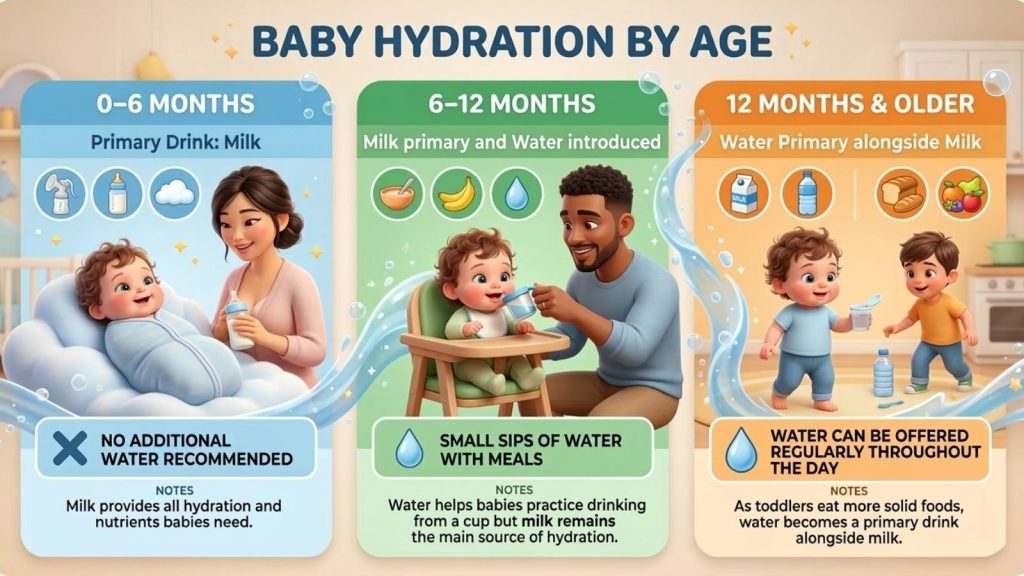
Table of Contents
Why Can’t Babies Under 6 Months Drink Water?
In the first months of life, babies’ bodies are designed to receive nearly all nutrition and hydration from breast milk or infant formula. Both are carefully balanced to meet a baby’s needs – breast milk is approximately 87% water and provides the right mix of fluids, calories, and nutrients 3,4.
Young infants also have immature kidneys, which means they cannot process large amounts of plain water as efficiently as older children or adults. When babies drink too much water, it can dilute the sodium levels in their bloodstream. In rare cases, this can lead to a condition known as water intoxication (dilutional hyponatremia), which can disrupt the body’s normal balance of electrolytes 5.
Even small amounts of water can also fill a baby’s stomach, leaving less room for breast milk or formula, which provide the calories and nutrients babies need for healthy growth.
For these reasons, pediatricians typically recommend avoiding water during the first six months unless specifically advised by a doctor.
When Is It Safe to Give a Baby Water?
Around 6 months of age, many babies begin eating solid foods. At this stage, small amounts of water can be introduced alongside meals 1.
Water at this age isn’t meant to replace breast milk or formula. Instead, it serves two main purposes: helping babies practice drinking from a cup and supporting digestion as solid foods become part of their routine.
During the second half of the first year, breast milk or formula still provides most of a baby’s hydration and nutrition. Water simply becomes an additional option offered in small amounts.
Parents often introduce water in a small open cup, a straw cup, or another beginner cup designed for early drinking practice – typically around the same time they begin baby-led weaning or spoon-fed solids.
How Much Water Can Babies Drink and When?
Once babies start solids, water can be offered in small sips with meals. For most babies between six and twelve months, this typically means around 4 to 8 ounces (1/2 to 1 cup) per day 1,2.
Breast milk or formula should remain the primary source of fluids during the first year. Babies usually continue drinking several bottles or nursing sessions per day even after solids and water are introduced.
If a baby seems particularly thirsty, it is often a sign that they may want another feeding rather than more water. Milk feedings still provide the hydration their bodies are designed to rely on.
Do Babies Need Water in Hot Weather?
Parents sometimes worry that babies might become dehydrated during hot weather. In most cases, babies younger than six months stay adequately hydrated through breast milk or formula alone, even when temperatures rise.
Feeding more frequently is usually the best way to ensure proper hydration during warm weather. Babies often naturally increase feeding when they are thirsty.
Once babies are over six months and eating solids, small sips of water can be offered with meals or occasionally between meals if needed, but milk feedings should still provide the majority of fluids.
How Much Water Does a Baby Need by Age?
Milk only — no water needed
Introducing sips with solids
Water becomes a daily staple
Milk only — no water needed
Introducing sips with solids
Water becomes a daily staple
Swipe to compare
During the first year, breast milk or formula should remain the primary source of hydration.
Every baby’s hydration and feeding journey is different
Get a personalized plan that fits your baby’s age, sleep patterns, and feeding stage.
Take the 3-Min Quiz →Can Water Help With Baby Constipation?
Water sometimes becomes part of the conversation when babies experience constipation after starting solid foods.
For babies over six months, offering small amounts of water with meals may help support digestion. However, pediatricians often recommend focusing first on fiber-rich foods, such as fruits and vegetables, and ensuring babies are receiving enough milk feedings.
If constipation becomes persistent or uncomfortable for a baby, it is best to speak with a pediatrician before making significant changes to feeding routines.
What Type of Water Is Safe for Babies?
For most families, regular tap water that meets local safety standards is safe for babies once they begin drinking water around six months.
Some parents prefer filtered water, particularly in areas where tap water quality varies. Bottled water is also acceptable, although it is usually not necessary.
If water is used to prepare infant formula, it should follow the preparation guidance provided by pediatricians or formula manufacturers, especially in the early months.
How to Introduce Water to a Baby
When babies begin solids, water is often introduced in small amounts during mealtime. Many parents offer a few sips at the end of a meal or while the baby practices using a cup.
This stage is less about hydration and more about learning a new skill. Babies are exploring how to sip, swallow, and coordinate drinking from a cup. Some babies quickly enjoy the experience, while others may simply play with the cup at first.
Over time, drinking water becomes part of normal mealtime routines.
How Do You Know If Your Baby Is Getting Enough Water?
Parents often wonder whether their baby is getting enough fluids. In most cases, babies who are feeding regularly and producing normal wet diapers are well hydrated.
Typical signs of healthy hydration include steady wet diapers throughout the day, a baby who appears alert and comfortable, and regular feeding patterns. Breast milk or formula continues to provide the majority of hydration during the first year. As your baby grows and sleep patterns evolve, understanding common sleep training methods can also help you build consistent routines around feeding and rest.
If parents notice signs such as fewer wet diapers, unusual sleepiness, or feeding difficulties, it can be helpful to speak with a pediatrician.
FAQ About When Can Babies Drink Water
Can babies drink water before 6 months?
Most pediatric experts recommend waiting until around six months to introduce water. Before this age, breast milk or formula provides all the hydration babies need and is balanced to support their developing bodies. Offering water earlier can interfere with feeding and, in larger amounts, may disrupt a baby’s electrolyte balance.
Do breastfed babies need water?
Breastfed babies typically do not need additional water during the first six months. Breast milk naturally adjusts to provide the fluids babies need, even during warm weather — the foremilk produced at the start of a feeding is higher in water content, while the fattier hindmilk follows to provide energy 6. When babies begin eating solids, small sips of water can be introduced alongside meals.
How much water can a 6-month-old drink?
Around six months, babies can begin taking small sips of water with meals. For most infants in the second half of the first year, this usually amounts to only a few ounces per day. Breast milk or formula should remain the primary source of hydration until the baby approaches their first birthday.
Can babies drink water at night?
During the first year, babies generally do not need water overnight. If a baby wakes during the night, feeding with breast milk or formula is usually more appropriate than offering water. As children grow older and transition away from night feedings, water may occasionally be offered, but this typically happens after infancy. If you’re navigating night wakings and feeding transitions, a 6-month sleep schedule can help you see how feeding and sleep fit together.
What happens if a baby drinks too much water?
If a baby consumes excessive water, it can dilute the sodium levels in their bloodstream, which may lead to a condition called water intoxication. While this is uncommon, it is one reason pediatricians recommend waiting until about six months and offering water only in small amounts once solids are introduced.
Can babies drink water with solid foods?
Yes. Once babies begin eating solid foods around 6 months, small sips of water can be offered during meals. At this stage, water helps babies practice drinking from a cup and supports digestion as their diet expands. However, breast milk or formula should still provide most of a baby’s hydration during the first year.
Can babies drink water from a bottle?
While it is safe for babies over six months to drink small amounts of water, pediatric experts often recommend offering it in an open cup or straw cup instead of a bottle. This helps babies learn drinking skills that support oral development. Bottles are typically reserved for breast milk or formula during the first year.
Can babies drink tap water?
In most areas, tap water that meets local safety standards is safe for babies once they begin drinking water around six months. Some parents prefer filtered water, particularly if they have concerns about taste or local water quality. If tap water is used to prepare formula, parents should follow pediatric guidance on safe preparation.
Can water replace milk for babies?
No. During the first year, water should not replace breast milk or formula. The AAP recommends breast milk or formula as the sole source of nutrition for approximately the first six months, and babies rely on milk feedings for calories, nutrients, and hydration 2. Water is introduced in small amounts mainly to support drinking skills and accompany solid foods.
What are signs a baby drank too much water?
Drinking excessive water is uncommon but can lead to symptoms such as unusual sleepiness, irritability, puffiness, or vomiting. This happens because too much water can dilute sodium levels in the bloodstream. Offering only small amounts of water after six months helps avoid this risk.
6 Sources
- Healthy Beverage Consumption in Early Childhood: Recommendations from Key National Health and Nutrition Organizations. Consensus Statement.
Lott M, Callahan E, Welker Duffy E, Story M, Daniels S. Healthy Eating Research, 2019.
healthyeatingresearch.org - Recommended Drinks for Children Age 5 & Younger.
American Academy of Pediatrics — HealthyChildren.org.
healthychildren.org - Review of Infant Feeding: Key Features of Breast Milk and Infant Formula.
Martin CR, Ling PR, Blackburn GL. Nutrients. 2016;8(5):279.
pubmed.ncbi.nlm.nih.gov/27187450 - Components of Human Breast Milk: From Macronutrient to Microbiome and MicroRNA.
Kim SY, Yi DY. Clin Exp Pediatr. 2020;63(8):301-309.
pubmed.ncbi.nlm.nih.gov/32024322 - Hyponatremic Seizures Secondary to Oral Water Intoxication in Infancy: Association With Commercial Bottled Drinking Water.
Bruce RC, Kliegman RM. Pediatrics. 1997;100(6):E4.
pubmed.ncbi.nlm.nih.gov/9374582 - Physiology, Breast Milk.
StatPearls [Internet]. National Library of Medicine. Updated Dec 2025.
ncbi.nlm.nih.gov/books/NBK539790