



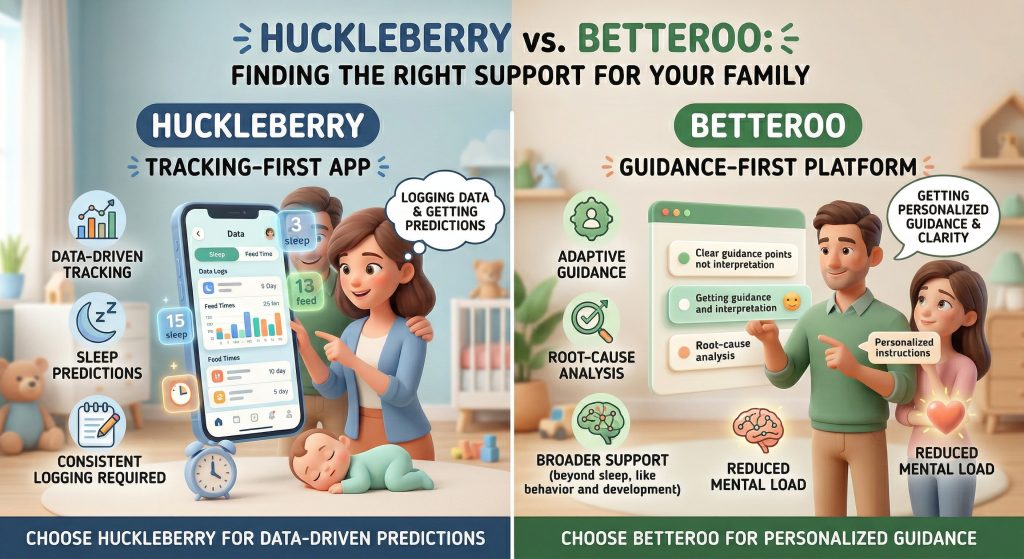
The huckleberry vs betteroo question comes up a lot – and for good reason. Here’s the simplest way to think about it: Huckleberry is a tracking-first app with sleep predictions, while Betteroo is a guidance-first platform designed to help you understand and respond to your child’s needs, without relying on constant logging. The goal is to reduce the constant mental loop of: “Is this normal? Are we improving? What should I change?”
We’ll be upfront: we build Betteroo, so we’re not neutral about the huckleberry vs betteroo debate. But parents don’t benefit from one-sided comparisons. This guide is designed to give you a clear, fair look at both tools, where each one works well, where they differ, and how to decide what actually fits your family.
Table of Contents
Quick Answer
In short, Huckleberry is best for parents who want data-driven sleep tracking with nap predictions, while Betteroo is best for parents who want tracking, personalized predictions, and guidance that helps them understand what’s actually happening and what to do next.
- Choose Huckleberry if: you want a data-driven tracking app with sleep predictions
- Choose Betteroo if: you want tracking, personalized predictions, and guidance that helps you understand what’s actually happening
Feature Comparison
Huckleberry
Sleep tracking app with predictive nap timing
Betteroo
Personalized guidance that adapts to your family
Huckleberry
Sleep tracking app with predictive nap timing
Betteroo
Personalized guidance that adapts to your family
Swipe to compare
Not sure which approach fits your family?
Take our quick quiz and get a personalized sleep plan built around your baby’s age, patterns, and your parenting style.
What Huckleberry Does Really Well
Huckleberry is widely used for a reason. It offers a clean, intuitive experience that many parents find easy to start with—especially in the early months.
Where it stands out:
- Structured tracking tools: Logging sleep, feeds, and patterns is straightforward and visually clear
- Predictive features: The app suggests nap timing based on patterns, which can feel helpful when you’re unsure where to start
- Pattern visibility: Seeing sleep trends over time can help some parents feel more in control
- Strong fit for data-oriented parents: If you like having numbers and structure, Huckleberry can feel reassuring
For many families, especially early on, this kind of structure can reduce guesswork.
Where Huckleberry Can Feel Limiting
At the same time, the same features that make Huckleberry helpful can also create friction for some parents.
Common challenges include:
- Reliance on consistent logging: The app works best when data is entered regularly, which can become burdensome over time
- Pressure to follow predictions closely: When real-life sleep doesn’t match the app, it can create uncertainty or second-guessing
- Limited context beyond sleep timing: Sleep disruptions are often driven by development, transitions, or behavior, not just timing
- Less flexibility when patterns shift: Predictions can lag behind real-world changes
These aren’t flaws, they’re tradeoffs that come with a tracking-first model, and they’re central to the huckleberry vs Betteroo decision.
What Betteroo Is Designed to Do Differently
Betteroo was built around a different question: What’s actually going on, and what should I do next? That’s why instead of focusing on prediction, Betteroo focuses on interpretation and guidance.
Here’s what that looks like in practice:
Personalization without constant tracking
Betteroo includes built-in tracking and data-driven predictions – but it doesn’t stop there. It adapts based on your child’s age, patterns, and what you’re experiencing, so even on days when you don’t log everything, the guidance still works. It uses structured inputs, parent-reported context and adaptive prompts to tailor support. You can track if you want, but you don’t need to in order to get value.
Root-cause guidance
Instead of only answering “when should my baby sleep,” and focusing specifically on timing, Betteroo helps you understand why sleep may be changing, whether it’s a regression, schedule issue or developmental shift, and what adjustments are likely to help if desired. It is designed to help reduce cognitive load and trial and error. Research shows that sleep disruptions in infancy are often tied to neurological development rather than timing alone. 1
Smart Schedule (Joey): Guidance Without Guessing
Betteroo’s Smart Schedule (Joey) uses your baby’s age and patterns to suggest when sleep is likely coming, and gives you a gentle heads-up before it happens. It will:
- suggest likely nap or bedtime
- give a ~30-minute wind-down reminder
- adjust as your day shifts
Importantly, it’s designed as a guide, not a rule. We always encourage parents to follow their baby’s cues and their gut! For a deeper look at how timing works across ages, see our wake windows by age chart.
Broader support beyond sleep
The Betteroo team recognizes that sleep rarely exists in isolation. That’s why Betteroo is designed to help support transitions like nap changes and routines, behavior and regulation questions and challenges, and other developmental shifts. It goes beyond being a sleep tool to operate as a decision-support system and as your expert-best buddy. Betteroo is designed to support your judgement, not replace it. We’ll help you reduce second-guessing and offer flexible paths forward, but ultimately we recognize no one knows as much about your life and baby as you do.
Proprietary tools designed for real-life parenting
Betteroo includes guided frameworks and tools that help you identify patterns without required overtracking. It automatically adjusts schedules with context provided, and responses to challenges like overtiredness or regressions. The system is designed to work even when your day doesn’t go “according to plan.”
Where Betteroo May Not Be the Best Fit
Betteroo isn’t the right tool for everyone, and that’s important to say clearly.
It may not be the best fit if you:
- prefer tracking-only tools and dashboards without guidance layers
- want exact, predictive sleep timing
- feel most comfortable following structured schedules closely
In those cases, a tracking-first tool like Huckleberry may feel more aligned.
Pricing and Value Comparison
| Category | Huckleberry | Betteroo |
|---|---|---|
| Free content | Limited | Extensive free guides on site |
| App model | Subscription | Subscription |
| What you’re paying for | Tracking + predictions | Personalized guidance + decision support |
Both are paid tools. The difference is less about cost and more about what kind of support you’re looking for.
Huckleberry vs Betteroo: Which One Should You Choose?
Huckleberry and Betteroo aren’t just different tools, they reflect different approaches.
- Huckleberry: Track → predict → follow the pattern
- Betteroo: Understand → interpret → adjust with context
Neither is inherently better, but one may feel more aligned depending on how you prefer to make decisions.
Choose Huckleberry if:
- you enjoy tracking data
- you want help with timing and prediction
- you like structured, app-led guidance
Choose Betteroo if:
- you want to understand why sleep is changing
- you feel overwhelmed by conflicting advice
- you want guidance that adapts to your child and your context
- you prefer not to track everything throughout the day
If You’re Currently Using Huckleberry
You don’t need to switch tools just because another option exists.
Huckleberry may continue to work well if:
- tracking feels manageable
- predictions are helping
- you feel confident in your approach
You might consider something different if:
- you feel like you’re logging more than you’re learning
- timing adjustments aren’t solving the issue
- you’re still unsure what’s actually driving sleep challenges
The goal of any huckleberry vs betteroo decision isn’t to switch – it’s to find what reduces friction and increases clarity.
A Real-World Example
A parent with a 6-month-old might notice:
- short naps
- more night waking
- uncertainty about whether to adjust timing or wait it out
With a tracking-first app, they might:
- log sleep consistently
- adjust timing based on patterns
- try to align more closely with predicted windows
With Betteroo, the experience often looks different:
- stepping back to understand whether this is a schedule shift, regression, or developmental phase. For more on what these disruptions look like at different stages, see our sleep regression ages guide.
- using Sleep Insights to see patterns across days—not just individual logs
- getting a gentle nudge from Smart Schedule about when sleep is likely coming
- making small adjustments with more confidence
The difference isn’t that one approach is right and the other is wrong – it’s how much interpretation the tool does with you.
How This Fits Into the Bigger Picture
The huckleberry vs betteroo decision is just one piece of a larger puzzle – apps can be helpful tools, but they’re not the whole picture. If you’re comparing tools more broadly, we break down how different apps fit different parenting styles in our guide to the best baby tracker apps.
That guide looks at how different tools fit different parenting styles, not just which one is “best.” You might also find our guide on whether sleep training apps actually work helpful for context.
FAQ: Huckleberry vs Betteroo
Is Betteroo just a replacement for Huckleberry?
Not exactly. The two tools take different approaches to better understanding and supporting sleep for parents of babies. Huckleberry is primarily a tracking and prediction tool, it helps you log sleep and identify patterns over time. Betteroo is designed as a guidance and decision-support system, helping you understand why sleep is changing and what to do next. Some parents use one or the other. Others transition from tracking tools to guidance tools as their needs evolve.
Can I use Huckleberry and Betteroo together?
Yes, and some parents do. For example, some parents may continue to use Huckleberry to track patterns, and use Betteroo to interpret those patterns and decide what to adjust. However, many parents find that over time they prefer one approach, either tracking-focused or interpretation-focused, depending on what reduces their mental load.
Is Huckleberry or Betteroo better for newborns?
Huckleberry can be especially helpful in the early months when parents are trying to establish patterns and rhythms through tracking. Betteroo can also support newborn sleep, but tends to be more helpful once parents are asking questions like “Why is this changing?” or “What should I adjust?” We recognize a big part of parenthood is asking yourself, “Is this normal?” The best fit often depends on whether you want data tracking or guided interpretation.
For help structuring early routines, see our baby sleep schedule by age guide.
What if I don’t want to track everything?
That’s one of the biggest differences between the two. Huckleberry becomes more useful with consistent tracking, while Betteroo is designed to work without requiring you to log every detail of your day. If tracking feels helpful, Huckleberry may fit better. If it feels like a burden, Betteroo may feel more sustainable.
Is Betteroo worth it if I already use Huckleberry?
It depends on what you feel is missing. If tracking alone is giving you enough clarity, you may not need anything else. But if you’re still asking:
- “Why is this happening?”
- “Is this a regression or something else?”
then a guidance-based tool like Betteroo may add value alongside, or instead of, tracking.
Which app is better for sleep regressions?
Huckleberry can help you track disruptions and changes in timing.
Betteroo is designed to help you interpret what’s happening during regressions and decide how to respond.
If your main need is pattern tracking, Huckleberry may be enough.
If your main need is understanding and decision-making, Betteroo may be more helpful.
For a breakdown of when regressions typically happen, see our sleep regressions by age guide.
Final Take: The Best App Is the One That Reduces Your Mental Load
There isn’t a single winner in the huckleberry vs betteroo comparison, only the one that makes your day feel more manageable.
- If tracking and structure help you feel in control, Huckleberry can be a great fit
- If you’re looking for clarity, guidance, and support that adapts to you, Betteroo may feel more aligned
The bottom line: Both apps let you track and get predictions – but Huckleberry stops at the data, while Betteroo uses it as a starting point to help you understand why sleep is changing and what to do about it. Both are legitimate tools – the right choice depends on whether you want data or interpretation.
Because whether you’re weighing huckleberry vs betteroo or any other option, the goal isn’t perfect sleep. It’s feeling like you understand what’s happening, and that you’re not figuring it out alone.
Ready to try the guidance-first approach?
See what a personalized Betteroo plan looks like for your baby — no tracking required to get started.
1 Source
- Mindell, J.A., et al. (2006). Behavioral Treatment of Bedtime Problems and Night Wakings in Infants and Young Children. Sleep, 29(10), 1263–1276. https://pubmed.ncbi.nlm.nih.gov/17068979/