
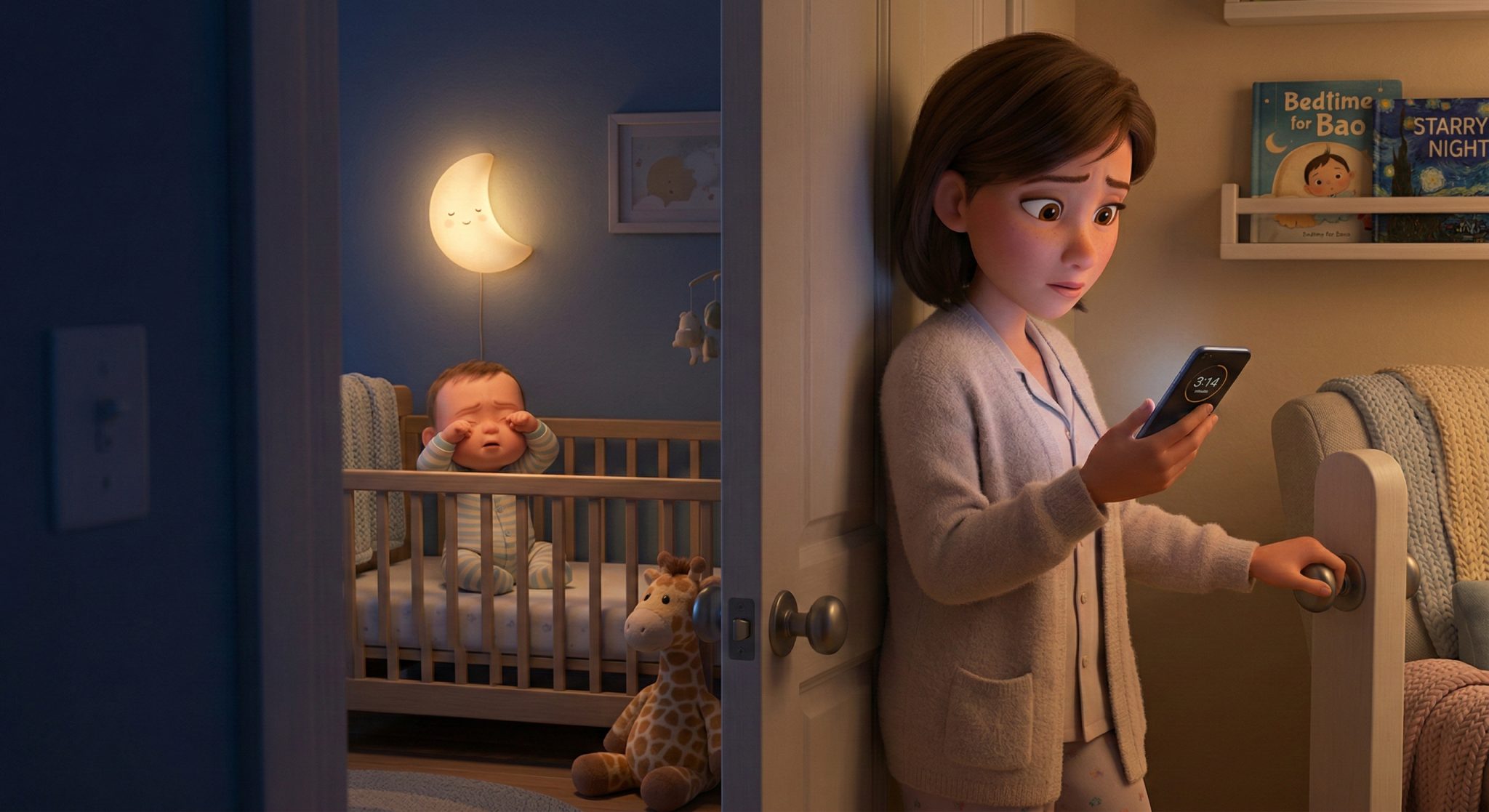


Current research does not show that the Ferber method harms children’s emotional development, attachment, or mental health, including studies following children up to age 5. That said, knowing the research and feeling okay about it are two different things. If you’ve found yourself awake at 2:13 a.m., googling “Ferber method safe?” while your baby cries in the next room, you are not alone. Few parenting decisions feel as emotionally loaded as the Ferber Method for sleep training. On one side, you’re exhausted — physically, mentally, sometimes emotionally unraveling. On the other, you’re terrified of doing something that might harm your baby or your bond.
The Ferber Method sits right at the center of that tension. It’s one of the most researched and widely used sleep training approaches, and yet it’s also one of the most misunderstood. Let’s slow it down and look at what it actually is, and what it isn’t.
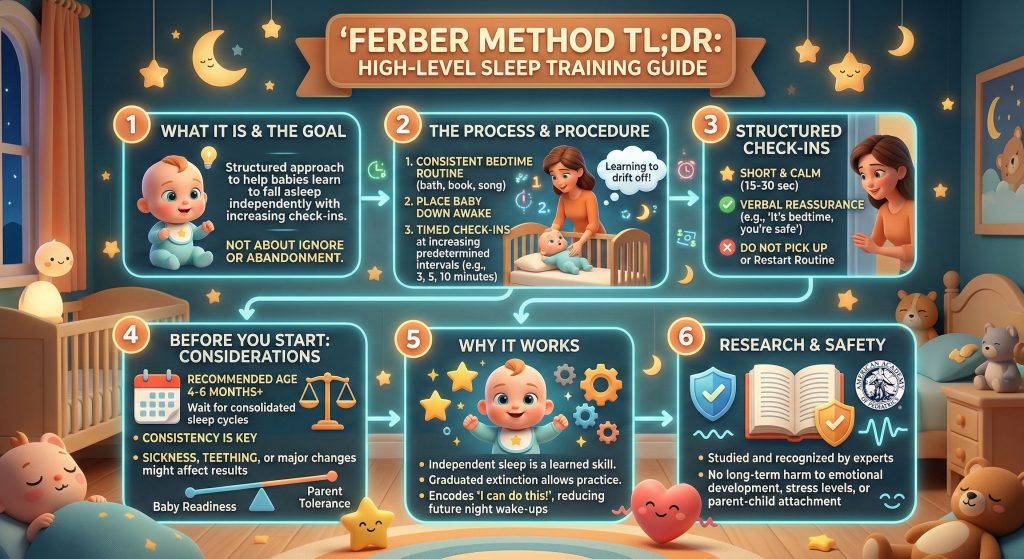
Table of Contents
What Is the Ferber Method for Sleep Training?
The Ferber Method, sometimes called graduated extinction or timed checks, is a structured approach to helping babies learn to fall asleep independently.
The core idea is simple: instead of responding immediately to every cry, you wait for predetermined intervals before briefly checking in. Over time, those intervals gradually increase. During check-ins, you offer short, calm reassurance, but you do not pick your baby up or restart the bedtime routine.
It is typically recommended for babies around four to six months and older, when circadian rhythms are maturing and night feeding patterns are more predictable. Despite how it’s often portrayed online, the Ferber Method is not the same as leaving a baby alone indefinitely. It is not about ignoring or abandonment. It is structured, time-limited response designed to teach a skill: falling asleep without external help. That’s an important distinction.
How the Ferber Method Works in Practice
Interestingly, the process begins long before the crying. A consistent bedtime routine becomes the anchor: bath, feed, books, song, whatever feels calming and repeatable in your home. The predictability signals safety and tells your baby: this is what happens before sleep.
Research published in Sleep found that a consistent nightly bedtime routine led to significant improvements in sleep onset, night wakings, and overall sleep continuity in infants and toddlers 4.
You place your baby down awake, not fully asleep in your arms, because the skill being practiced is the transition into sleep itself. If your baby cries, you wait for a short, predetermined amount of time. On the first night, that might be three minutes. You then go in briefly, usually no more than 15 to 30 seconds, and offer calm verbal reassurance. You might say, “You’re safe. It’s bedtime.” You do not pick up. You do not rock. You leave again.
If the crying continues, you wait five minutes before the next check. Then ten. Then perhaps fifteen. On subsequent nights, those initial intervals increase. Most families see meaningful improvement within three to seven nights, though nights two and three are often the hardest. It’s common for crying to temporarily intensify before it decreases, something called an extinction burst. That increase doesn’t mean it isn’t working; it often means the learning process is underway. Consistency is what allows the learning to consolidate.
Is the Ferber Method the Same as Cry It Out?
This is one of the most common points of confusion. The Ferber Method includes structured, timed check-ins. Traditional “cry it out” (full extinction) does not involve returning to the room at all after bedtime. That difference changes the emotional experience for many families. Some parents feel more regulated knowing they will check in. Others find that check-ins escalate their baby further.
Temperament matters, both yours and your baby’s. Neither approach has been shown in research to cause long-term attachment harm when used appropriately. But they feel different, and that emotional experience matters.
What Does the Research Say?
Graduated extinction is one of the most studied behavioral sleep interventions. A 2016 randomized controlled trial led by Gradisar and colleagues found no long-term negative effects on emotional development, attachment, or stress levels in children who underwent graduated extinction compared to those who did not receive sleep training 1. Follow-up data years later showed no measurable differences in emotional health or parent-child attachment.
Earlier research, including a 2006 review by Mindell and colleagues 2, found that behavioral sleep interventions significantly reduced bedtime resistance and night wakings while improving parental well-being. And in general, the American Academy of Pediatrics recognizes behavioral sleep interventions as safe and effective when developmentally appropriate 3.
Short-term crying does occur, which is real and can be challenging. But long-term harm has not been demonstrated in well-designed studies. Attachment is built across thousands of interactions over time, through responsiveness during the day, attunement, repair, feeding, play, comfort, and presence. A few structured nights do not override that foundation.
When Is the Right Time to Start?
Most experts suggest waiting until at least four months of age. Before that, babies are still developing more consolidated sleep cycles and often require nighttime feeding for nutritional reasons. Even at four to six months, readiness matters. A baby who is sick, teething intensely, traveling, or going through a major developmental leap may struggle more.
Parents often overlook their own readiness, but that matters just as much. If you feel deeply dysregulated by any amount of crying, this method may not align with your nervous system, and that tension can make consistency difficult. Sleep training works best when both baby and parent are developmentally ready.
Why It Works
Falling asleep independently is a learned skill. When babies rely on rocking, feeding, or holding to fall asleep, they often expect those same conditions during normal nighttime wake-ups. Graduated extinction allows babies to practice transitioning into sleep without that assistance. The waiting intervals create space for self-soothing behaviors, sucking fingers, shifting positions, settling.
When those behaviors succeed, the brain encodes the experience: “I can do this.” That learning reduces future wake-ups that require intervention.
Common Reasons Ferber Fails
When families say the Ferber Method “didn’t work,” it is often because one of three things happened: the intervals were inconsistent, the baby was overtired, or hunger was still a primary waking driver. Overtiredness is especially common. If bedtime is too late, cortisol rises, making it harder for babies to settle, regardless of the method.
Another frequent issue is changing the plan mid-night. Picking up during one check but not another can prolong crying because the reinforcement pattern becomes unpredictable. Consistency is not about rigidity. It’s about clarity.
Is the Ferber Method Harmful?
This is usually the quiet question under all the others. Here’s what the research shows:
- Long-term attachment: No negative effects found in studies following children up to age 5.
- Stress and cortisol: Short-term elevation during the first few nights, which normalizes as sleep improves – similar to other everyday frustrations in infancy.
- Emotional development: No measurable differences between children who experienced graduated extinction and those who didn’t.
- Parental wellbeing: Studies consistently report reduced maternal depression and improved family functioning.
That does not mean it feels easy and it doesn’t mean you won’t question yourself during the first night. It doesn’t mean it’s right for every family. It simply means that, from a developmental standpoint, secure attachment is resilient. Babies can experience short periods of frustration without damage to their bond.
The deeper question is often not “Is this harmful?” but “Can I tolerate this process?” And that answer is personal.
The Ferber Method FAQ
How long should I let my baby cry during the Ferber Method?
You do not let your baby cry indefinitely. The method uses predetermined, increasing intervals before brief check-ins. For example, on the first night, you might wait three minutes before entering the room, then five, then ten. On later nights, those starting intervals lengthen. The structure provides predictability, which supports learning. The key is deciding the intervals ahead of time so you are not making emotional decisions in the moment.
Does the Ferber Method cause trauma or attachment problems?
Research to date has not found long-term negative effects on attachment, emotional regulation, or stress markers in children who experienced graduated extinction. Short-term crying does temporarily raise stress hormones, as many everyday frustrations do in infancy, but follow-up studies show no lasting differences in emotional health. Attachment is built through repeated patterns of responsiveness across time, not defined by a few structured nights.
How long does the Ferber Method take to work?
Many families see improvement within three to seven nights. Night two or three is often the hardest, as babies test whether the pattern will change. That temporary increase in protest, sometimes called an extinction burst, can feel discouraging but is a normal part of behavioral learning. By the end of the first week, most babies fall asleep more quickly and wake less frequently.
Can I use the Ferber Method at three months?
Most pediatric experts recommend waiting until at least four months of age. Before that, babies’ sleep cycles are still organizing, and night feeds are often biologically necessary. Starting too early can lead to frustration without meaningful progress. Developmental readiness matters more than eagerness to begin.
What if my baby cries harder when I check in?
Some babies become more upset when they see a parent but are not picked up. If check-ins consistently escalate crying rather than soothe it, you may consider lengthening intervals or exploring a different method altogether. There is no single approach that works for every temperament.
What if Ferber isn’t working for us?
Before abandoning the method, assess foundational factors. Is bedtime aligned with age-appropriate wake windows? Is your baby overtired? Are night feeds still needed? Are you implementing intervals consistently? Sometimes adjusting timing or expectations makes a significant difference. And sometimes, a different method is simply a better fit for your family.
Final Thoughts
Sleep training is not a referendum on your attachment. It is a decision about how to teach a skill within your family’s emotional and practical reality. The Ferber Method is structured and well-researched, and works for many families. It is not universally easy nor morally superior. It is definitely not the only path to healthy sleep.
If you choose graduated extinction, choose it with clarity and consistency. If you choose something gentler or slower, that is equally valid. The goal is not perfection. The goal is sustainable rest, for everyone in your home.
4 Sources
- Gradisar, M., et al. (2016). Behavioral Interventions for Infant Sleep Problems: A Randomized Controlled Trial. Pediatrics, 137(6), e20151486. https://pubmed.ncbi.nlm.nih.gov/27221288/
- Mindell, J.A., et al. (2006). Behavioral Treatment of Bedtime Problems and Night Wakings: An American Academy of Sleep Medicine Review. Sleep, 29(10), 1263–1276. https://pubmed.ncbi.nlm.nih.gov/17068979/
- American Academy of Pediatrics. (2022). Sleep-Related Infant Deaths: Updated 2022 Recommendations for Reducing Infant Deaths in the Sleep Environment. https://pubmed.ncbi.nlm.nih.gov/35726558/
- Mindell, J.A., Telofski, L.S., Wiegand, B., & Kurtz, E.S. (2009). A Nightly Bedtime Routine: Impact on Sleep in Young Children and Maternal Mood. Sleep, 32(5), 599–606. https://pubmed.ncbi.nlm.nih.gov/19480226/