If you’re worried about daylight saving time baby sleep disruptions, you’re not alone. Twice a year, when the clocks shift forward or back, many parents brace themselves for overtired evenings, early wake-ups, and nap confusion.
It’s understandable to feel protective of your baby’s sleep, especially if it’s been hard-won. But here’s the reassuring truth: daylight saving time can temporarily shift your baby’s rhythm, yet it rarely causes lasting disruption.
This guide will walk you through what actually happens to baby sleep during the time change, why it feels bigger for little ones, and how to adjust your baby’s schedule gently and confidently.
Table of Contents
What Is Daylight Saving Time (And Why It Disrupts Baby Sleep)?
Daylight Saving Time simply shifts the clock by one hour.
In the spring, we “spring forward,” losing one hour. In the fall, we “fall back,” gaining one. The clock changes instantly, but your baby’s internal rhythm does not.
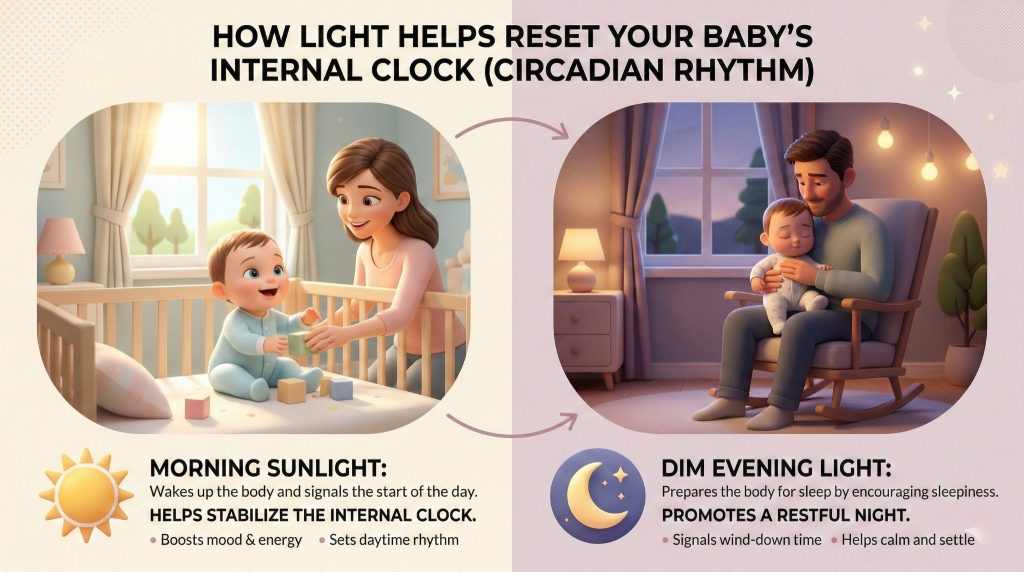
Baby sleep isn’t regulated by the numbers on the wall. It’s guided by the circadian rhythm, a biologically driven system influenced primarily by light exposure. Melatonin rises in darkness and falls with light. Consistent timing helps anchor that rhythm.
Research published in the Journal of Clinical Sleep Medicine confirms that infant circadian rhythms develop postnatally, with melatonin and sleep efficiency emerging around 9 weeks of age, and that light exposure through the eye is a key driver of this development ¹.
When the clock suddenly shifts, your baby’s body still expects sleep and wake times based on yesterday’s schedule. A 7:00 p.m. bedtime may suddenly feel like 8:00 p.m. internally. That mismatch is what creates temporary wobble.
The good news? Circadian systems recalibrate. Especially with steady light exposure and predictable routines.
Adults feel the time change too, but babies often feel it more intensely. Their internal clocks are still maturing. They build overtiredness more quickly. And their sleep regulation systems are more sensitive to shifts in light and routine.
The transition to daylight saving time has been shown to increase sleep fragmentation and reduce sleep duration, with effects that can persist for at least a week — and the AASM has formally called for the elimination of seasonal time changes due to their public health impact ².
When bedtime is pushed later than their body expects, as happens during spring forward, cortisol can rise, making it harder to settle. What looks like “resistance” is often just physiological adjustment. Your baby is adapting, and that takes a few days.
Spring Forward vs. Fall Back — What’s the Difference?
While both time changes can affect baby sleep, they tend to show up differently.
Spring forward, losing an hour, usually feels harder at first. Bedtime effectively becomes an hour later according to your baby’s internal clock. That can lead to overtiredness, short naps, or early morning waking for a few days.
Fall back often causes earlier wake-ups. If your baby normally wakes at 7:00 a.m., they may wake at what now reads 6:00 a.m., because internally it still feels like 7:00.
Both shifts are manageable. They simply require slightly different pacing.
How to Prepare Before the Time Change
There isn’t one “right” way to handle daylight saving time baby sleep shifts. The best approach depends on your baby’s temperament, age, and how sensitive they are to schedule changes, as well as how much bandwidth you have.
Option 1: Gradual Adjustment
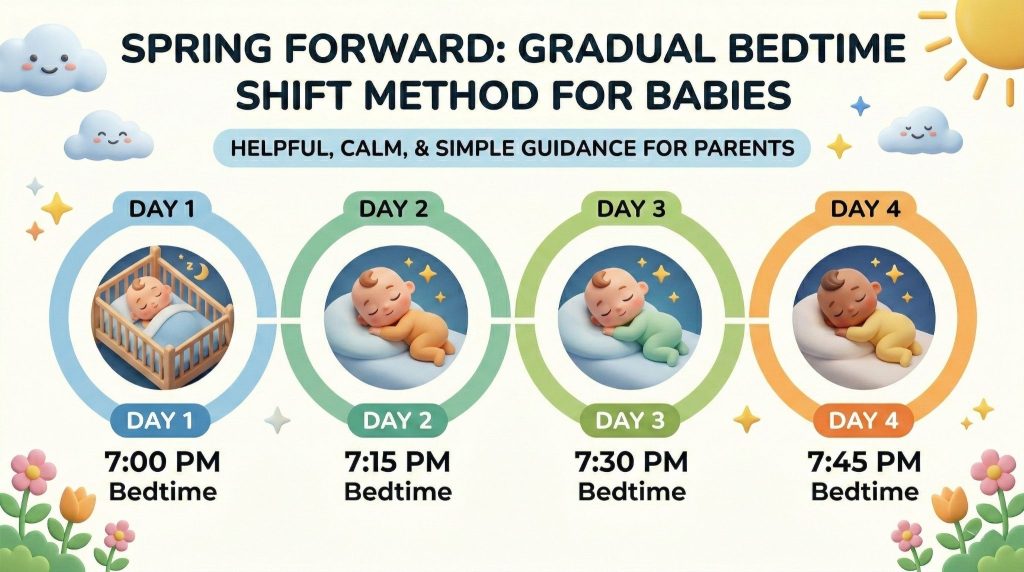
Starting three to five days before the time change, you can shift bedtime and naps by about 10–15 minutes each day. Morning wake time moves gradually as well.
This approach gives your baby’s circadian rhythm time to adjust more smoothly and may feel gentler for sensitive sleepers or babies under 12 months. This gradual approach is recommended by both the AAP and the AASM as a way to ease the transition for children ² ³.
Option 2: Cold Turkey Reset
On the day of the change, you can follow the new clock immediately. Wake at the desired time, keep naps aligned with developmentally appropriate wake windows, and use light strategically.
Most babies adjust within three to five days using this method. It can work well for flexible sleepers or toddlers. The AAP notes that while time changes can cause some drowsy days, kids usually adjust within about a week ³.
Both options are valid. As with anything in parenting, consistency matters more than perfection.
What to Do the Morning After “Spring Forward”
The first morning often feels the most confusing. If possible, wake your baby at your desired clock time rather than letting sleep drift too far. Expose them to bright natural light soon after waking. Light is the strongest regulator of circadian rhythm. A scoping review in the European Journal of Pediatrics found that duration of light exposure above 500 lux was a significant predictor of infant circadian rhythm development, reinforcing why morning light matters so much after a time change ⁴.
During the day, focus on appropriate wake windows rather than obsessing over the exact clock minute. If naps run slightly short, avoid dramatically restructuring the entire day. A slightly earlier bedtime can help prevent overtiredness.
Expect some temporary wobble. A few days of short naps or early waking does not mean sleep is unraveling.
Age-Specific Tips for Daylight Saving Time Baby Sleep
0–3 Months
Newborns are less clock-dependent. Focus on feeding cues, daytime light exposure, and calm evenings. Their sleep is biologically irregular already, so rigid shifting isn’t necessary.
4–8 Months
This age group is often most sensitive to time changes. Wake windows matter more. A gradual adjustment may feel smoother here, especially if sleep has been predictable.
If your baby is also in a 4 month sleep regression, remember that the developmental shift, not just the clock, may be influencing sleep.
9–18 Months
Older babies and toddlers may resist bedtime more behaviorally than biologically. Clear routines, consistent boundaries, and blackout curtains for early morning light can help anchor sleep.
Signs Your Baby Is Adjusting Well
Adjustment doesn’t mean perfection.
It’s normal to see:
A few days of early waking
One or two shorter naps
Mild fussiness at bedtime
Slight schedule drift
If sleep begins stabilizing within a week, your baby’s internal clock is recalibrating as expected.
Daylight Saving Time vs. Sleep Regression
It’s easy to confuse daylight saving time baby sleep disruptions with a sleep regression. Daylight Saving Time is an external clock shift. It temporarily misaligns your baby’s circadian rhythm but does not represent developmental change.
A sleep regression, by contrast, is tied to brain growth, new motor skills, or increased separation awareness.
Sometimes the two overlap, for example, daylight saving time may coincide with a 4 month sleep regression. In those cases, the disruption can feel amplified. But the time change itself does not cause a true regression.
Understanding this distinction helps prevent unnecessary panic.
When to Worry (Rarely)
Most daylight saving time baby sleep disruptions resolve within one week, occasionally stretching closer to two.
You do not need to worry if:
Sleep is slightly off for under 10 days
Wake times temporarily shift
Naps fluctuate briefly
Consider checking in with your pediatrician if sleep disruption persists beyond two weeks, your baby seems unusually lethargic or distressed, or appetite changes significantly, all of which are uncommon during this transition. Or of course always contact your doctor if you are ever concerned.
A Gentle Reminder for Parents
Daylight saving time baby sleep can feel like a fragile moment, especially if sleep has been hard-earned. But babies are adaptive. Their circadian systems recalibrate with light exposure, steady routines, and time. You don’t need drastic measures. You need gentle consistency.
This week might feel long. But your baby’s rhythm will settle again. And if you’d like help tracking sleep patterns or adjusting routines smoothly, Betteroo can guide you through transitions like this with clarity and calm.
Spring Forward 2026 FAQ
How long does it take babies to adjust to daylight saving time?
Most babies adjust to daylight saving time within three to seven days. For some, especially younger infants or very schedule-sensitive sleepers, it can take closer to 10–14 days for rhythms to fully recalibrate. The adjustment timeline depends on several factors:
Age and circadian maturity
Sensitivity to schedule changes
Light exposure patterns
Consistency of bedtime routine
If you’re seeing gradual stabilization over the course of a week, that’s expected. The body clock responds primarily to light and consistent timing. As long as mornings are anchored and evenings are predictable, most babies settle without long-term disruption. If sleep remains significantly misaligned beyond two weeks, it’s worth reassessing schedule structure rather than assuming the time change is still to blame.
Is spring forward harder for baby sleep?
For many families, yes. During “spring forward,” bedtime suddenly feels one hour later to your baby’s internal clock. A 7:00 p.m. bedtime may feel like 8:00 p.m. biologically. That can increase overtiredness, which in turn makes settling more difficult and may lead to short naps or early morning waking for several days. The key is protecting wake windows and preventing overtiredness from compounding. A slightly earlier bedtime on the first few nights can help buffer the shift. The disruption feels bigger than it usually is. Once the circadian rhythm resets to the new light-dark pattern, sleep typically smooths out.
Should I adjust my baby’s schedule before daylight saving time?
There are two reasonable approaches. A gradual shift involves moving naps and bedtime by 10–15 minutes per day starting three to five days before the change. This can feel smoother for sensitive babies or those under 12 months. A cold-turkey reset involves following the new clock immediately the day of the change, using morning light exposure and consistent routines to recalibrate quickly. Neither method is inherently superior. What matters most is consistency once you choose your approach.
Can daylight saving time cause a sleep regression?
Daylight saving time can temporarily disrupt sleep, but it does not cause a true developmental sleep regression. A sleep regression is driven by brain growth, motor milestones, or increased awareness. The time change is an external shift in the clock, not a neurological change. Sometimes the two overlap. For example, daylight saving time may coincide with the 4 month sleep regression. In those cases, sleep may feel particularly fragmented. But the clock change itself is not the developmental driver. Understanding this distinction can prevent unnecessary overhauls to your sleep approach.
Should I let my baby sleep in after the time change?
It depends on your goals. If your baby wakes slightly earlier or later than usual, modest flexibility can be helpful during the first few days. However, allowing sleep to drift too far from your desired wake time can delay adjustment. Morning light is the strongest circadian anchor. Waking within 30–60 minutes of your goal time and exposing your baby to natural light supports faster recalibration. The aim is gentle anchoring, not rigid enforcement.
Yates, J. (2018). The Long-Term Effects of Light Exposure on Establishment of Newborn Circadian Rhythm. Journal of Clinical Sleep Medicine, 14(10), 1829–1830.https://jcsm.aasm.org/doi/10.5664/jcsm.7426
Rishi, M.A., et al. (2020). Daylight saving time: an American Academy of Sleep Medicine position statement. Journal of Clinical Sleep Medicine, 16(10), 1781–1784.https://pmc.ncbi.nlm.nih.gov/articles/PMC7954020/
Yew, S.Y., et al. (2024). The role of light exposure in infant circadian rhythm establishment: A scoping review perspective. European Journal of Pediatrics.https://pmc.ncbi.nlm.nih.gov/articles/PMC11685245/