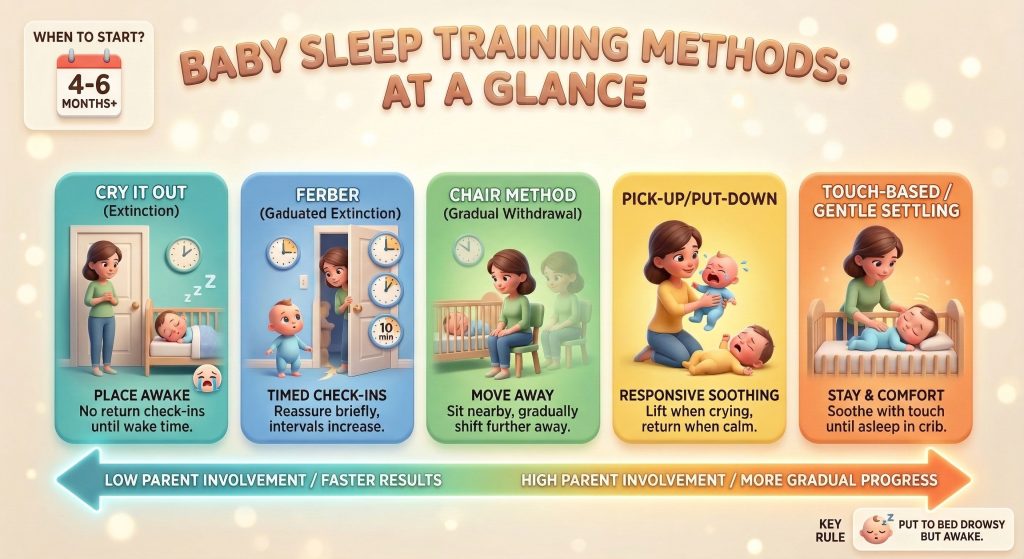
The most common sleep training methods include Cry It Out (extinction), the Ferber method (graduated extinction), the chair method, pick-up/put-down, and gentler touch-based settling approaches. These methods differ mainly in how much caregiver involvement they include and how gradually babies learn to fall asleep on their own.
Sleep training is one of those parenting topics that can feel bigger and more complicated than it actually is. The phrase itself often brings up strong reactions — curiosity, hope for better sleep, or sometimes worry about whether a baby might be pushed too quickly toward independence.
In practice, sleep training simply refers to a range of approaches that help babies learn to fall asleep with less help from caregivers over time. Some methods involve stepping back more quickly, while others allow parents to stay close and gradually reduce support.
There isn’t a single right approach for every family. Babies differ in temperament, parents differ in comfort level, and sleep often evolves in stages. Understanding the most common methods can help parents decide what might feel sustainable for their household.
Table of Contents
What Is Sleep Training?
Most babies wake several times during the night. This is a normal part of infant sleep cycles, especially in the early months when feeding and development are closely linked to sleep. Sleep training focuses on helping babies settle themselves back to sleep when they naturally wake between cycles. The goal isn’t to eliminate night waking entirely. Instead, it’s to help babies fall asleep more independently so that each wake-up doesn’t require the same level of assistance — feeding, rocking, or being held — every time.
Research supports this general framework, with a comprehensive review of behavioral treatments finding that teaching babies to fall asleep independently at bedtime is the most consistent predictor of fewer night wakings ¹.
For many families, interest in common sleep training methods begin when nights start to feel unsustainable. A baby may wake every hour or require long stretches of rocking or feeding to fall asleep. Caregivers can become exhausted, and routines that once worked no longer seem to help. At that point, parents often start exploring ways to support more predictable sleep.
It’s also important to remember that sleep development varies widely. Some babies begin settling more easily on their own with very little intervention, while others need more structure or consistency to develop those skills.
Most structured sleep training methods are introduced around four to six months of age, or older. Around this time, babies’ sleep cycles mature and begin to resemble the sleep patterns seen in older children and adults. Before this stage, newborn sleep tends to be biologically driven, where babies often need frequent feeding and soothing, and their sleep patterns shift rapidly as their nervous systems develop.
The American Academy of Pediatrics notes that babies do not develop regular sleep cycles until about four months of age, and suggests putting babies to bed drowsy but awake to encourage self-settling ⁶.
Signs a baby may be ready for more structured sleep support can include:
more predictable feeding patterns
longer stretches of sleep during the night
the ability to settle briefly with comforting routines.
Because each baby develops at a different pace, readiness can look slightly different from one family to another, and one child to another. When in doubt, many parents find it helpful to talk with their pediatrician before beginning a new sleep approach.
For younger babies, the focus is usually on gentle foundations, including calming bedtime routines, a consistent sleep environment, and responsive soothing. Evening fussiness like the witching hour is also common in the early months and typically resolves before formal sleep training begins.
What Are the Most Common Sleep Training Methods?
Sleep training approaches generally differ in three main ways:
how much crying may occur during the process
how much caregiver involvement they involve
how quickly sleep habits change
Method
Crying Level
Speed of Results
Parent Involvement
Cry It Out (Extinction)
Higher
Faster
Low
Ferber / Graduated Extinction
Moderate
Faster
Medium
Chair Method
Low–Moderate
Moderate
High
Pick-Up / Put-Down
Low–Moderate
Gradual
High
Touch-Based Settling
Low
Gradual
Very High
These methods can be thought of as existing on a spectrum. Some approaches gradually reduce parental involvement, while others emphasize staying physically present while babies learn new sleep patterns.
Common sleep training methods
Cry It Out (Extinction) Parents place the baby in the crib awake and allow them to fall asleep independently without returning for check-ins until a planned wake time or feeding.
Ferber Method (Graduated Extinction) Parents check on their baby at gradually increasing intervals while allowing them to fall asleep independently.
Chair Method (Gradual Withdrawal) A caregiver sits near the crib while the baby falls asleep and slowly moves farther away over several nights.
Pick-Up / Put-Down Parents briefly pick up the baby when they become upset and place them back in the crib once calm.
Touch-Based Settling Parents soothe the baby with gentle touch, such as patting or shushing, while the baby remains in the crib.
Cry It Out (Extinction Method)
The extinction method — often called “cry it out” — is one of the most widely discussed sleep training approaches. In this method, parents place their baby in the crib awake at bedtime and allow the baby to fall asleep without returning for check-ins.
The idea behind extinction is to remove sleep associations that may make it difficult for babies to settle independently. If a baby always falls asleep while feeding or rocking, they may expect that same support each time they wake during the night.
For some families, this method leads to relatively quick changes in sleep patterns. Babies may begin falling asleep more independently within several nights ². At the same time, it can be emotionally challenging for parents who find it difficult to listen to extended crying. Some babies also respond better to approaches that include periodic reassurance.
Ferber Method (Graduated Extinction)
The Ferber method takes a more gradual approach than extinction. Instead of leaving the room for the entire night, parents return to check on their baby at scheduled intervals that gradually increase. During these brief check-ins, caregivers typically offer verbal reassurance or a gentle touch but avoid picking the baby up.
Many families view the Ferber method as a middle ground. It allows babies to develop independent sleep skills while still giving parents opportunities to offer reassurance ¹. However, babies respond differently to check-ins. Some settle more easily when they hear a parent’s voice, while others may become more upset when a caregiver briefly appears and leaves again.
Chair Method (Gradual Withdrawal)
The chair method focuses on gradually reducing parental presence at bedtime. At the start, a caregiver sits next to the crib while the baby falls asleep. Over several nights, the chair is slowly moved farther away, toward the middle of the room, then near the door, and eventually outside the room.
This approach allows babies to adjust to falling asleep without constant assistance while still sensing that their caregiver is nearby. Because the process unfolds gradually, it often takes longer than extinction-based methods. Many families choose it because it feels emotionally gentler while still encouraging independent sleep.
Pick-Up / Put-Down Method
The pick-up / put-down method focuses on responsive soothing. When the baby becomes upset, the caregiver briefly picks them up to calm them. Once the baby is settled, they are placed back in the crib while still awake. The process is repeated as needed until the baby falls asleep.
For some babies, this brief reassurance helps them feel calm enough to remain in their sleep space while learning to settle independently. However, other babies may become more stimulated when picked up repeatedly, which can make the process feel physically demanding for caregivers.
Touch-Based or Responsive Settling
Touch-based methods use soothing techniques such as gentle patting, shushing, or placing a hand on the baby while they lie in the crib. These approaches often begin earlier in infancy and are sometimes used as a bridge before more structured sleep training methods.
For families who prefer to remain highly responsive at bedtime, touch-based settling can offer a way to support sleep without stepping away from the baby. Because the transition toward independence is gradual, these methods typically take longer to produce consistent changes.
How Sleep Training Methods Differ
Although these methods are often described separately, they largely differ in how quickly caregiver support fades during the bedtime process. At one end of the spectrum are highly responsive approaches where parents remain close and provide frequent soothing.
At the other end are approaches that reduce parental involvement more quickly so babies can develop independent settling skills. Neither approach is inherently better than another. The best fit often depends on the baby’s temperament, the caregiver’s comfort level, and the family’s capacity for consistency ⁵.
How to Choose a Sleep Training Method
When evaluating common sleep training methods, parents often choose a sleep approach based on several practical factors. One consideration is comfort with crying. Some methods involve more protest from babies than others, which can feel difficult for caregivers to tolerate.
Another factor is temperament. Some babies calm more easily when caregivers remain nearby, while others become more stimulated by parental presence. Families may also consider how quickly they hope to see changes. More structured approaches sometimes lead to faster shifts in sleep patterns, while gradual methods unfold more slowly.
Sleep learning rarely follows a perfectly predictable path. Some babies adjust within a few nights, while others need more time to adapt to new routines ⁴.
If a method does not seem to be helping after several days of consistent practice, families sometimes choose to adjust their approach. This might mean lengthening check-in intervals, offering more reassurance, or pausing and trying again later.
Sleep development continues throughout infancy — and new sleep behaviors like night terrors in toddlers can emerge as children grow — so strategies that feel difficult at one stage may become easier as a baby grows ⁴.
Are Sleep Training Methods Safe?
Research on behavioral sleep interventions has generally found no evidence that common sleep training methods harm emotional development or attachment when used with healthy infants ³.
Cleveland Clinic confirms that sleep training is considered safe and healthy for babies who are old enough and in a safe sleep environment, regardless of which method parents choose ⁷.
A five-year follow-up of a randomized sleep intervention trial found no lasting differences in emotional health, behavior, or parent-child attachment between children whose families used behavioral sleep strategies and those who did not ³.
Still, every baby’s needs are unique. If a baby has medical concerns, feeding difficulties, or ongoing sleep challenges, it can be helpful to discuss sleep strategies with a pediatrician.
Common Sleep Training Methods FAQ
What are the most common sleep training methods?
The most common sleep training methods include Cry It Out (extinction), the Ferber method, the chair method, pick-up / put-down, and gentler touch-based settling approaches.
These strategies differ mainly in how much caregiver involvement they include and how gradually babies transition toward independent sleep.
What sleep training method works fastest?
Sleep training approaches that reduce caregiver involvement more quickly—particularly extinction (often called “cry it out”) and graduated extinction methods like Ferber—tend to produce the fastest changes in sleep patterns.
With these methods, babies learn to fall asleep independently at bedtime rather than relying on feeding, rocking, or being held. Because the sleep association changes quickly, some families notice longer stretches of sleep within three to seven nights.
That said, “fastest” doesn’t necessarily mean easiest. Babies may protest more strongly at first as they adjust to a new routine, which can be emotionally difficult for caregivers.
More gradual approaches – such as the chair method, pick-up/put-down, or touch-based settling -usually take longer because parental support fades more slowly. These methods often feel more comfortable for families who prefer to remain physically present during the process.
In practice, the method that works “fastest” is often the one parents can apply consistently for several nights in a row.
What is the gentlest sleep training method?
Methods often described as “gentle” typically involve high levels of caregiver presence and responsiveness while babies learn to settle themselves. Common gentle approaches include (1) Pick-up / put-down, where caregivers briefly pick up a baby when they become upset and place them back in the crib once calm, (2) Touch-based settling, which uses soothing techniques like patting, shushing, or placing a hand on the baby while they lie in the crib and (3) The chair method, where parents remain in the room while their baby falls asleep and gradually move farther away over several nights.
These approaches allow parents to offer reassurance and physical presence while still helping babies practice falling asleep in their own sleep space. Because the transition happens gradually, gentle methods often require more patience and consistency, and results may unfold over several weeks rather than several nights. It’s also worth noting that babies respond differently. Some infants settle best with steady parental presence, while others become more stimulated by repeated interaction and may actually sleep better with fewer check-ins.
Is the Ferber method the same as cry it out?
The Ferber method and cry-it-out (extinction) are related but not identical. Both approaches aim to help babies learn to fall asleep independently without relying on feeding, rocking, or being held. The key difference is how caregivers respond during the process. With extinction, parents place the baby in the crib awake and typically do not return to the room until a scheduled wake time or feeding. With the Ferber method, parents check on their baby at gradually increasing intervals. These check-ins are brief and calm, usually involving verbal reassurance or a gentle touch without picking the baby up. For example, a caregiver might check after 3 minutes, then 5 minutes, then 10 minutes, lengthening the interval each time. Many families view the Ferber method as a middle-ground approach, combining independent sleep with structured reassurance.
What age should babies start sleep training?
Most pediatric sleep experts suggest that structured sleep training methods are most appropriate to begin around four to six months of age. Around this stage, babies’ sleep cycles begin to mature and their circadian rhythms become more established, which means they are often better able to learn new sleep patterns.
Before four months, sleep tends to be more biologically driven. Newborns wake frequently for feeding, growth, and neurological development, and their sleep patterns can change rapidly from week to week. Because of this, many families focus first on gentle sleep foundations—such as consistent bedtime routines, calming sleep environments, and responsive soothing—rather than formal sleep training.
Even after four months, readiness varies. Some babies may still need overnight feeds or extra support to settle, while others begin consolidating longer stretches of sleep naturally. Many parents start considering sleep training when their baby begins showing signs of predictable feeding patterns, longer stretches between nighttime wakings, or the ability to settle with a bedtime routine. If there are concerns about feeding, growth, or medical conditions, it can be helpful to discuss sleep strategies with a pediatrician before beginning.
Can parents combine sleep training methods?
Yes. In practice, many families use elements from several approaches rather than following a single sleep training method exactly as written. Sleep training frameworks are often best understood as guiding ideas rather than strict formulas, and parents frequently adjust them to fit their baby’s temperament and their own comfort level.
For example, some families begin with highly responsive strategies—such as touch-based settling or pick-up/put-down—while their baby is younger, then gradually transition to approaches like the chair method as routines become more established. Others may start with timed check-ins and adjust the length or frequency depending on how their baby responds.
Because sleep development continues to change throughout infancy, it’s common for families to modify their approach over time. The method that ultimately works best is usually the one that parents can apply consistently and that feels sustainable within the rhythms of their household.
Mindell, J.A., Kuhn, B., Lewin, D.S., Meltzer, L.J., & Sadeh, A. (2006). Behavioral Treatment of Bedtime Problems and Night Wakings in Infants and Young Children. Sleep, 29(10), 1263–1276.https://pubmed.ncbi.nlm.nih.gov/17068979/
Gradisar, M., Jackson, K., Spurrier, N.J., et al. (2016). Behavioral Interventions for Infant Sleep Problems: A Randomized Controlled Trial. Pediatrics, 137(6), e20151486.https://pubmed.ncbi.nlm.nih.gov/27221288/
Price, A.M.H., Wake, M., Ukoumunne, O.C., & Hiscock, H. (2012). Five-Year Follow-up of Harms and Benefits of Behavioral Infant Sleep Intervention: Randomized Trial. Pediatrics, 130(4), 643–651.https://pubmed.ncbi.nlm.nih.gov/22966034/
Tikotzky, L., & Sadeh, A. (2010). Sleep Patterns and Sleep Disruptions in Young Children: The Role of Parental Intervention. Journal of Child Psychology and Psychiatry, 51(10), 1150–1157.https://pubmed.ncbi.nlm.nih.gov/20659217/
Blunden, S., Thompson, K., & Dawson, D. (2011). Behavioral Sleep Interventions and Sleep Outcomes in Infants and Children: A Meta-Analysis. Sleep Medicine Reviews, 15(3), 177–185.https://pubmed.ncbi.nlm.nih.gov/21087885/