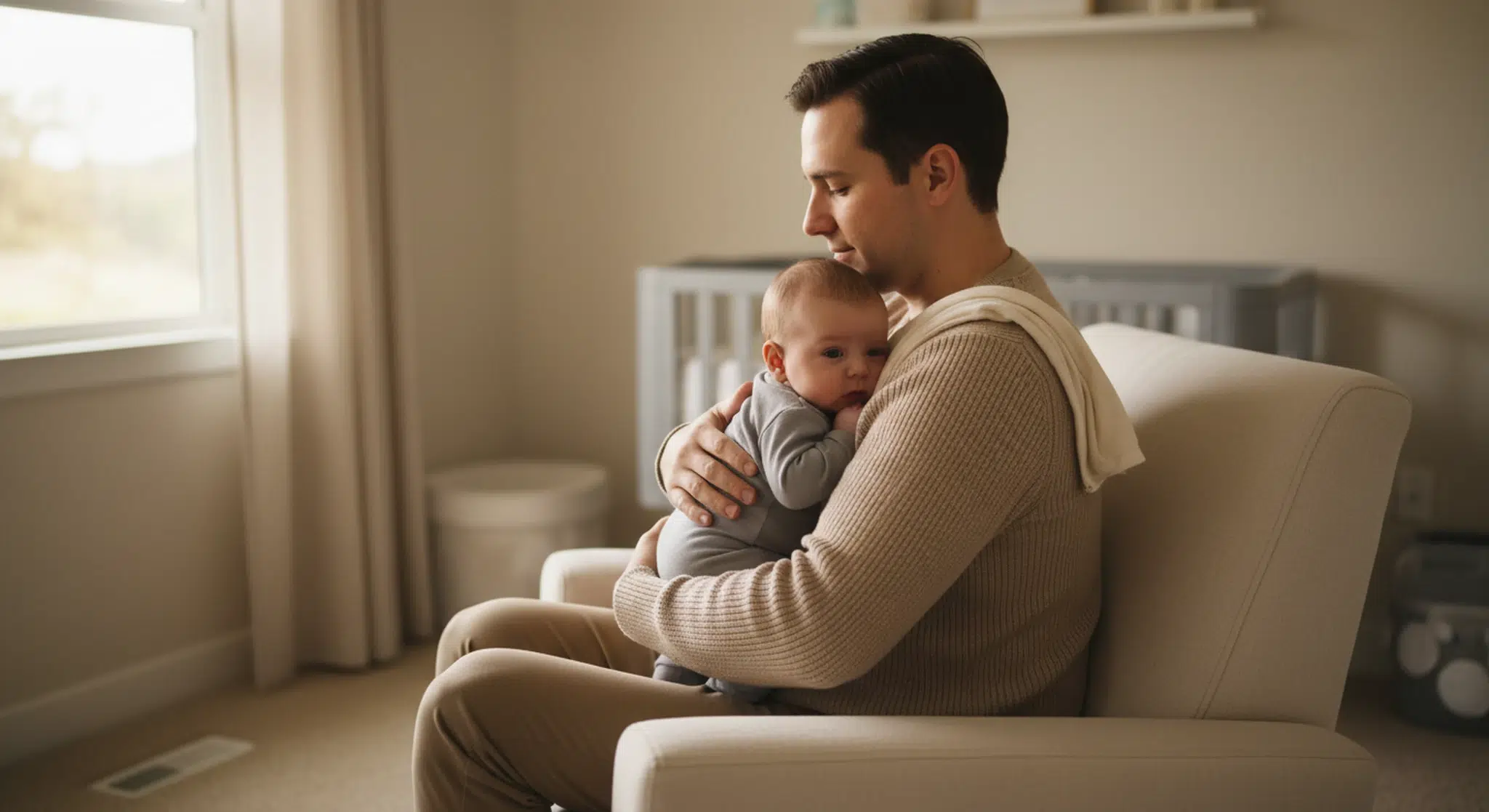
If your baby will not burp, it is usually because there is no trapped air to bring up. Not every feed produces a burp, and a baby who seems comfortable does not need one.
You have been patting for fifteen minutes. You have tried the shoulder, the lap, the knee thing your aunt swears by. Nothing. And now you are stuck deciding whether to keep going or put your baby down and risk the whole feed coming back up at 2am.
This is one of the most common newborn stalemates, and the reassuring news is that the stakes are much lower than they feel. Burping is a helpful comfort measure, not a medical requirement, and the absence of a burp is usually information rather than failure.
Key Takeaways
Not every feed produces a burp. No burp often just means no trapped air.
Try for about 5 to 10 minutes, then move on. Prolonged patting rarely helps.
Breastfed babies typically swallow less air than bottle-fed babies and often need less burping.
If your baby seems comfortable, you can safely lay them down without a burp.
Trapped lower gas comes out the other end, and bicycle legs help more than back patting.
Persistent pain with feeds, poor weight gain, or forceful vomiting are reasons to call your pediatrician.
Table of Contents
Why Your Baby Might Not Be Burping
The most common reason a baby will not burp is the simplest one: there is nothing to bring up. Burping releases air swallowed during a feed, and if your baby did not swallow much air, there is no burp waiting.
How much air a baby swallows varies a lot. A deep, well-formed latch at the breast lets very little air in. A bottle with a good seal and an appropriately slow nipple also limits swallowing. Fast flow, a shallow latch, a nipple that is not full of milk, or feeding during hard crying all increase it substantially.
There genuinely is no air. Common with an efficient latch or a calm, well-paced feed.
The air has already moved on past the stomach into the intestines, where patting cannot reach it.
Your baby is too relaxed. A deeply asleep baby has a relaxed esophagus and may not release air easily.
The position is not upright enough. Air needs to rise to the top of the stomach to escape.
Your baby burped without you noticing. Small burps are often silent, especially in newborns.
There is also a genuine developmental component. Very young newborns are less efficient at burping because the muscles involved are immature. Many babies become noticeably better at it after the first few weeks, and most need much less help by 4 to 6 months once they are sitting more upright and have better trunk control.
How Long Should You Try to Burp a Baby?
About 5 to 10 minutes is the practical limit. If a burp has not arrived by then, more patting is unlikely to produce one.
Quick Answer
Try one position for 3 to 5 minutes. If nothing happens, switch positions and try for another 3 to 5 minutes. If there is still no burp and your baby seems settled, stop. It is safe to lay them down.
The exception is a baby who is clearly uncomfortable: squirming, drawing legs up, grimacing, arching, or fussing in a way that suggests pressure rather than hunger or tiredness. That baby probably does have trapped air, and it is worth persisting a little longer and cycling through positions.
A useful reframe: you are not trying to extract a burp. You are giving your baby a comfortable opportunity to release air if they have any. That distinction takes the pressure off considerably.
Burping Positions That Actually Work
Different positions apply gentle pressure to the stomach from different angles. If one is not working, switching is more productive than continuing.
Position
How to do it
Best for
Over the shoulder
Baby upright against your shoulder, chest against you, high enough that your shoulder presses gently on their belly
The standard first attempt
Sitting on your lap
Baby seated upright, supporting the chin and jaw with your hand, leaning them slightly forward
Babies who need more abdominal pressure
Face down across your lap
Baby lying tummy-down across your thighs, head slightly higher than body, supported
Stubborn air, and gassy babies
Walking and swaying
Upright against your shoulder while you walk slowly
Babies who settle with motion
Sitting upright, gentle rock
Baby seated, supported, rocked slowly forward and back
A gentler alternative to patting
Common burping positions and when each tends to work best.
Two technique notes matter more than the position itself. Use a cupped hand rather than a flat one, which is gentler and more effective, and pat firmly enough to be felt rather than tapping lightly. Timid patting does very little.
Rubbing upward along the back in firm strokes, from the lower back toward the shoulders, works well for some babies who do not respond to patting. And genuinely upright matters: a baby slumped forward with their chin on their chest has a compressed airway and a compressed stomach, which is both less safe and less effective.
Gas sorted, nights still broken?
Betteroo builds a sleep plan around your baby’s real feeding and sleeping rhythms. About two minutes to see where you stand.
No. A baby who does not burp after a feed is usually fine, and this is worth stating clearly because the worry keeps a lot of parents awake.
The concern people carry is that trapped air will cause pain, or that the baby will spit up and choke while lying down. Neither holds up well. Babies who need to release air generally will, sometimes as a burp, sometimes as a passed gas, sometimes with a bit of spit-up. And healthy babies have strong protective reflexes: a baby who spits up while on their back will cough, swallow, or turn their head. Back sleeping does not increase choking risk in healthy infants, and it substantially reduces the risk of sleep-related death.
So if your baby is calm, has soft relaxed limbs, and is drifting off contentedly, you can lay them down on their back without a burp. If they are squirming, tense, drawing their legs up, or fussing, that discomfort is your signal to keep trying.
One caveat that is often overlooked: many babies fall asleep at the end of a feed and simply will not burp while deeply asleep. Holding a sleeping baby upright against your shoulder for 10 to 15 minutes after a feed lets gravity help, and often produces a burp without any patting at all.
When the Problem Is Lower Gas, Not a Burp
This distinction resolves a lot of frustration. Burping only reaches air still in the stomach. Once air has passed into the intestines, no amount of back patting will help, because you are working on the wrong part of the system.
The signs point to a different location. A baby with trapped intestinal gas typically draws their knees to their chest, has a firm or distended belly, strains and grunts, and gets visible relief after passing gas rather than after a burp.
Bicycle legs: lay your baby on their back and gently cycle their legs. Simple and often effective.
Knees to chest: hold both knees gently up against the abdomen for a few seconds, then release, and repeat.
Tummy time while awake: gentle pressure on the abdomen helps move gas along.
Warm bath: relaxes the abdominal wall and often helps things move.
Clockwise belly massage: follows the direction of the intestines.
Prevention through paced feeding: slower feeds with regular pauses mean less air in the first place.
Simethicone gas drops are widely sold for this and are generally considered safe, but the evidence that they outperform placebo is weak. Gripe water is not regulated as a medication in the United States, formulations vary considerably, and it is not recommended for young infants. Check with your pediatrician before giving your baby anything, including remedies marketed as natural.
Preventing Trapped Air in the First Place
Reducing swallowed air is more effective than getting better at removing it.
Feed before your baby is frantic. Crying hard means swallowing air, so watch for early hunger cues.
Check the latch. A deep latch with a wide mouth and lips flanged outward lets in far less air.
Keep the bottle nipple full of milk, so your baby is not drawing on air pockets.
Use a slow-flow nipple and resist moving up sizes on a schedule.
Feed more upright rather than reclined, which helps air separate and rise.
Pause mid-feed to burp, particularly for bottle-fed babies, at around the halfway point.
Keep your baby upright for 10 to 20 minutes after feeds if they are prone to spit-up.
If your baby is consistently very gassy, feeds are difficult, or you hear clicking during nursing, an evaluation of the latch by an IBCLC lactation consultant is worth doing. A shallow latch or an oral restriction can drive air swallowing, and both are fixable once identified.
When to Talk to Your Pediatrician
Difficulty burping is rarely a medical problem on its own, but call if you notice any of the following.
Your baby seems in pain during or after most feeds, arching, screaming, or pulling off repeatedly.
Forceful or projectile vomiting, or vomit that is green, or contains blood.
Poor weight gain, or falling off the growth curve.
Refusing feeds, or feeds that take much longer than they used to.
A hard, swollen, or tender belly that does not soften after passing gas.
Blood or mucus in the stool, or persistent diarrhea.
Inconsolable crying for more than about 3 hours a day, several days a week.
Any breathing difficulty, choking, or color change during feeds. Seek emergency care.
Persistent discomfort around feeds can point to reflux, a cow milk protein allergy, or a feeding mechanics issue such as a shallow latch or tongue restriction. All of these are identifiable and treatable, so persistent symptoms are worth investigating rather than waiting out.
Frequently Asked Questions
What if my baby won’t burp after feeding?
Try one position for 3 to 5 minutes, then switch and try another for 3 to 5 minutes. If there is still no burp and your baby seems comfortable and relaxed, it is safe to lay them down. No burp usually just means there was no trapped air to release.
How long should I try to burp my baby?
About 5 to 10 minutes total is the practical limit. Beyond that, more patting rarely produces a burp. The exception is a baby who seems visibly uncomfortable, squirming or drawing their legs up, in which case it is worth cycling through a few more positions.
Is it OK to put my baby down without burping?
Yes, if your baby seems settled and comfortable. Healthy babies have strong protective reflexes and will cough, swallow, or turn their head if they spit up. Back sleeping does not increase choking risk in healthy infants and significantly reduces the risk of sleep-related death.
Why can’t my baby burp but seems gassy?
The gas has likely moved past the stomach into the intestines, where burping cannot reach it. Look for knees drawn to the chest, a firm belly, and straining. Bicycle legs, knees to chest, supervised tummy time, and a warm bath help more than back patting in this situation.
Do breastfed babies need to be burped?
Often less than bottle-fed babies, because a deep latch lets in very little air. Many breastfed babies burp easily or do not need to at all. It is still worth offering the opportunity, especially if your milk flows quickly or your baby feeds while upset.
Comfortable baby, still no sleep?
Betteroo builds a plan around how your baby actually feeds and settles, not a one-size schedule. Takes about two minutes.