In the first year of life, most babies sleep 12–16 total hours per day 1, but sleep develops gradually, from irregular newborn sleep to longer night stretches and predictable naps by the end of the first year. Understanding baby sleep expectations during this time can help parents make sense of these changes. Baby sleep in the first year changes rapidly as circadian rhythms develop, sleep cycles mature, and feeding patterns evolve. Knowing what’s typical at each stage can help parents adjust expectations and respond with confidence.
Sleep in the first year evolves alongside rapid brain development, physical growth, and increasing awareness of the world. New skills, changing sleep cycles, and expanding social awareness can all influence how babies fall asleep and how often they wake.
Understanding what’s typical across the first year can make these changes feel far less alarming. We designed this guide to help you walk through how infant sleep develops month by month, why patterns shift, and what realistic sleep expectations actually look like during the first year.
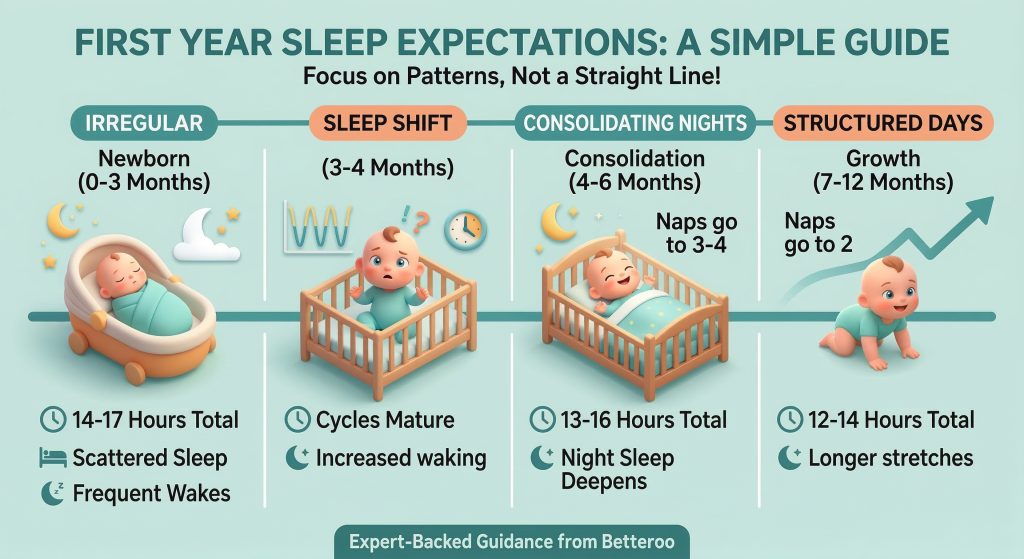
infographic of first year sleep expectations
Table of Contents
How Sleep Evolves During The First Year
Newborn stage: Sleep is irregular and spread across the entire day and night.
Around 3–4 months: Sleep cycles mature, which can temporarily disrupt sleep.
By 6 months: Many babies consolidate more sleep overnight and reduce naps.
By 12 months: Most babies take two naps and sleep longer stretches at night.
What Parents Often Expect vs. What Baby Sleep Actually Looks Like
Before diving into age-by-age sleep patterns, it helps to address a quiet assumption many parents carry: that baby sleep should gradually improve and stabilize over time. In reality, sleep in the first year tends to follow a more dynamic pattern where babies often make progress for a period, then experience a temporary disruption tied to development. For instance, a baby who begins sleeping longer stretches may suddenly wake more often again while learning a new motor skill or becoming more aware of their surroundings.
This pattern of improvement followed by reorganization is a normal part of neurological development. Sleep is closely connected to how the brain is maturing, and periods of change often accompany major developmental milestones. Understanding this pattern can help shift the question from “What did we do wrong?” to a more helpful one: “What might be changing for our baby right now?”
Sleep during infancy is shaped by several biological systems that mature gradually over time.
0-3 months: Newborns are not born with a fully developed circadian rhythm, so their sleep is distributed fairly evenly across day and night. Feeding needs also frequently interrupt longer stretches of rest. Over the first few months, light exposure and consistent routines help anchor the internal clock that eventually guides nighttime sleep.
3-4 months: Around three to four months, another important shift occurs as babies begin transitioning from newborn sleep patterns into more mature sleep cycles. These cycles include lighter and deeper stages of sleep, similar to those experienced by older children and adults. As babies begin cycling through these stages, they may wake more fully between cycles.
5-12 months: Throughout the rest of the first year, sleep continues to evolve alongside physical development, mobility, and social awareness. These changes help explain why sleep can feel stable for a while and then temporarily unsettled again.
Baby Sleep Expectations by Age
Newborn Sleep Expectations (0–3 Months): Newborn Sleep Is Irregular
In the newborn stage, sleep tends to be highly variable. Most babies sleep between 14 and 17 hours in a day 1, but that sleep is scattered throughout the day and night rather than concentrated in longer nighttime stretches.
Newborns wake frequently for feeding and comfort, and their internal clocks are still developing. Many babies fall asleep easily but wake often because their sleep cycles are short and their bodies require frequent nourishment.
While certainly challenging for parents, predictable schedules are uncommon during this stage. Instead, sleep often follows feeding rhythms and the baby’s natural sleep cues.
How Baby Sleep Changes Around 3–4 Months: Sleep Cycles Begin to Mature
Around three to four months, babies experience one of the most significant shifts in infant sleep. Their sleep cycles begin transitioning from newborn patterns into more organized stages of light and deep sleep 6.
This developmental change is commonly referred to as the 4 month sleep regression, though the term can be misleading. Sleep is not regressing so much as reorganizing.
As babies begin cycling through lighter sleep stages, they may wake more often between cycles. If they rely on specific conditions to fall asleep, they may signal for those conditions again when they wake.
This period can temporarily increase night wakings or shorten naps, but it reflects an important step in sleep maturation.
What Sleep Looks Like at 4–6 Months: Sleep Starts Consolidating
Between four and six months, many babies begin developing longer nighttime sleep stretches. Their circadian rhythm becomes more established, and their bodies start producing melatonin more consistently in response to darkness.
During this stage, naps may start falling into a loose pattern of three to four per day, though exact timing can still vary widely between babies.
Some babies begin experimenting with self-settling during this period. Our guide to common sleep training methods covers the main approaches, though night wakings remain common and feeding needs may still occur overnight.
Sleep Expectations for 6–9 Months: Mobility and Awareness Affect Sleep
Between six and nine months, baby sleep expectations often shift again as physical development accelerates. Babies learn to roll, sit, crawl, and explore their environment in entirely new ways.
These motor milestones can temporarily disrupt sleep. A baby who just learned to roll may practice rolling repeatedly in the crib. Another may push up to hands and knees during the night while learning to crawl.
At the same time, separation awareness begins to strengthen. Babies become more aware of caregivers leaving the room, which can make nighttime separations feel more noticeable ².
These changes can lead to brief phases of increased night waking or bedtime resistance. In Betteroo’s State of Baby Sleep survey of over 32,000 parents, the most frequent night waking occurred between 7 and 9 months, not at the commonly discussed 4-month regression.
Sleep Patterns for 9–12 Months: Sleep Becomes More Structured
By the end of the first year, many babies settle into a more predictable rhythm. Nighttime sleep often becomes longer and more consolidated, and daytime sleep typically transitions toward two naps.
During this stage, babies may experience a nap transition as they move from three naps to two. Temporary sleep disruptions can occur while schedules adjust, but they usually stabilize once the new rhythm settles.
Even at this age, some babies still wake occasionally overnight. Sleep consolidation continues gradually through the toddler years, and some children may begin experiencing night terrors as they grow.
How Much Sleep Babies Need in the First Year
Sleep needs vary between babies, but pediatric guidelines provide general ranges that help parents understand what’s typical.
Baby Sleep Schedule By Age
Age
Total Sleep
Naps
Typical Wake Window
0–2 months
14–17 hours
4–6 naps
45–90 minutes
3–4 months
13–16 hours
3–4 naps
1.5–2 hours
5–6 months
12–15 hours
3 naps
2–2.5 hours
7–9 months
12–14 hours
2–3 naps
2.5–3 hours
10–12 months
12–14 hours
2 naps
3–4 hours
These ranges represent averages rather than strict targets ¹ ⁴. Some babies naturally fall toward the lower end, while others need more sleep.
When Babies Start Sleeping Through The Night
Many parents wonder when babies are supposed to sleep through the night. This phrase can be confusing because it’s often defined differently depending on the source. In pediatric sleep research, “sleeping through the night” often means a stretch of about five to six hours without waking. For parents, however, the phrase usually implies sleeping from bedtime until morning without interruption.
In practice, many babies continue waking at least occasionally during the first year. Feeding needs, developmental changes, and individual temperament all influence nighttime sleep patterns. For some babies, longer stretches emerge earlier. For others, nighttime waking remains part of normal sleep development for a longer period.
When baby sleep expectations suddenly shift, it can feel confusing or discouraging. In most cases, however, these changes are tied to developmental progress rather than something parents did wrong.
Several factors commonly influence sleep patterns during the first year.
Developmental milestones: Motor skills such as rolling, crawling, and pulling to stand often appear during the same months that sleep disruptions occur. Babies frequently practice these new abilities at night while their brains consolidate new skills.
Cognitive growth: As babies develop stronger memory and awareness, they begin understanding that caregivers exist even when they are not visible. This new awareness can briefly make nighttime separations feel more significant.
Schedule changes: Wake windows gradually lengthen as babies grow. When daily rhythms drift too long or too short, sleep may become temporarily unsettled until the schedule adjusts.
Environmental disruptions: Illness, travel, new childcare environments, or even time changes can temporarily affect sleep rhythms.
Looking at sleep changes through these categories can help parents respond thoughtfully rather than assuming something has gone wrong. While infant sleep evolves naturally, a few consistent habits can support more stable rhythms.
A predictable bedtime routine helps signal that sleep is approaching 3. This routine does not need to be elaborate; a simple sequence such as feeding, bathing, reading, and dimming lights can help anchor the transition to sleep.
Maintaining developmentally appropriate wake windows during the day can also help prevent overtiredness, which sometimes makes it harder for babies to settle.
During periods of disruption, gentle consistency tends to be more helpful than dramatic changes ³. Babies often move through sleep shifts more smoothly when routines stay familiar and reassuring.
A Simple Way to Think About Sleep Changes
When baby sleep expectations suddenly change, it can help to step back and look at the bigger picture.
Many parents find it useful to ask three simple questions:
Has my baby recently learned a new skill?
Has our daily rhythm shifted?
Has something changed in the environment?
These questions often reveal the underlying reason for a sleep shift. Rather than reacting to a single difficult night, this approach encourages observing patterns over several days before making adjustments.
With time, many sleep disruptions resolve naturally as babies adapt to their newest stage of development.
Most babies sleep 12–16 hours total per day during the first year.
Sleep becomes more predictable between 4–6 months.
Many babies transition from 3 naps to 2 naps between 6–9 months.
Night waking is still common during the first year and often developmentally normal.
FAQs About First Year Sleep
How much sleep should babies get in the first year?
Most babies sleep between 12 and 17 hours in a 24-hour period during the first year, though the exact amount varies with age. Newborns typically sleep the most overall but in short stretches spread across day and night. As babies grow, sleep gradually consolidates into longer nighttime periods with fewer daytime naps. It’s important to remember that these numbers represent averages. Some healthy babies naturally fall slightly above or below these ranges without it indicating a problem.
When do babies usually sleep through the night?
Many babies begin sleeping longer stretches between four and six months, though “sleeping through the night” can mean different things. Pediatric sleep studies often define it as a five- to six-hour stretch of sleep. Some babies reach this stage earlier, while others continue waking occasionally through the first year. Night waking can reflect feeding needs, developmental changes, or temperament rather than a sleep issue.
Why does baby sleep expectations suddenly get worse after it seemed to improve?
Sleep disruptions often coincide with developmental milestones. When babies learn new motor skills or become more aware of their surroundings, their brains remain active during sleep as they process these changes. As a result, night wakings or shorter naps may temporarily appear even after sleep had been improving. In many cases, sleep stabilizes again once the new developmental phase settles.
Are sleep regressions real?
The term “sleep regression” is commonly used to describe temporary periods when sleep becomes more disrupted. While the label suggests backward movement, these phases are often linked to forward development. Changes around four months, for example, reflect the maturation of sleep cycles rather than a loss of sleep ability. Other disruptions may appear when babies are learning new physical or cognitive skills.
What if my baby still wakes several times at night?
Frequent night waking can be normal in the first year, especially during the early months. Babies have small stomachs, developing sleep cycles, and changing comfort needs. Some babies consolidate nighttime sleep earlier than others, while some continue waking periodically into the toddler years. Observing patterns over time often provides more insight than focusing on a single night of disrupted sleep.
Do all babies follow the same sleep schedule in the first year?
No two babies follow identical sleep patterns. While general sleep ranges and developmental stages provide useful guidance, temperament, feeding patterns, and individual sleep needs all influence how a baby’s rhythm unfolds. Some babies naturally fall into predictable schedules earlier, while others take longer to develop consistent routines.
When do naps become predictable?
Naps often begin to stabilize between four and six months as circadian rhythms strengthen and wake windows lengthen. Earlier in infancy, naps may be short and unpredictable, which is developmentally typical. As babies approach the middle of the first year, many begin settling into a more consistent pattern of daytime sleep, though occasional variation remains common.
A Reassuring Takeaway
Sleep during the first year rarely follows a straight path. Babies move through phases of steady progress, temporary disruption, and gradual stabilization as their brains and bodies grow.
When sleep shifts occur, they often reflect developmental change rather than something parents did wrong. Responding with steady routines, patience, and observation can help families navigate these changes with more confidence.
With time, most babies naturally move toward longer, more predictable sleep rhythms. And understanding realistic baby sleep expectations can make those unpredictable moments feel far less overwhelming.
And if you need help spotting patterns or deciding what’s actually changing, that’s exactly where Betteroo can support you — tracking rhythms, milestones, and shifts so you can respond with clarity instead of guesswork.
Paruthi, S., et al. (2016). Recommended Amount of Sleep for Pediatric Populations: A Consensus Statement of the American Academy of Sleep Medicine. Journal of Clinical Sleep Medicine.https://pmc.ncbi.nlm.nih.gov/articles/PMC4877308/
Mindell, J.A., Leichman, E.S., DuMond, C., & Sadeh, A. (2017). Sleep and Social-Emotional Development in Infants and Toddlers. Journal of Clinical Child & Adolescent Psychology.https://pubmed.ncbi.nlm.nih.gov/27845587/
Gruber, R., et al. (2014). The Association Between Sleep Duration and Developmental Outcomes in Infancy and Early Childhood. Sleep Medicine Clinics.https://pubmed.ncbi.nlm.nih.gov/25193188/
Bruni, O., et al. (2014). Longitudinal Study of Sleep Behavior in Normal Infants during the First Year of Life. Journal of Clinical Sleep Medicine, 10(10), 1119–1127.https://pmc.ncbi.nlm.nih.gov/articles/PMC4173090/