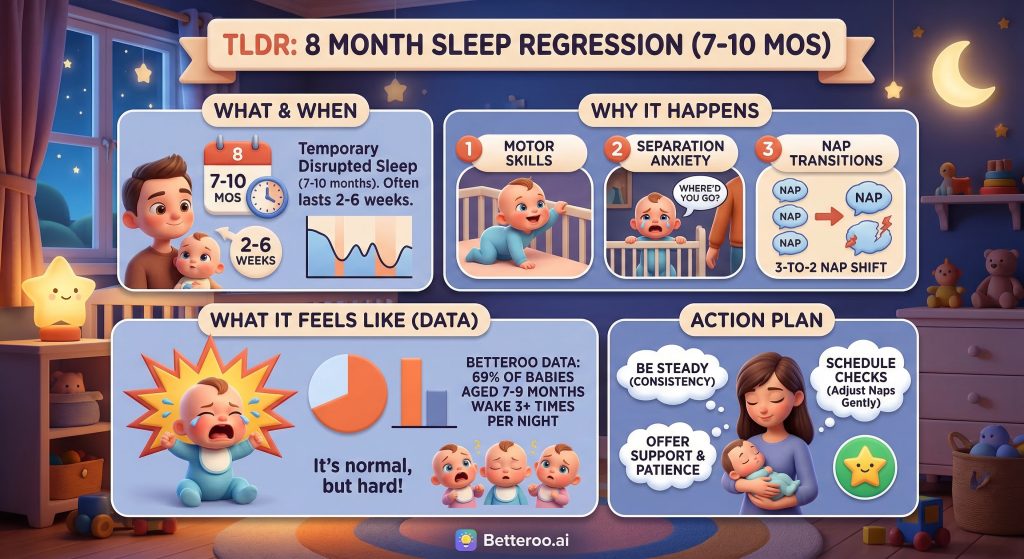
The 8 month sleep regression is a period of disrupted sleep, most often occurring between 7 and 10 months, when a baby who had been sleeping more predictably may suddenly begin waking more at night, resisting naps, or struggling to settle at bedtime.
Despite the name, it isn’t a precise milestone that happens right at 8 months. It’s better understood as a developmental window where sleep becomes more inconsistent as your baby is learning, moving, and processing the world in entirely new ways. For many families, this ends up being one of the most challenging stretches of sleep in the first year, not because something is wrong, but because several important changes are happening at once.
Key takeaways
The 8 month sleep regression is a temporary period of disrupted sleep that typically occurs between 7 and 10 months.
It’s driven by developmental changes — crawling, pulling to stand, separation anxiety, and the shift from three naps to two.
Most babies move through it in 2 to 6 weeks with consistency and small schedule adjustments.
Betteroo’s sleep data shows that 69% of babies aged 7–9 months wake three or more times per night — if this feels hard, you’re not imagining it.
8 month sleep regression infographic
Table of Contents
What is the 8 month sleep regression?
The 8 month sleep regression refers to a temporary shift in sleep patterns in late infancy, where a baby may wake more frequently overnight, take shorter or more inconsistent naps and need more support to fall asleep. It often follows a period of more stable sleep, which is why it can feel especially frustrating.
Not every baby goes through a clear regression, and for those who do, the timing varies. Many parents who search for “8 month sleep regression” are actually experiencing a broader 7–10 month sleep disruption, which reflects normal developmental changes rather than a fixed event.
How much sleep does an 8 month old need?
At this age, most babies need about 12 to 15 hours of total sleep in a 24-hour period, including both nighttime sleep and naps 1.
Typically, that looks like:
10–12 hours overnight (often with at least one waking)
2–3 hours of daytime sleep, usually across two naps
What matters just as much as total sleep, though, is how that sleep is distributed. Around 8 months, many babies are in the middle of shifting from three naps to two, and that transition alone can temporarily disrupt both naps and nighttime sleep.
What are the signs of the 8 month sleep regression?
Most parents don’t need a definition, they recognize it because something that was working suddenly isn’t. You might notice your baby waking more often overnight, even if they had started to stretch longer sleep. Bedtime can become harder, with more resistance or longer settling. Naps may shorten, become inconsistent, or feel like they’ve fallen apart entirely. At the same time, your baby may seem more alert, more mobile, and more emotionally aware, pulling up in the crib, practicing new skills, or becoming upset when you leave the room. These changes tend to show up together, which is what makes this stage feel so intense.
Why does the 8 month sleep regression happen?
If this phase feels sudden, it’s because several developmental shifts tend to converge at once. Physically, many babies are learning to crawl, pull to stand, or move in new ways. Those skills don’t simply turn off at bedtime, your baby may literally be too busy practicing to settle easily 2,3.
Emotionally, this is also when separation anxiety becomes more pronounced. Your baby now understands that you exist even when you’re not in the room, which can make both bedtime and night wakings feel more distressing 4. If you’re wondering whether this is a developmental phase or something else, our guide on growth spurts vs. sleep regressions can help you tell the difference.
At the same time, daytime sleep is often in transition. As babies move toward a two-nap schedule, the balance between being overtired and not tired enough becomes more delicate. Even small mismatches in timing can show up as night waking or nap resistance.
Layer in cognitive development, possible teething, and the simple fact that what worked a month ago may no longer work the same way, and it starts to make sense why sleep can feel like it’s unraveling.
How long does the 8 month sleep regression last?
For most babies, the 8 month sleep regression lasts between 2 and 6 weeks.
If the disruption is primarily developmental, it often improves on its own as your baby adjusts. If it’s being reinforced by schedule issues or sleep habits that no longer align with your baby’s needs, it may persist longer until something shifts.
A helpful rule of thumb: if sleep is gradually improving, even slowly, you’re likely in a temporary phase. If it’s staying the same or getting harder over several weeks, it may be worth taking a closer look at schedule and routines.
What should you do during the 8 month sleep regression?
The instinct to fix everything quickly is understandable, but this stage usually responds better to steady, thoughtful adjustments than big resets.
Start with consistency. A predictable bedtime routine becomes even more important when your baby is dealing with separation anxiety and increased awareness. The goal isn’t to make bedtime perfect—it’s to make it familiar.
From there, look at the daytime rhythm. Around this age, small shifts in nap timing or total daytime sleep can have an outsized impact on nights. If naps have become erratic, it’s often a signal that your baby is transitioning schedules rather than regressing randomly.
It’s also okay to offer more support than usual. Many parents worry about “creating bad habits” in this phase, but short-term responsiveness doesn’t undo long-term progress. In fact, feeling supported can help your baby move through the disruption more smoothly.
At the same time, it can be helpful to zoom out and make a clear decision: is this something you want to ride out, or is this a moment to adjust how sleep is happening? There isn’t a single right answer, but deciding intentionally is often what reduces stress the most.
Not sure what’s causing your baby’s sleep disruption?
Get a personalized plan based on your baby’s age, schedule, and sleep patterns.
Should you sleep train during the 8 month sleep regression?
This is one of the most searched, and most misunderstood, questions. There’s no universal recommendation to either sleep train or avoid it during this phase. What matters more is why your baby’s sleep has changed and what you want to change in response. If your baby was previously sleeping well and the disruption feels clearly tied to development, many families choose to wait it out and stay consistent.
If sleep has been difficult for a while, or is becoming less sustainable, it can also be a reasonable time to introduce more structure or change how your baby falls asleep. Research supports that a range of behavioral sleep approaches can be safe and effective when used appropriately – our guide to sleep training methods walks through the options so you can decide what fits your family. But none are required. A more helpful question than “should I sleep train?” is: Do we want to change our current approach to sleep right now, or give this phase more time?
What parents expect vs. what actually happens at 8 months
Many parents enter this stage thinking sleep should be getting easier. And in some ways, it is, babies are more predictable, more interactive, more engaged. But sleep doesn’t always follow that same linear path.
In fact, for many families, this is one of the most disrupted windows of sleep in the entire first year. That gap between expectation and reality is often what makes this phase feel so discouraging. If you’re curious about what’s actually typical, our breakdown of baby sleep expectations by age puts it in context.
What Betteroo’s sleep data shows about this age
This isn’t just anecdotal. In Betteroo’s State of Parent & Baby Sleep 2026, 69% of babies between 7 and 9 months were waking three or more times per night, higher than any other age group measured.
In other words, if this stage feels especially hard, you’re not imagining it, and you’re not alone in it.
Is this really an 8 month sleep regression—or something else?
Not every change in sleep at this age is a regression. Sometimes what looks like a regression is actually:
a baby who is ready for a different nap schedule
temporary overtiredness or undertiredness
teething or mild illness
a shift in routine due to travel or life changes
The label matters less than understanding what’s driving the pattern you’re seeing.
When should you talk to your pediatrician?
Most sleep disruption at this age is developmental. But it’s worth checking in if you notice signs of ongoing discomfort, feeding changes, or sleep challenges that persist beyond several weeks without improvement. You don’t need to wait for things to feel extreme, if something feels off, it’s reasonable to ask. Sleep regressions can affect appetite and feeding patterns too — if you’re navigating both at once, our 7-8 month feeding schedule can help you stay oriented.
Bottom line
The 8 month sleep regression isn’t a single moment, it’s a stretch of rapid change. Your baby is learning new skills, developing new awareness, and adjusting to a shifting daily rhythm. Sleep is often where all of that shows up. Most of the time, this phase passes with consistency, small adjustments, and time. Not perfectly, but steadily.
Every baby’s sleep journey is different
Find out what’s behind your baby’s night wakings and what to adjust first.
Most babies experience disrupted sleep for about 2 to 6 weeks during this phase. If the changes are primarily developmental — new motor skills, separation anxiety, cognitive leaps — sleep often stabilizes on its own as your baby adjusts. However, if the disruption is being reinforced by schedule mismatches or sleep habits that no longer fit your baby’s needs, it can stretch longer.
A helpful indicator: if sleep is gradually improving, even slowly, you’re likely moving through a temporary phase. If it’s staying the same or getting harder after several weeks, it may be time to take a closer look at your baby’s daytime routine and how they’re falling asleep.
Is the 8 month sleep regression real?
Yes – though it’s not a precise milestone that happens at exactly 8 months. It’s better understood as a common window of sleep disruption between 7 and 10 months, driven by developmental changes like crawling, separation anxiety, and the shift from three naps to two. Not every baby goes through a dramatic regression, and the timing varies.
But the pattern is well-documented: research shows that infants who are actively learning to crawl tend to have more night wakings than those who haven’t yet started 2.
Why is my 8 month old waking every 2 hours?
Frequent night waking at this age usually comes from several things happening at once. Your baby may be practicing new physical skills like crawling or pulling to stand, which can carry over into sleep. Separation anxiety is also emerging — your baby now understands you exist when you’re out of sight, but doesn’t yet grasp that you’ll come back.4
On top of that, the transition from three naps to two can create overtiredness or undertiredness, both of which show up as more wakings. If your baby has always needed help to fall asleep (feeding, rocking), they may also be waking between sleep cycles and needing that same help to resettle.
Does the 8 month sleep regression affect naps?
Yes — naps are often one of the first things to shift. You might notice shorter naps, more resistance at nap time, or your baby skipping a nap entirely. Much of this is connected to the 3-to-2 nap transition, which typically happens between 7 and 9 months. As wake windows lengthen, the timing that used to work may no longer fit.
If your baby is fighting the third nap consistently, it’s usually a sign they’re ready to drop it — though the adjustment period can temporarily make both naps and nights feel harder.
How much sleep should an 8 month old get?
Most 8 month olds need 12 to 15 hours of total sleep in a 24-hour period, including 10–12 hours overnight and 2–3 hours of daytime sleep across two naps 1. Wake windows at this age are typically around 2.5 to 3.5 hours. Keep in mind that these are ranges — some babies fall on the higher or lower end and still sleep well.
What matters more than hitting an exact number is whether your baby seems rested during the day and is able to settle at bedtime without a prolonged struggle.
Can teething cause the 8 month sleep regression?
Teething can contribute to disrupted sleep, but it’s rarely the whole picture. Teething discomfort typically lasts a few days per tooth, while the 8 month sleep regression tends to stretch over several weeks. If your baby is showing signs of teething – drooling, chewing, red gums – it may be adding to the difficulty, but it’s more likely that developmental changes and schedule shifts are the primary drivers. One way to tell: if sleep disruption continues well after the tooth has come through, something else is going on.
Should I sleep train during the 8 month sleep regression?
There’s no single right answer — it depends on your baby’s patterns and what feels sustainable for your family. If your baby was sleeping well before and the disruption feels clearly developmental, many families choose to stay consistent and ride it out. If sleep has been difficult for a while and is becoming harder to manage, this can also be a reasonable time to introduce more structure.
Research supports that a range of behavioral sleep approaches are safe and effective when used appropriately 5. A more helpful question than “should I sleep train?” is: do we want to change our current approach, or give this phase more time?
Why was my baby sleeping well and suddenly isn’t?
This is one of the most common and frustrating experiences at this age. Your baby’s brain and body are going through rapid changes – learning to crawl, developing object permanence, becoming more emotionally aware – and sleep is often where all of that shows up.2,3 What worked a month ago may no longer match your baby’s current needs.
That doesn’t mean something is wrong or that previous progress has been lost. In most cases, it means your baby is developing exactly as they should, and their sleep needs a chance to catch up.
Is this the hardest sleep regression?
For many families, yes. Both parent reports and sleep data suggest that 7 to 9 months is one of the most challenging sleep periods in the first year. In Betteroo’s State of Parent & Baby Sleep 2026, 69% of babies between 7 and 9 months were waking three or more times per night – higher than any other age group measured.
Part of what makes this phase feel so hard is the gap between expectations and reality: parents often assume sleep should be getting easier by now, so the disruption comes as a surprise.
What if my baby’s sleep isn’t improving?
If sleep hasn’t improved after several weeks, it’s worth reassessing a few things: is your baby’s schedule still age-appropriate? Are they getting too much or too little daytime sleep? Has the way they fall asleep changed in a way that’s now reinforcing the wakings? You don’t have to stay stuck in a difficult pattern.
Sometimes a small schedule shift – adjusting wake windows or moving bedtime earlier – is all it takes. If you’re unsure where to start, Betteroo’s free sleep quiz can help you figure out what to adjust first based on your baby’s age and current routine.
6 Sources
Hirshkowitz, M., et al. (2015). National Sleep Foundation’s Sleep Time Duration Recommendations: Methodology and Results Summary. Sleep Health, 1(1), 40–43.https://pubmed.ncbi.nlm.nih.gov/29073412/
Berger, S.E. & Moore, C.T. (2021). A Time Series Analysis of the Relation Between Motor Skill Acquisition and Sleep in Infancy. Infant Behavior and Development, 65, 101654.https://pubmed.ncbi.nlm.nih.gov/34688078/
Mindell, J.A., et al. (2006). Behavioral Treatment of Bedtime Problems and Night Wakings in Infants and Young Children. Sleep, 29(10), 1263–1276.https://pubmed.ncbi.nlm.nih.gov/17068979/