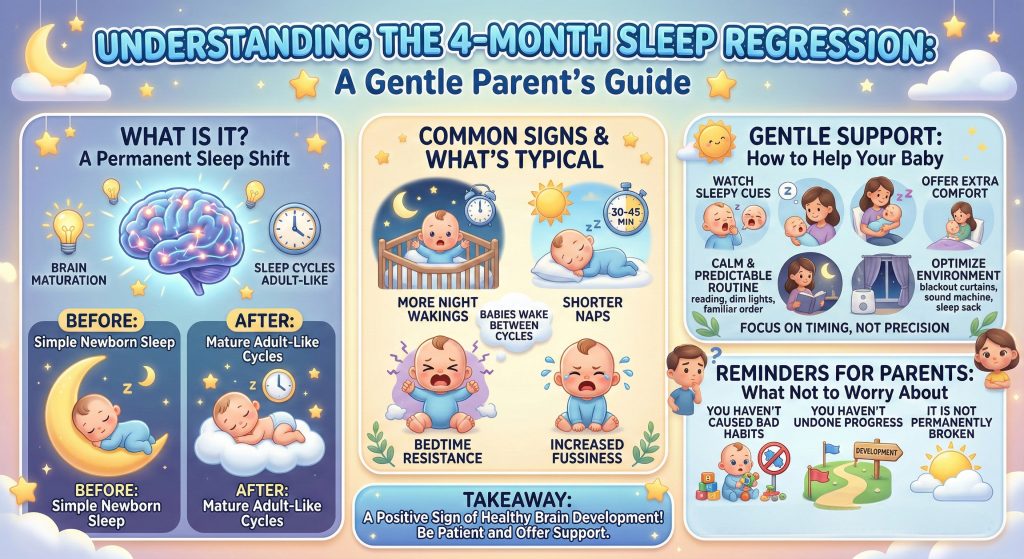
The 4 month sleep regression typically lasts 2–6 weeks, with peak disruption in weeks 2–3. It’s driven by a permanent shift in your baby’s sleep architecture, not by anything you did or didn’t do.
If your baby was sleeping longer stretches and suddenly isn’t, waking more often, fighting naps, or needing much more help to fall asleep, it can feel like everything unraveled overnight. One day sleep feels manageable. The next, it feels fragile and unpredictable.
Here’s the most important thing to know upfront: you didn’t cause this, and your baby isn’t doing anything wrong. The 4 month old sleep regression is driven by development, not habits, missed routines, or something you should have done differently.
Around this age, your baby’s brain matures in a way that permanently changes how sleep works. That change can temporarily make sleep feel harder, even if nothing else has changed.
This guide explains what’s actually happening, what’s normal (even when it’s exhausting), what helps right now without pressure or panic, and what doesn’t need fixing.
The 4 month sleep regression is a developmental shift in how your baby’s sleep cycles work. It often shows up as more night wakings and shorter naps and typically eases over a few weeks as your baby adapts.
Table of Contents
What is the 4 month sleep regression, really?
Despite the name, the 4 month old sleep regression isn’t a setback, and it isn’t temporary in the way a cold or growth spurt is. It marks a permanent shift in sleep structure.
In the early months, newborn sleep is relatively simple. Many babies:
Fall asleep easily, even with stimulation
Move quickly between light and deep sleep
Wake and resettle with minimal effort
Earlier patterns like the witching hour have usually resolved by now, but sleep is entering a new phase of reorganization. Between about 3 and 5 months, sleep becomes more organized and adult-like1. That’s a healthy neurological milestone, but it can feel disruptive at first. After this shift:
Sleep cycles become more defined
Babies briefly wake between cycles
Falling asleep and staying asleep requires more regulation
The result? Your baby may wake more fully during naps and overnight and need more help settling back down. While that can feel anything but gentle, it’s actually a sign of healthy brain development.
What’s Changing In Your Baby’s Brain
The 4 month sleep regression happens because your baby’s brain is learning how to move through sleep in a more mature way.
Sleep is made up of cycles. Before this transition, those cycles are shorter and blur together. After it, cycles become longer and more distinct, and the brief wake-ups between them become more noticeable1,2.
In practical terms, this means:
Your baby may wake fully after one sleep cycle instead of drifting into the next (these partial arousals between cycles are also what later drives night terrors in toddlers)
Naps may suddenly shorten to one cycle (often 30 – 45 minutes)4
Your baby may need more support to fall asleep again
This isn’t sleep breaking. It’s sleep organizing itself. Many parents notice that sleep now feels more sensitive to:
Timing
Environment
How their baby falls asleep
That’s not a problem to solve, it’s information about what your baby’s nervous system needs right now.
Signs You Might Be In The 4 Month Sleep Regression
Recognising 4 month sleep regression signs can help you understand what’s happening and respond with more confidence. This phase looks different for every baby, but common signs include:
More frequent night wakings
Naps that suddenly shorten
Increased fussiness when falling asleep
Bedtime that feels harder than it used to
A baby who seems tired but resists sleep
A few important notes:
Not all babies show every sign
Some struggle mainly with naps, others mainly overnight
The timing varies, it often starts between 3 and 5 months, not exactly at four months
Seeing these changes doesn’t mean something is wrong. It means your baby is learning a new way of sleeping.
Every baby is different though. A more reliable guide than the clock is your baby’s mood – a well-rested 4-month-old is generally alert and content between sleeps, not overtired or difficult to settle.
What to expect during the regression
If you’re in the middle of the 4-month sleep regression, your baby is likely getting less than this — shorter naps, more frequent wake-ups, and harder nights are all part of the transition. These numbers reflect what a settled 4-month-old typically needs, not what the regression phase looks like in practice. That gap is normal, and it closes as your baby adjusts.
How Long Does the 4 Month Sleep Regression Last?
The sleep changes themselves are permanent, but the hardest part of this phase isn’t.
Typical duration: 2–6 weeks for most babies.
Peak disruption: Usually weeks 2–3, then gradual improvement.
With sleep associations: Can extend several months, this is the variable factor.
The permanent change: Sleep architecture shifts (this never reverts); the disruption itself is temporary.
Some babies move through it quickly, while others take longer, especially if growth spurts, feeding shifts, or new motor skills are happening at the same time. Rather than ending abruptly, this phase usually softens gradually as your baby learns to move through sleep cycles more smoothly.
What Actually Helps During The 4 Month Sleep Regression?
There’s no single fix for the 4 month sleep regression, and that’s important to know.
The goal right now isn’t perfect sleep. It’s supporting your baby through a big transition in how sleep works.
Pay attention to timing, not precision
Wake windows begin to matter more around this age, but rigid schedules still aren’t realistic. Watching for early sleepy cues and making gentle adjustments often helps more than chasing the clock or pushing through overtiredness.
Support falling asleep
During this phase, it’s very common for babies to need more help settling, through feeding, rocking, motion, or contact. Needing support now doesn’t undo future sleep learning. It reflects where your baby’s nervous system is today.
Keep bedtime predictable and calm
A simple, repeatable wind-down can make sleep transitions feel safer. Dim lights, quiet play, and a familiar order often matter more than the length or complexity of a routine.
Optimize the sleep environment
Many families find that a calmer setup becomes more important now, including:
A darkened room
Consistent white noise
A sleep sack instead of a swaddle, especially if rolling is near5
These changes don’t “fix” the regression, they reduce friction while your baby adjusts. If you haven’t already, blackout blinds are one of the simplest upgrades – especially for daytime naps where light leaks can cut sleep short.
Sleep training is a personal choice, not a requirement of the 4 month sleep regression. At this age, it’s normal for babies to:
Need help falling asleep
Wake frequently overnight
Have inconsistent naps
Those patterns don’t mean you’re behind. They mean your baby is still learning how sleep works.
Some families choose to explore sleep learning later in infancy — our guide to common sleep training methods covers the main approaches and how they differ. Others continue responding hands-on through this transition and beyond. There’s no rush, and there’s no single right approach.
Research shows that behavioral approaches to sleep can be effective for young children, with the vast majority of studies reporting positive outcomes2. However, the timing and approach are always a family decision and what matters most is what feels sustainable and supportive for your family.
What You Don’t Need to Worry About
During this phase, many parents worry that:
They’ve created bad habits
They’ve undone earlier progress
Sleep will never get better
None of those fears reflect what’s actually happening.
This is a developmental transition, not a failure, and not a permanent state. Supporting your baby through it is not a mistake.
When Extra Support Can Help
If sleep feels unmanageable, or exhaustion is making everything harder, support can make a real difference.
That might mean learning what’s typical for your baby’s age, adjusting expectations, or getting guidance that adapts as your baby changes. You don’t have to figure this out alone, and needing help doesn’t mean you’re doing anything wrong.
4 Month Sleep Regression FAQ
Is the 4 month sleep regression permanent?
The change in sleep structure is permanent — your baby’s sleep cycles have matured and won’t go back to the simpler newborn pattern. But the most difficult part of this phase is not permanent. The intense period of frequent wakings, short naps, and harder settling typically lasts two to six weeks for most families.
As your baby adjusts to cycling through lighter and deeper sleep stages, sleep often becomes more predictable again, though it may not look exactly the way it did before. Think of it less as something that “ends” and more as something your baby gradually adapts to.
Why did naps suddenly get so short?
Short naps — often around 30 to 45 minutes — are one of the most common signs of the 4 month sleep regression. What’s happening is that your baby is now waking fully at the end of a single sleep cycle instead of drifting into the next one. Before this transition, cycles blurred together more easily.
Now each transition point is a potential wake-up. This doesn’t mean naps are broken or that you need to change your approach. Most babies don’t consistently link daytime sleep cycles until closer to five or six months, and some take longer. In the meantime, offering a calm sleep environment and watching wake windows can help, but short naps at this stage are developmentally normal.
Is it normal for my baby to wake more at night?
Yes. Increased night wakings are one of the hallmark signs of this transition. Your baby is now cycling through distinct sleep stages, and the brief wake-ups between those stages — which used to go unnoticed — may now result in full alertness. Some of these wakings are hunger-related, especially if your baby still needs nighttime feeds.
Others are simply your baby surfacing between cycles and not yet knowing how to settle back down. Both patterns are normal at four months. Not every sound at night means your baby is fully awake — our guide on baby crying in sleep can help you decide when to respond and when to wait. The frequency of night wakings usually decreases over time as your baby’s nervous system adjusts to the new sleep architecture.
My baby only sleeps when held or fed, did I cause this?
No. Needing more support to fall asleep during this phase is driven by development, not by anything you did or didn’t do. As sleep cycles mature, the process of falling asleep becomes more complex for your baby’s brain. Many babies who previously settled easily now need feeding, rocking, holding, or motion to transition into sleep.
This is a normal response to a nervous system that’s reorganizing how it handles sleep. Providing that support right now doesn’t create long-term dependency — it meets your baby where they are developmentally. For most families, the need for intensive settling support decreases again as the transition passes.
Does rolling affect sleep during the 4 month regression?
It can. Many babies begin working on rolling around the same time the sleep regression hits, and practicing new motor skills can add another layer of disruption. You might notice your baby rolling onto their side or stomach in the crib and then getting stuck or frustrated, or simply being too excited by their new ability to settle.
If your baby is showing signs of rolling, the American Academy of Pediatrics recommends transitioning out of the swaddle for safety. A sleep sack is a common alternative that still provides comfort without restricting arm movement. The motor skill disruption is usually temporary and resolves as rolling becomes more automatic.
Should I change nighttime feeding?
Not necessarily. Many four-month-olds still need one or more nighttime feeds, and the regression itself doesn’t change that. What can get confusing is distinguishing between hunger wakings and cycle-transition wakings — your baby may wake at times that don’t align with their usual feeding pattern.
Rather than making sudden changes to night feeds, it often helps to observe patterns over several nights. If your baby feeds well and settles quickly afterward, the waking is likely hunger-driven. If they wake frequently regardless of feeding, sleep cycle transitions are more likely the cause. When in doubt, feeding your baby is always a safe choice at this age.
When should I be concerned?
Most sleep changes during the 4 month regression fall within the range of normal development. However, it’s worth checking in with your pediatrician if your baby seems consistently uncomfortable or in pain during sleep, if feeding or weight gain has become a concern, if sleep challenges persist well beyond six weeks with no improvement at all, or if your own exhaustion is affecting your ability to function safely.
Trusting your instincts matters here. If something doesn’t feel right, seeking guidance isn’t overreacting — it’s good parenting.
The Takeaway
The 4 month sleep regression can feel sudden and exhausting, but it’s a sign of healthy development, not something you caused or failed to prevent.
Sleep may feel harder before it feels easier. With time, support, and realistic expectations, many babies move through this transition and settle into more predictable patterns again. This won’t be the last time sleep shifts – many families notice another disruption around the 8 month sleep regression, when new motor skills and separation awareness can interrupt nights again.
You’re not behind. You’re in it, and that’s different.
5 Sources
Bruni, O., et al. (2014). Longitudinal Study of Sleep Behavior in Normal Infants during the First Year of Life. Journal of Clinical Sleep Medicine, 10(10), 1119–1127.https://pmc.ncbi.nlm.nih.gov/articles/PMC4173090/
Mindell, J.A., et al. (2006). Behavioral Treatment of Bedtime Problems and Night Wakings in Infants and Young Children. Sleep, 29(10), 1263–1276.https://pubmed.ncbi.nlm.nih.gov/17068979/
Paruthi, S., et al. (2016). Consensus Statement of the American Academy of Sleep Medicine on the Recommended Amount of Sleep for Healthy Children. Journal of Clinical Sleep Medicine, 12(11), 1549–1561.https://pmc.ncbi.nlm.nih.gov/articles/PMC5078711/
Mindell, J.A., et al. (2016). Development of Infant and Toddler Sleep Patterns: Real-World Data from a Mobile Application. Journal of Sleep Research, 25(5), 508–516.https://pubmed.ncbi.nlm.nih.gov/27252030/
Moon, R.Y., et al. (2022). Sleep-Related Infant Deaths: Updated 2022 Recommendations for Reducing Infant Deaths in the Sleep Environment. Pediatrics, 150(1), e2022057990.https://pubmed.ncbi.nlm.nih.gov/35726558/