If sleep suddenly feels different at four months, you’re not imagining it. Many parents reach this stage feeling like they were just beginning to understand their baby’s rhythms and then something shifts. Naps shorten. Night waking increases. A baby who once settled easily now seems more alert, more distracted, or harder to put down. This is often the point when families start searching for a 4 month old sleep schedule, wondering if adjusting wake windows, nap timing, or bedtime could help bring more predictability back to the day.
While it can feel quite abrupt, here’s the grounding truth: at four months, sleep changes because your baby’s brain is changing. What’s happening isn’t a failure or a step backward. It’s sleep maturing.
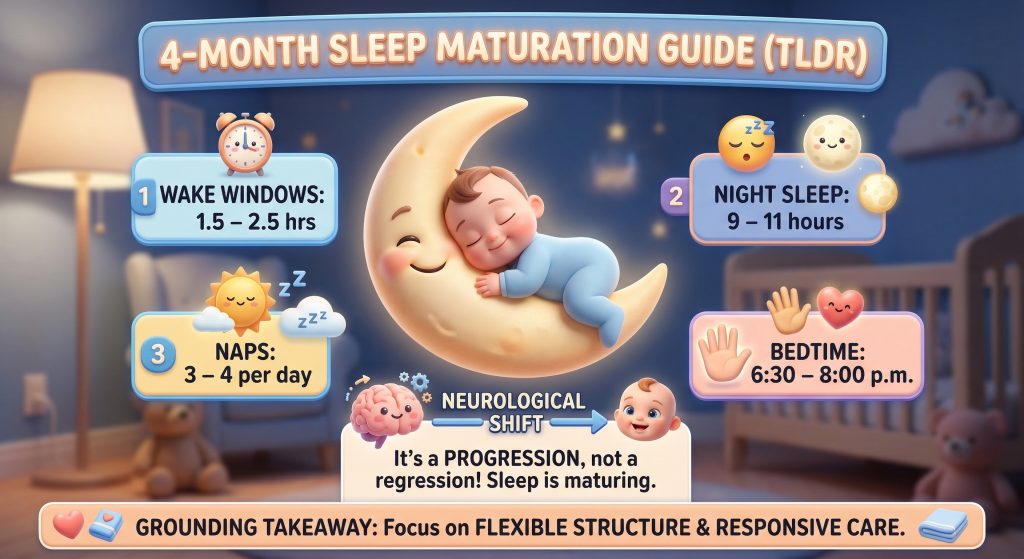
Infographic 4 month old sleep schedule
This guide will walk through what a typical 4 month old sleep schedule looks like, how much sleep babies need at this age, why night waking often increases, and what helps, without rigid expectations or pressure.
Table of Contents
At a Glance: 4 Month Sleep Expectations
At four months, most babies sleep 12–16 total hours in a 24-hour period, including 3–4 naps. Wake windows typically range from 1.5 to 2.5 hours, and bedtime often falls somewhere between 6:30 and 8:00 p.m.
Many babies experience what’s commonly called the 4 month sleep regression, though it’s more accurately a progression. Sleep cycles mature, night waking becomes more noticeable, and naps may temporarily shorten. This stage reflects neurological development, not bad habits.
How Much Should a 4 Month Old Sleep?
One of the most common questions at this age is simple and loaded at the same time: How much should a 4 month old sleep?
The short answer is that most babies need somewhere between 12 and 16 total hours of sleep over 24 hours. The American Academy of Sleep Medicine recommends that infants aged 4–12 months sleep 12 to 16 hours per 24 hours (including naps) to promote optimal health — a guideline endorsed by the AAP ¹. That usually includes 9–11 hours overnight, with the remainder distributed across daytime naps. But numbers alone don’t tell the whole story.
Some babies cluster more sleep at night. Others still wake to feed once or twice. Some take four shorter naps. Others begin consolidating into three slightly longer ones. Variation at this stage is not only common, it’s expected.
What often feels confusing is that four months is a period of transition. Your baby may look like they’re moving toward more predictable patterns while simultaneously becoming more sensitive to overtiredness or stimulation.
Wake windows at this age typically range from about 1.5 to 2.5 hours, gradually stretching slightly as the day progresses. A first wake window might be shorter, while the final one before bedtime may be closer to two hours or a bit more. If you’re not sure whether your baby’s wake windows are right, a baby tracker app can help you spot patterns.
Bedtime often settles somewhere between 6:30 and 8:00 p.m., depending on how naps went that day. If naps were short, bedtime may need to come earlier. That’s not a setback, it’s responsive adjustment.
For a quick reference:
Sleep Type
Typical Range
Total Sleep
12–16 hours
Night Sleep
9–11 hours
Naps
3–4 per day
Wake Windows
1.5–2.5 hours
These ranges are guides, not rules. A 4 month old sleep schedule works best when it supports your baby’s developing rhythms rather than forcing a perfect number.
What Is the 4-Month Sleep Regression?
The term “4 month sleep regression” can sound ominous. It suggests loss, decline, or undoing. In reality, this stage reflects a major neurological shift. Around four months, babies transition from newborn sleep patterns to more adult-like sleep cycles. Instead of drifting between deep and light sleep in simpler cycles, they begin moving through more defined stages. Research in Pediatric Research confirms that sleep architecture changes rapidly in the first year, with the transition from predominantly active (REM) sleep to more complex NREM and REM cycles representing a major neurological milestone ².
That maturation is healthy, but it can make sleep feel lighter and more fragmented.
You may notice:
More frequent night waking
Naps lasting 30–45 minutes
Increased awareness between sleep cycles
Greater sensitivity to sound or movement
Short naps are particularly common because one sleep cycle at this age often lasts around 30–45 minutes. Some babies naturally link cycles. Others wake fully between them for a period of time. Neither is inherently problematic. Darkening the room can make a meaningful difference for daytime naps — blackout blinds are one of the easiest changes to try.
This stage can last a few weeks as your baby adjusts to their new sleep architecture. For some families, it passes quietly. For others, it’s more noticeable.
Importantly, this is not caused by rocking, feeding, holding, or “doing it wrong.” It reflects brain development.
A Sample 4 Month Old Sleep Schedule (An Example, Not a Rule)
Parents often search for a 4 month old sleep schedule hoping for clarity. While no two babies follow identical days, it can help to see what a typical rhythm might look like.
A common structure might resemble:
7:00 a.m. — Wake
9:00 a.m. — Nap
12:00 p.m. — Nap
3:00 p.m. — Nap
7:00 p.m. — Bedtime
What matters most is the repeating pattern: wake, feed, play, sleep. That rhythm, more than the exact minute on the clock, helps anchor your baby’s day.
If one nap runs short or the timing shifts slightly, nothing is broken. Schedules at four months are flexible frameworks, not fixed scripts. The best 4 month old sleep schedule is one that adapts to your baby’s cues while keeping the day gently anchored.
Why Is My 4 Month Old Waking So Much at Night?
If night waking has increased, you’re likely wondering why your 4 month old is suddenly waking so often. Several things can be at play at once.
The maturation of sleep cycles makes babies more aware between stages of sleep. They may fully wake where previously they would have drifted through.
Development accelerates around this age. Rolling attempts, increased hand discovery, longer visual focus, and greater social awareness can all influence sleep. A brain that is busy learning often wakes more.
Hunger can still be a factor. Many four-month-olds continue to need one or two night feeds. Night weaning is not biologically required at this age.
Overtiredness can also amplify night waking. When wake windows stretch too long, cortisol rises, making it harder to stay asleep. In those cases, slightly earlier bedtimes for a few nights can help stabilize things.
Some babies also begin early teething discomfort around this time, though teething rarely causes prolonged multi-week disruptions on its own.
What’s most reassuring is this: increased night waking at four months is common and developmentally appropriate. It does not mean you’ve created habits that are impossible to undo. Research shows that all infants wake at night, but only some signal upon waking — night waking is a normal part of infant sleep development, not a sign of a problem ⁴.
Should You Sleep Train at 4 Months?
This question surfaces frequently at this stage. Some families begin exploring gentle sleep teaching methods around four months, particularly if exhaustion feels overwhelming. Others prefer to wait until five or six months. There is no single right answer.
Four months is a time of neurological change, and some babies respond well to consistent routines and gentle practice with independent settling. Others benefit from continued support through rocking, feeding, or holding while their sleep cycles mature.
What tends to matter most at this age isn’t strict training. It’s consistency. A predictable bedtime routine, appropriate wake windows, and calm responses create stability regardless of the specific approach you choose. Research published in Sleep found that implementing a consistent nightly bedtime routine led to significant improvements in how quickly infants fell asleep, the number of night wakings, and overall sleep continuity ³.
If you’re considering sleep training, it can help to evaluate your baby’s temperament, your family’s capacity, and what feels sustainable rather than pressured.
Signs Your 4 Month Old Is Getting Enough Sleep
It’s easy to focus on numbers. But how your baby feels during awake time tells you just as much. Signs that sleep is generally sufficient include:
Periods of alert, engaged wakefulness
Feeding well
Growing along their curve
Smiling and interacting between naps
Falling asleep within a reasonable window of being put down
Sleep does not need to look perfect to be adequate. Fluctuations during this stage are normal.
When to Talk to a Pediatrician
While variability is expected, certain patterns may warrant a conversation with your pediatrician. Consider reaching out if your baby:
Sleeps significantly less than 12 total hours consistently
Shows feeding or growth concerns
Triggers your intuition that something feels off
Parental instinct is data, and it’s always appropriate to ask questions.
For many babies, noticeable changes last 2–6 weeks, though every child’s timeline differs.
The AAP recommends that all infants be placed on their backs to sleep on a firm, flat surface, with the sleep area free of soft bedding — guidance that remains especially important as babies begin to roll around this age ⁵.
4 Month Old Sleep Schedule FAQ
How long should a 4 month old sleep at night?
Most four-month-olds sleep about 9–11 hours overnight, often with one or two feedings. Some babies begin stretching a longer first block of 4–6 hours, while others still wake every 3–4 hours. Both patterns are normal. What matters more than a continuous stretch is that your baby is getting enough total sleep across the full 24-hour period.
Is the 4 month sleep regression real?
Yes — but it’s more accurately a progression. Around four months, your baby’s sleep cycles permanently mature from simple newborn patterns to more complex adult-like stages. This makes transitions between cycles more noticeable, which is why sleep can suddenly feel lighter and more fragmented. It’s not caused by anything you did, and it doesn’t need to be “fixed.” Our full guide to the 4 month sleep regression breaks down the science and what actually helps.
How long does the 4 month sleep regression last?
For many babies, the most noticeable disruption lasts 2–6 weeks. However, the underlying change to sleep architecture is permanent — your baby won’t go back to newborn-style sleep. What improves is your baby’s ability to adjust to the new pattern. Consistent routines, appropriate wake windows, and responsive settling help most families through this transition.
How many naps should a 4 month old take?
Most four-month-olds take three to four naps per day. Short naps of 30–45 minutes are very common at this age and reflect a single sleep cycle — not a problem to solve. Some babies consolidate to three longer naps earlier, while others stay on four shorter naps for several more weeks. The total daytime sleep matters more than the number of individual naps.
What are typical 4 month wake windows?
Wake windows generally range from 1.5 to 2.5 hours, gradually lengthening throughout the day. The first wake window of the morning is usually the shortest, while the last one before bedtime tends to be the longest. If your baby consistently fights naps or seems overtired, the wake window may need a small adjustment — even 15 minutes can make a difference. If you’d like a schedule tailored to your baby’s specific patterns, Betteroo’s free quiz can help.
Sleep looks different for every baby at 4 months
Get a personalized sleep plan built around your baby’s age, temperament, and your family’s needs.
At four months, sleep doesn’t need fixing, it needs understanding. This stage is defined by brain growth. Night waking can increase, naps may shorten and patterns may shift. None of that means you’ve failed or that your baby is off track.
A flexible 4 month old sleep schedule, responsive care, and gentle consistency carry most families through this transition. Sleep matures because development unfolds, not because it was forced.
And if this stage feels harder than expected, that doesn’t mean you’re doing it wrong. It means you’re parenting through growth.
Paruthi, S., et al. (2016). Recommended Amount of Sleep for Pediatric Populations: A Consensus Statement of the American Academy of Sleep Medicine. Journal of Clinical Sleep Medicine, 12(6), 785–786.https://pmc.ncbi.nlm.nih.gov/articles/PMC4877308/
Mindell, J.A., Telofski, L.S., Wiegand, B., & Kurtz, E.S. (2009). A Nightly Bedtime Routine: Impact on Sleep in Young Children and Maternal Mood. Sleep, 32(5), 599–606.https://pubmed.ncbi.nlm.nih.gov/19480226/
Burnham, M.M., Goodlin-Jones, B.L., Gaylor, E.E., & Anders, T.F. (2002). Nighttime sleep-wake patterns and self-soothing from birth to one year of age. Journal of Child Psychology and Psychiatry, 43(6), 713–725.https://pubmed.ncbi.nlm.nih.gov/12236608/
American Academy of Pediatrics. (2022). Sleep-Related Infant Deaths: Updated 2022 Recommendations for Reducing Infant Deaths in the Sleep Environment.https://pubmed.ncbi.nlm.nih.gov/35726558/