3 month old milestones can feel uncertain – many many parents find themselves watching their baby more closely – noticing small changes, wondering what’s “supposed” to happen next, and sometimes comparing what they see at home to milestone lists online.
If you’re feeling that mix of curiosity and quiet worry, you’re not alone.
Here’s the most important thing to know upfront: milestones at this age are patterns, not deadlines. Development unfolds gradually, often unevenly, and rarely all at once. This stage is less about checking boxes and more about noticing how your baby is becoming more aware, coordinated, and engaged with the world. Understanding 3 month old milestones starts with knowing what to look for — and what not to stress about.
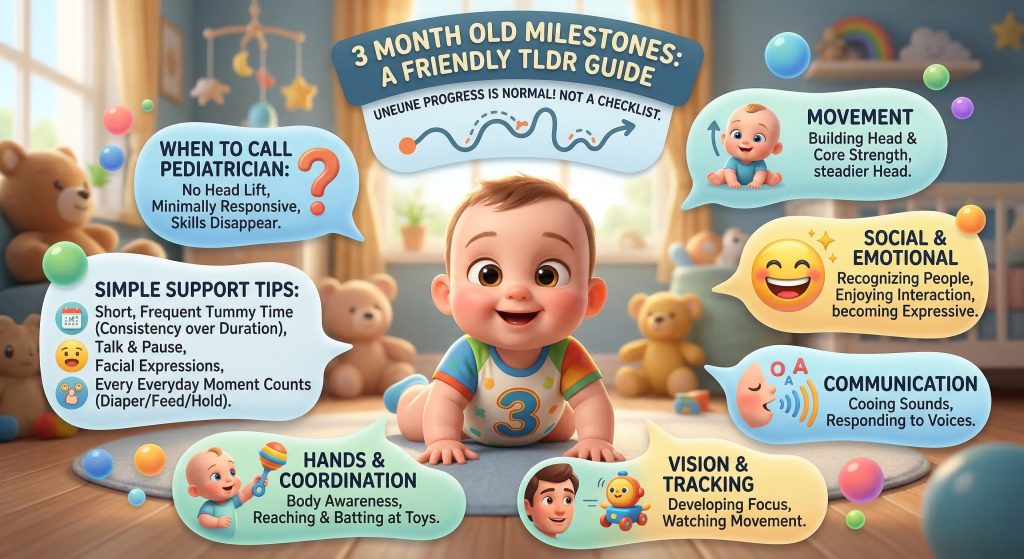
Infographic about 3 month old milestones
This guide walks through what typically develops around three months, what varies widely, how these changes may show up day to day, and when it’s worth checking in — all without pressure or performance framing.
Table of Contents
What 3 Month Old Milestones Really Look Like
Three months is a period of emerging control and connection.
Rather than mastering big, obvious skills, babies at this age are:
gaining better control of their bodies
becoming more socially responsive
staying awake and alert for longer stretches
interacting more intentionally with people and their surroundings
Progress often looks subtle. You may notice steadier movements, more expressive faces, or longer moments of engagement — even if no single “milestone” feels dramatic yet.
Movement & Physical Development at 3 Months
What You Might Notice
Many three-month-olds show gradual improvements in movement and strength, such as:
holding their head more steadily when upright
lifting their head and chest briefly during tummy time
pushing down with their legs when supported
bringing hands to their mouth
kicking with more purpose
These changes reflect growing strength and coordination, not polished motor skills. At three months, babies are building on skills from the CDC’s 2-month checklist — like holding the head up during tummy time and making sounds other than crying — while working toward 4-month milestones like pushing up on elbows and chuckling ¹.
What’s Still Emerging
Some skills are often in progress rather than fully present at this age:
Rolling: some babies begin experimenting, but consistent rolling often comes later
Sitting: babies may enjoy supported sitting briefly, but independent sitting is not expected
If your baby isn’t rolling yet, that is very common – it’s one of the most misunderstood 3 month old milestones.. Rolling typically builds on head control, core strength, and coordination – all of which are still developing now.
Mayo Clinic’s birth-to-3-month developmental overview notes that babies at this age are gaining the ability to follow objects with their eyes, beginning to smile in response to others, and may start testing sounds like cooing — all foundational skills that support later milestones ³.
Social & Emotional Milestones
Growing Social Awareness
Around three months, many babies become noticeably more social. You might see:
social smiling in response to faces or voices
increased interest in people over objects
longer eye contact
visible excitement when interacting
Some babies are more expressive than others. A quieter baby can still be socially engaged, just in subtler ways. The AAP notes that social smiling typically emerges around 2 months, and that by 3 months babies begin sorting familiar faces from strangers and using smiling intentionally to engage caregivers ². Many babies start smiling socially around this age, which often sets the stage for when babies laugh for the first time in the coming weeks.
Communication & Language Development
Early Communication
At this age, communication is less about words and more about sound and interaction.
You may notice:
cooing or vowel-like sounds
vocal play (testing volume and pitch)
turning toward familiar voices
brief “back-and-forth” sound exchanges
Babies develop communication skills at different paces. Frequent vocalizing isn’t required for healthy development, and listening is part of learning too.
Cognitive & Sensory Development
Three-month-olds are becoming more aware of patterns and surroundings. This can show up as:
tracking objects or faces with their eyes
watching hands move
reacting to changes in light, sound, or routine
appearing more alert during wake periods
This increased awareness is exciting – and sometimes overstimulating. You may notice your baby gets tired more quickly or needs more support settling. Bath time is also becoming more interactive – a supportive baby bathtub can make this part of the routine easier for both of you.
How Development Can Affect Sleep
As alertness increases, sleep can feel less predictable. If you’re looking for what a typical day looks like right now, our 3 month old sleep schedule breaks it down.
Some babies at this age:
nap more lightly
wake more between sleep cycles
need more help settling
This isn’t a regression. It’s a reflection of a brain that’s becoming more active and responsive. Flexibility, rather than strict schedules, tends to work best during this stage.
Supporting Development Without Pressure
Supporting a three-month-old’s development doesn’t require exercises or structured practice.
What helps most:
talking, singing, and making eye contact
offering tummy time in short, comfortable bursts
responding to cues rather than pushing skills
allowing plenty of time for rest
Interaction and connection matter more than stimulation. Development grows out of everyday moments, not optimization.
What You Don’t Need to Worry About Yet
At three months, it’s very common for parents to worry about things that are still well within normal range.
You don’t need to worry if:
your baby isn’t rolling yet
skills appear uneven or inconsistent
your baby is quieter or more active than others
progress feels slow week to week
Development is not linear, and variation at this age is expected.
When to Check In With Your Pediatrician
It’s always okay to bring questions to your pediatrician — especially if something doesn’t sit right with you.
You might consider checking in if you notice:
very limited movement over time
little response to sound or interaction
concerns about feeding, growth, or comfort
These conversations are about understanding patterns, not assuming problems.
The CDC encourages parents to act early if their baby is not meeting milestones or has lost skills they once had, and emphasizes that early intervention services can make a meaningful difference ⁴.
FAQs about 3 Month Old Milestones
Should my 3 month old be rolling?
Rolling is often still emerging at this age. Many babies don’t roll consistently until closer to 4-5 months, after gaining more core strength and coordination through tummy time and daily movement. If your baby isn’t rolling yet, that’s very common and not a cause for concern.
How much head control is typical at 3 months?
Many babies can hold their head up more steadily during supported sitting and tummy time, but wobbling is still common. Full head control typically develops gradually over the next few weeks as neck and upper body strength builds.
Do 3 month olds recognize their parents?
Yes. Babies often recognize familiar voices, faces, and routines, even if they can’t show it clearly yet.
What activities help development at this age?
Simple interaction — talking, playing, tummy time, and responding to cues — supports development naturally. You don’t need special toys or structured exercises. Everyday moments like face-to-face play, bath time, and narrating your day give your baby exactly what they need.
Is it okay if my baby develops unevenly across skills?
Yes. Uneven development is very common and usually temporary. A baby might be very social but slower to roll, or physically active but quieter vocally. Skills tend to even out over time. If you’d like guidance tailored to where your baby is right now, Betteroo’s free quiz can help.
A Grounding Takeaway
When it comes to 3 month old milestones, development isn’t about hitting milestones on time — it’s about building foundations.
Your baby is learning how their body moves, how people respond, and how the world works. That learning unfolds gradually, in fits and starts, and often looks messier than milestone charts suggest.
If you’re responding, connecting, and giving your baby space to grow, you’re doing exactly what this stage asks of you.