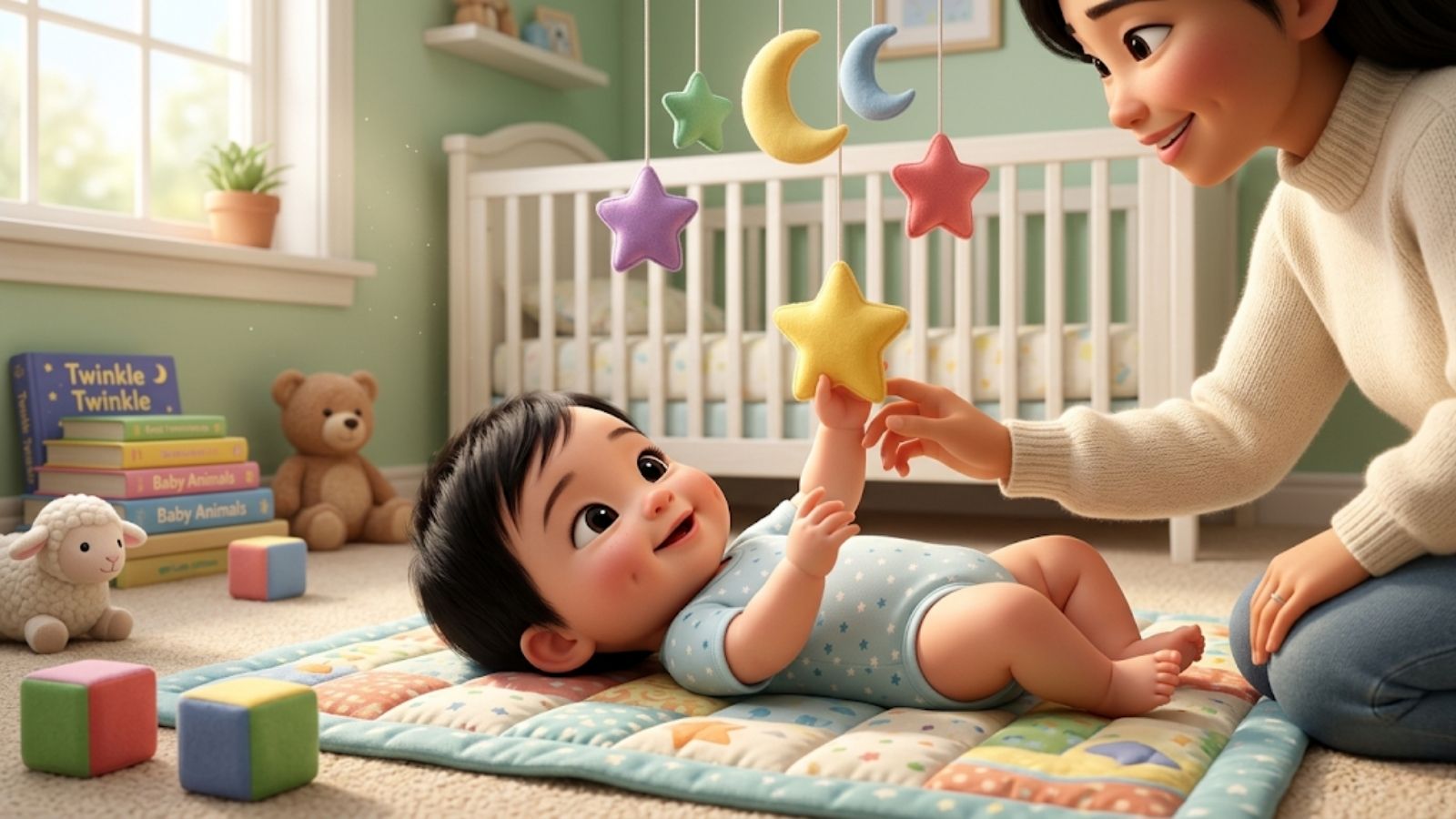
Around 2 months, many babies are beginning to show their first signs of social connection, early movement control, and responsiveness to the world around them.This is still a very early stage of development. 2 Month Old Milestones are just beginning to appear, and most skills are only starting to emerge. They may show up briefly, inconsistently, or not yet at all. It’s common to wonder what “counts” as progress, or whether you should be seeing more by now.
Milestones at this age are best understood as early signals of development, not a checklist your baby needs to complete.
Key Takeaways
At 2 months, most babies are beginning to smile at people, coo, briefly lift their head during tummy time, and pay more attention to faces and voices.
These skills often appear in short, inconsistent bursts — that’s normal and expected at this age.
What matters most is whether your baby is showing early signs of engagement and responsiveness, not whether every milestone is present.
Talk to your pediatrician if your baby shows very limited response to sound, faces, or has unusually stiff or floppy movement.
Table of Contents
What Are 2 Month Old Milestones?
Milestones are skills that many babies begin to develop around a certain age. At 2 months, these are foundational behaviors that reflect early brain, body, and social development. According to the Centers for Disease Control and Prevention, milestones at this stage include early social engagement, basic movement control, and growing awareness of surroundings 1. At 2 months, it helps to expect:
emerging, not consistent skills
short bursts of ability
variation across babies
What matters most is whether your baby is beginning to engage, respond, and show small signs of change over time.
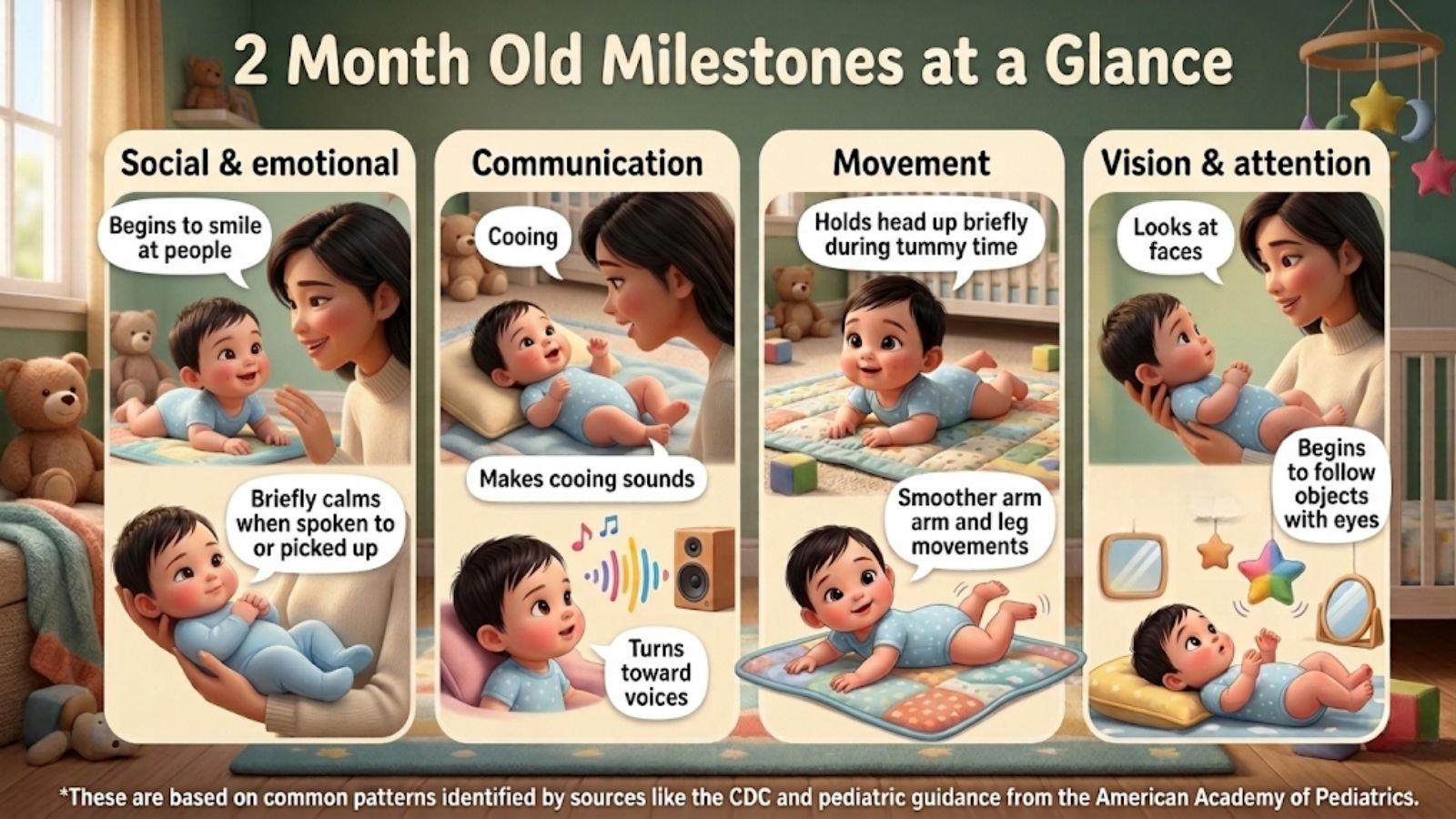
2 Month Old Milestones at a Glance
2 month old milestones at a glance
Area
What you may notice around 2 months
Social and emotional
Begins to smile at people, can briefly calm when spoken to or picked up
Communication
Makes cooing sounds, turns toward voices
Movement
Holds head up briefly during tummy time, smoother arm and leg movements
Vision and attention
Looks at faces, begins to follow objects with eyes
Social & emotional
Connecting with people
Begins to smile at people. Can briefly calm when spoken to or picked up.
Communication
Early sounds and listening
Makes cooing sounds. Turns toward voices and familiar sounds.
Movement
Building strength
Holds head up briefly during tummy time. Arm and leg movements become smoother.
Vision & attention
Noticing the world
Looks at faces up close. Begins to follow objects with eyes.
Social & emotional
Connecting with people
Begins to smile at people. Can briefly calm when spoken to or picked up.
Communication
Early sounds and listening
Makes cooing sounds. Turns toward voices and familiar sounds.
Movement
Building strength
Holds head up briefly during tummy time. Arm and leg movements become smoother.
Vision & attention
Noticing the world
Looks at faces up close. Begins to follow objects with eyes.
Swipe to explore
These are based on common patterns identified by sources like the CDC and pediatric guidance from the American Academy of Pediatrics 1,2.
Infographic 2 month old milestones at a glance
What These 2 Month Old Milestones Actually Mean
At this stage, development is less about visible skill and more about what’s happening underneath. A baby smiling is not just a reaction, it reflects early social recognition. Turning toward a voice shows growing awareness and connection. Lifting the head, even briefly, signals the beginning of physical strength and control.
Research from the Center on the Developing Child at Harvard University emphasizes that early emotional and social experiences are built into the brain’s architecture 3. Even simple, everyday interactions, like responding to your baby’s sounds or making eye contact—are helping shape development in meaningful ways.
What Counts as Progress in 2 Month Old Milestones
Progress at 2 months can be subtle. You might notice your baby makes eye contact for a few seconds, briefly lifts their head and then drops it, or coos occasionally (not frequently). These small, inconsistent moments still count. At this stage, development often shows up as first signs, not steady ability. A skill appearing once or twice is meaningful, even if it’s not repeated right away.
What Parents Often Expect vs What Actually Happens at 2 Months
It’s easy to expect development to look more defined by this point. In reality, 2 months is still very early.
Parents often expect clearer patterns—more predictable movement, more consistent interaction—but most babies are still building toward those abilities.
You may see a glimpse of something one day and not again for a while. That doesn’t mean it’s gone. It means it’s still developing.
What’s Typical vs When to Check In
Most variation at this age is expected. The goal is not to track every behavior, but to notice general patterns of engagement and response.
2 month old milestones: typical variation vs signs to check in with pediatrician
Area
Usually typical
Worth checking in
Smiling
Not smiling yet — still in normal range
No response to faces at all
Head control
Inconsistent head lifting during tummy time
No attempt to lift head at all
Engagement
Some engagement but not constant
Very limited eye contact or interaction
Sound response
Turns toward some sounds
No response to voices or loud sounds
Movement
Jerky or uneven arm and leg movement
Very stiff or very floppy body tone
Usually typical
Normal variation at 2 months
SmilingNot smiling yet — still in normal range
Head controlInconsistent lifting during tummy time
EngagementSome interaction but not constant
Sound responseTurns toward some sounds
MovementJerky or uneven arm/leg movement
Worth checking in
Mention at your next visit
SmilingNo response to faces at all
Head controlNo attempt to lift head at all
EngagementVery limited eye contact or interaction
Sound responseNo response to voices or loud sounds
MovementVery stiff or very floppy body tone
Usually typical
Normal variation at 2 months
SmilingNot smiling yet — still in normal range
Head controlInconsistent lifting during tummy time
EngagementSome interaction but not constant
Sound responseTurns toward some sounds
MovementJerky or uneven arm/leg movement
Worth checking in
Mention at your next visit
SmilingNo response to faces at all
Head controlNo attempt to lift head at all
EngagementVery limited eye contact or interaction
Sound responseNo response to voices or loud sounds
MovementVery stiff or very floppy body tone
Swipe to compare
If something feels off to you, it’s reasonable to ask. You don’t need to wait for certainty.
A Simple Way to Think About 2 Month Development
At 2 months, development is mostly about three things:
Beginning to connect (smiling, eye contact, responding)
Becoming more aware (voices, faces, movement)
Starting to build strength (especially in the neck and upper body)
If you’re seeing even small signs of these shifts, that reflects meaningful progress.
How Much Sleep Does a 2 Month Old Need?
Sleep is one of the most common concerns parents have at this age, and it’s closely connected to 2 Month Old Milestones. At 2 months, most babies need around 14 to 17 hours of total sleep across a 24-hour period. That includes both nighttime sleep and daytime naps.
But here’s what’s important to understand: sleep at this age is still irregular. Your baby’s internal clock hasn’t fully developed yet, and it won’t begin to regulate until closer to 3 or 4 months. That means sleep times, nap lengths, and nighttime stretches will vary — sometimes a lot — from day to day.
At this stage, most babies still wake 2 to 3 times per night to feed. This is normal and expected — night feeds are an important part of growth. Some babies may begin to stretch their longest sleep period to 4 to 6 hours, but many won’t reach that consistently for several more weeks.
What You Can Do to Support Sleep
You don’t need to follow a strict schedule at 2 months — and sleep training isn’t recommended yet. But you can start building simple habits that support better sleep over time. A short, consistent bedtime routine (a diaper change, pajamas, a feeding, and a lullaby) helps signal to your baby that it’s time to wind down. Keeping nighttime feeds quiet and low-light can also help reinforce the difference between day and night.
If your baby’s sleep feels unpredictable right now, that’s completely normal. For a closer look at how sleep begins to organize over the coming weeks, see our guide to baby sleep expectations in the first year.
How to Support Your 2 Month Old’s Development (Without Overthinking It)
At this stage, development is supported through simple, responsive interaction.
Holding your baby where they can see your face, talking during routine moments, and responding to their sounds all help build early communication, which is an important part of 2 Month Old Milestones. These exchanges may feel small, but they are foundational.
Tummy time helps develop strength, even if it only lasts a minute or two at a time. It’s normal for babies to tire quickly here. Short, repeated opportunities are more useful than trying to extend a single session.
Play doesn’t need to be structured. A face, a voice, or a slowly moving object is enough to capture attention at this age.
What matters most is that your baby is experiencing interaction, movement, and responsiveness throughout the day.
Every baby develops on their own timeline
Get a personalized plan based on your baby’s age, sleep patterns, and developmental stage.
Around this age, most babies have a well-child visit guided by the American Academy of Pediatrics 4.
This visit typically includes:
checking growth and development
observing movement and responsiveness
discussing feeding, sleep, and routines
recommended vaccinations
It’s also a space for you to ask questions—even small ones. You’re not expected to assess development on your own. This visit is designed to support both you and your baby.
Do You Need to Be Tracking Milestones Closely?
Not closely. At 2 months, it’s more helpful to notice general patterns than to track individual skills. If your baby is becoming gradually more alert, responsive, or physically active, that’s meaningful.
Pediatric visits are structured to monitor development over time, so you don’t need to carry that responsibility alone.
When to Talk to Your Pediatrician
It’s reasonable to check in if you notice:
your baby does not respond to sound or voices
very limited eye contact or engagement
no attempts to lift the head during tummy time
unusually stiff or floppy movement
loss of a skill your baby had started to show
Reaching out doesn’t mean something is wrong. It means you’re getting support 1,4.
Wondering what’s normal for your 2 month old?
Take a quick quiz and get personalized sleep and development guidance based on your baby’s age.
Over the next several weeks, many babies begin to show more consistent strength, interaction, and communication.
If you want to see how these early skills build, you can explore 3 month old milestones next. By 3 months, many babies start laughing out loud, hold their head steady when upright, and begin reaching for nearby objects. These are direct extensions of the early skills you’re seeing now — so if your baby is showing even glimpses of interaction and strength at 2 months, they’re building toward what comes next.
1 month vs 2 month vs 3 month baby milestones comparison
Milestone area
1 Month
2 Months
3 Months
Social
Brief eye contact
First social smiles
Smiles often, may laugh
Communication
Crying only
Cooing sounds begin
Babbles back and forth
Head control
Turns head side to side
Lifts head briefly on tummy
Holds head steady upright
Hands
Fists mostly closed
Opens hands briefly
Reaches for objects
Awareness
Startles at sounds
Follows faces with eyes
Tracks objects in an arc
1 Month
Early reflexes and alertness
SocialBrief eye contact
CommunicationCrying only
Head controlTurns head side to side
HandsFists mostly closed
AwarenessStartles at sounds
2 Months
First signs of interaction
SocialFirst social smiles
CommunicationCooing sounds begin
Head controlLifts head briefly on tummy
HandsOpens hands briefly
AwarenessFollows faces with eyes
3 Months
More consistent engagement
SocialSmiles often, may laugh
CommunicationBabbles back and forth
Head controlHolds head steady upright
HandsReaches for objects
AwarenessTracks objects in an arc
1 Month
Early reflexes and alertness
SocialBrief eye contact
CommunicationCrying only
Head controlTurns head side to side
HandsFists mostly closed
AwarenessStartles at sounds
2 Months
First signs of interaction
SocialFirst social smiles
CommunicationCooing sounds begin
Head controlLifts head briefly on tummy
HandsOpens hands briefly
AwarenessFollows faces with eyes
3 Months
More consistent engagement
SocialSmiles often, may laugh
CommunicationBabbles back and forth
Head controlHolds head steady upright
HandsReaches for objects
AwarenessTracks objects in an arc
Swipe to compare
Frequently Asked Questions
What should a 2 month old be doing?
At 2 months, many babies begin smiling at people, making cooing sounds, briefly lifting their head during tummy time, and paying more attention to faces and voices. These behaviors often appear in short, inconsistent bursts rather than steady patterns.
What matters most is not how many milestones your baby is showing, but whether you’re seeing early signs of engagement and responsiveness. Development at this stage is still foundational, so small changes over time are more meaningful than any single moment.
What if my baby isn’t hitting 2 month old milestones?
It’s very common for babies to develop at different paces at this age. Some may smile early, while others take longer. Some may show more movement, while others focus more on interaction.
Rather than focusing on whether every milestone is present, it helps to look for signs that your baby is beginning to engage with you and their surroundings in some way.
If you feel unsure, you can always bring it up at your baby’s next visit. You don’t need to wait until something feels clearly wrong to ask.
Can a 2 month old hold their head up?
Many babies at this age can briefly lift their head during tummy time or when held upright, but this skill is still developing and is part of normal 2 Month Old Milestones. You may notice short bursts of control, some wobbling, or fatigue after a few seconds. This is expected. Strength builds gradually, and improvement over time matters more than consistency in any one moment.
What’s the difference between 1, 2, and 3 month milestones?
Development across these months is gradual, not abrupt.
So 2 months is often a stage where early abilities begin to appear, but are not yet consistent.
How much should a 2 month old weigh?
At 2 months, average weight is roughly 10 to 12 pounds for boys and 9 to 11 pounds for girls, though there’s a wide range of normal. Your pediatrician tracks your baby’s growth on a percentile curve — what matters most is that your baby is following a consistent pattern over time, not hitting a specific number. Weight gain, length, and head circumference are all reviewed at the 2-month well-child visit.
How long should a 2 month old sleep?
Most 2 month olds need about 14 to 17 hours of total sleep in a 24-hour period, split between nighttime and several short naps. However, sleep is still very irregular at this age — nap lengths vary, and most babies wake 2 to 3 times per night to feed. A consistent long stretch of 4 to 6 hours is possible but not yet typical for every baby.
What toys are good for a 2 month old?
At 2 months, babies respond best to high-contrast images, soft rattles, and anything that encourages them to track movement with their eyes. Hanging mobiles, play mats with overhead arcs, and simple black-and-white cards are all developmentally appropriate. You don’t need many toys at this stage — your face and voice are the most engaging things in your baby’s world. For specific recommendations, see our guide to the best developmental toys for 0–3 month old babies.
Lipkin, P.H., Macias, M.M.; Council on Children With Disabilities. (2020). Promoting Optimal Development: Identifying Infants and Young Children With Developmental Disorders Through Developmental Surveillance and Screening. Pediatrics, 145(1), e20193449.https://pubmed.ncbi.nlm.nih.gov/31843861/