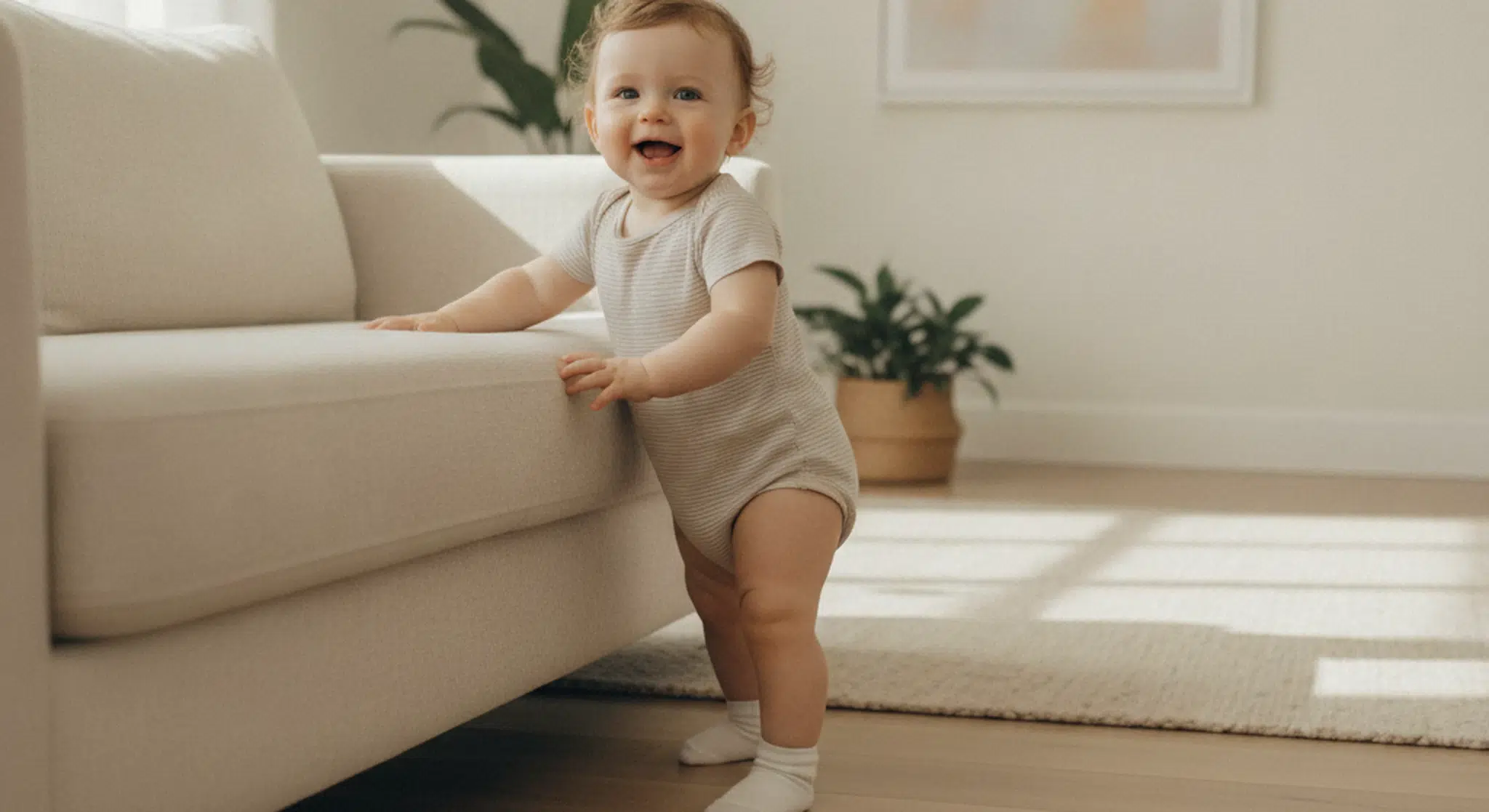
At eleven months, many babies are cruising along furniture, pulling to stand with ease, waving and clapping, babbling long strings of sounds, and picking up tiny objects with a neat finger and thumb grasp.
Eleven months sits between the twelve month checkpoint pediatricians often use and the busy stretch just before the first birthday. The range of normal is genuinely wide here, so some babies are already taking steps while others are happily crawling and cruising.
This guide walks through the movement, language, thinking, and social milestones that are typical around eleven months, how sleep tends to shift, and the signs worth mentioning to your pediatrician.
Key Takeaways
Many 11 month olds pull to stand, cruise along furniture, and may stand alone briefly.
Expect lots of babbling, a first word or two for some, plus waving, clapping, and pointing.
A refined pincer grasp lets babies pick up small pieces of food and tiny objects.
Most 11 month olds need about 12 to 15 hours of sleep across a night and two naps.
Ranges are wide, so focus on steady progress and raise any concerns with your pediatrician.
Table of Contents
Movement and Physical Milestones
Getting upright is the theme of this age. Most eleven month olds pull to stand confidently, cruise sideways along furniture, and lower themselves back down with more control. Some are standing alone for a second or two, and a handful of early walkers take their first independent steps, though walking more commonly arrives between twelve and fifteen months.
Hands are busier too. The pincer grasp, using the tip of the thumb and index finger, is usually well established, which is why self feeding small soft pieces gets easier. Your baby may bang two objects together, drop things to watch them fall, and poke at small details.
Pulls to stand and cruises along furniture, some standing alone briefly.
Neat pincer grasp for picking up small pieces of food and tiny objects.
May crawl quickly, climb onto low surfaces, or take first steps.
Begins to help with dressing by pushing an arm through a sleeve.
Language and Communication
Around eleven months, babbling starts to sound a lot like real talking, with long runs of syllables and the melody of conversation. Many babies say mama or dada with meaning, and some have one other simple word. Understanding runs well ahead of speaking, so your baby likely grasps far more than they can say.
Gestures are a milestone in their own right. Waving bye, clapping, and pointing to share interest all show growing communication. If you want to see how these sounds develop, our when babies start babbling guide maps the months around this stage.
Babbles long strings of sounds with a conversational rhythm.
May say mama or dada with meaning, and possibly one other word.
Waves bye bye, claps, and points at things of interest.
Responds to their name and simple words like no.
Struggling with your baby’s sleep?
A personalized plan meets your baby where they are, at every age and stage.
Eleven month olds are curious explorers who love cause and effect. They put objects in and out of containers, look for a toy they watched you hide, and imitate simple actions like stirring or pretending to talk on the phone. Object permanence is strengthening, which is part of why peekaboo stays so satisfying.
Emotionally, expect strong attachment and some clinginess. Separation anxiety and wariness of strangers are common and normal at this age. Your baby may check your face before trying something new, hand you toys, and show clear preferences for favorite people and activities.
Sleep at 11 Months
Most eleven month olds need roughly twelve to fifteen hours of sleep across a full day, including night sleep and two naps. Two naps is still the norm at this age. The drop to a single nap usually comes later, more typically between about fifteen and eighteen months, so holding onto that second nap now is completely appropriate.
This age also sits near a common bout of sleep disruption around twelve months, driven by the wave of new skills and separation anxiety. If nights get bumpy, our sleep regression ages guide maps the common windows, and our baby sleep schedule by age guide shows realistic wake windows and nap timing.
Milestones and sleep move together in the first year. New physical skills can temporarily unsettle sleep as your baby wants to practice standing in the crib. It usually passes as the skill becomes familiar. Our 14 month milestones guide shows what comes next.
When to Talk to Your Pediatrician
Most eleven month olds who are a little behind on one skill are simply moving at their own pace. Still, mention these to your pediatrician:
Not sitting steadily, not bearing weight on the legs, or not pulling to stand.
No babbling, gestures like waving or pointing, or response to their name.
Not searching for objects they watched you hide.
A loss of skills your baby previously had.
Early checks are always worthwhile, and often the reassurance is exactly what you need.
Frequently Asked Questions
What milestones should an 11 month old have?
Many 11 month olds pull to stand and cruise along furniture, babble in long strings, wave and clap, point to share interest, and use a neat pincer grasp to pick up small pieces. Ranges are wide, so some skills may arrive a little earlier or later and still be normal.
Should an 11 month old be walking?
Not necessarily. Some early walkers take their first steps around 11 months, but independent walking more commonly appears between 12 and 15 months. An 11 month old who is cruising and pulling to stand is usually right on track.
How many words should an 11 month old say?
Often none yet, or just mama or dada with meaning and perhaps one other word. Understanding is ahead of speaking, and lots of babbling plus gestures like waving and pointing are the key signs of healthy communication at this age.
How much sleep does an 11 month old need?
Most need about 12 to 15 hours of total sleep across a night and two naps. Two naps is still typical at 11 months, with the shift to a single nap usually happening between 15 and 18 months.
When should I worry about my 11 month old’s development?
Talk to your pediatrician if your baby is not bearing weight on their legs, not babbling or gesturing, not responding to their name, not looking for hidden objects, or has lost skills they once had. Early conversations are always worthwhile.
Milestones and sleep in one plan
Get a personalized plan built around your baby’s stage, naps, and temperament.
Paruthi S, et al. Recommended Amount of Sleep for Pediatric Populations: A Consensus Statement of the American Academy of Sleep Medicine. Journal of Clinical Sleep Medicine, 2016. https://jcsm.aasm.org/doi/10.5664/jcsm.5866