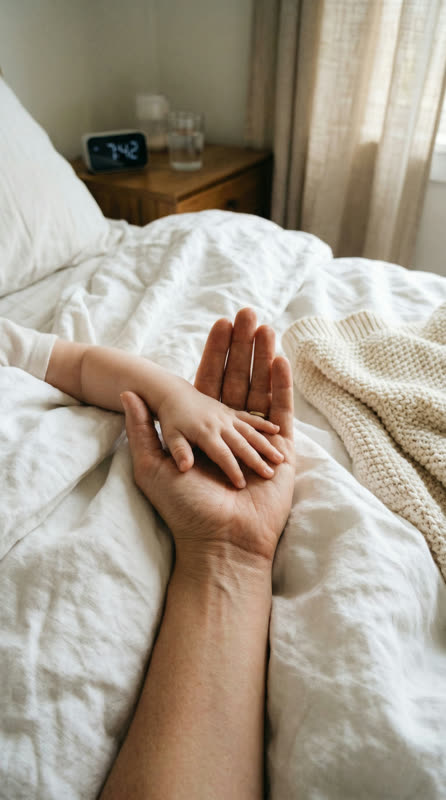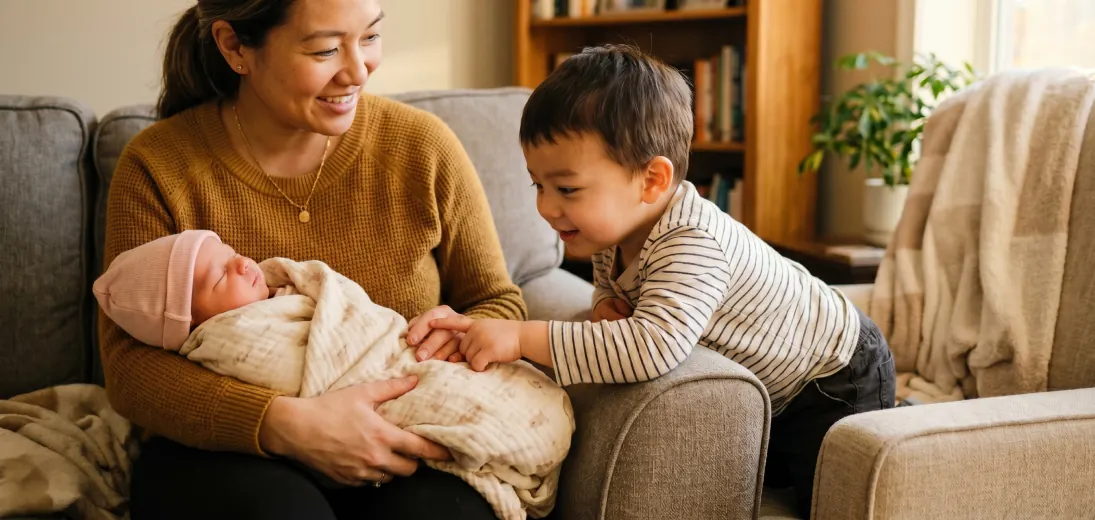

Babies sleep with their arms up, often in a cactus or goalpost pose with hands near the ears, mostly because of the startle reflex and because it is a naturally comfortable, secure position for them. It is a normal, healthy sign, and for many babies it is also a clue that they are ready to have their arms free.
That flung open, arms up posture is so common in newborns that it has its own nicknames. It looks dramatic, but it is one of the most reassuring things a sleeping baby can do.
This guide explains the reasons behind the pose, why it can even signal better sleep to come, and what it means for swaddling and safe sleep.
Key Takeaways
- The arms up pose is largely driven by the Moro (startle) reflex, which is strongest in the newborn weeks and fades by around 3 to 6 months.
- Many babies simply find arms up near the head a comfortable, self soothing position, sometimes echoing how they were curled in the womb.
- Babies also raise their arms to release heat, so an arms up sleeper may be telling you they are warm enough.
- When a swaddled baby keeps breaking free to get arms up, it is often a sign to transition out of the swaddle.
- Whatever the arm position, safe sleep stays the same: on the back, in a bare crib, no loose blankets.
Table of Contents
The Startle Reflex
The main driver is the Moro reflex, the startle response newborns are born with. When a baby feels a sudden movement or drop sensation, their arms fling outward and then draw back in. It is an involuntary, protective reflex, and it is one reason so many newborns sleep with arms raised: their bodies are primed for that outward motion.
The Moro reflex is strongest in the first weeks and normally fades between about 3 and 6 months as the nervous system matures. As it goes, the dramatic startles ease, though plenty of older babies keep sleeping arms up simply because they like it.
Comfort and the Womb
For many babies, arms up near the head is just cozy. Some spent late pregnancy curled with hands near the face, and the position can feel familiar and secure. You will often see babies bring their hands toward their face or mouth to self soothe, which is a healthy, developing skill.
An arms up sleeper is usually a relaxed, settled sleeper. Far from a problem, it often signals a baby who feels safe enough to sprawl out.
Temperature Regulation
Babies release heat through their heads and hands, so raising the arms is one way to cool down. If your baby consistently sleeps with arms up and thrown back, they may be plenty warm. Dress them in light layers, aim for a comfortable room temperature, and check the back of the neck or chest (not the hands, which run cool) to judge warmth. Our guide to baby room temperature for sleep has specifics.
What It Means for Swaddling
If you swaddle and your baby keeps wriggling their arms free to get them up by the face, that is a meaningful signal. It usually means they crave the arms up position, and it is often a cue to move toward an arms out swaddle or a sleep sack. More importantly, once a baby shows any sign of rolling, swaddling must stop for safety, because a swaddled baby who rolls to their stomach cannot easily reposition.
Our guide on when to stop swaddling walks through the timing and the transition. Many babies actually sleep better once their arms are free and up where they want them.
Outgrowing the swaddle and the startle?
Get a personalized plan built around your baby’s age, patterns, and temperament.
Take the 3-Min Quiz →Keeping It Safe
The arm position itself is not a safety issue. What matters is the fundamentals: always place your baby on their back to sleep, on a firm, flat mattress with a fitted sheet only, in a completely bare crib with no pillows, blankets, bumpers, or toys, following AAP safe sleep guidance. An arms up baby on their back in a bare crib is doing exactly the right thing. Talk to your pediatrician if the startle reflex seems very asymmetric (much stronger on one side) or persists well beyond 6 months, since reflex patterns are something they can check.
Sorting out swaddling and startles? See our guides on when to stop swaddling, how to swaddle a baby, and baby room temperature for sleep. For the full picture, visit our sleep schedule by age guide.
Frequently Asked Questions
Why do babies sleep with their arms up?
Mostly because of the Moro (startle) reflex, which primes the arms to fling outward, and because arms up near the head is a naturally comfortable, secure position. Babies also raise their arms to release heat. It is a normal, healthy sleep posture.
Is it safe for my baby to sleep with their arms up?
Yes. The arm position is not a safety concern. What matters is that your baby sleeps on their back, on a firm flat mattress, in a bare crib with no loose bedding, in line with AAP safe sleep guidance.
Does arms up sleeping mean my baby is ready to stop being swaddled?
Often, yes. If your baby keeps working their arms free to get them up, it is a strong cue to move to an arms out swaddle or sleep sack. And once a baby shows any sign of rolling, swaddling must stop for safety regardless of arm position.
When does the startle reflex go away?
The Moro reflex is strongest in the newborn weeks and normally fades between about 3 and 6 months as the nervous system matures. If it seems very one sided or lasts well beyond 6 months, mention it to your pediatrician.
Does arms up mean my baby is too hot?
It can. Babies release heat through their heads and hands, so an arms up, thrown back posture may mean they are warm enough. Dress them in light layers and check the chest or back of the neck, not the hands, to judge temperature.
Understand your baby’s sleep
Get a personalized plan built around your baby’s age, patterns, and temperament.
4 Sources
-
American Academy of Pediatrics, HealthyChildren.org. Newborn Reflexes and Behavior.
https://www.healthychildren.org/English/ages-stages/baby/Pages/Newborn-Reflexes.aspx -
American Academy of Pediatrics. Sleep-Related Infant Deaths: Updated 2022 Recommendations for Reducing Infant Deaths in the Sleep Environment. Pediatrics, 2022.
https://publications.aap.org/pediatrics/article/150/1/e2022057990/188304 -
American Academy of Pediatrics, HealthyChildren.org. Swaddling: Is It Safe for Your Baby?
https://www.healthychildren.org/English/ages-stages/baby/diapers-clothing/Pages/Swaddling-Is-it-Safe.aspx -
Paruthi S, et al. Recommended Amount of Sleep for Pediatric Populations: A Consensus Statement of the American Academy of Sleep Medicine. Journal of Clinical Sleep Medicine, 2016.
https://jcsm.aasm.org/doi/10.5664/jcsm.5866