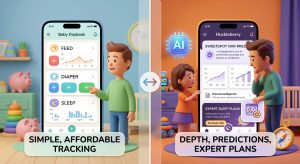
Most people searching for a Huckleberry app review are really asking two questions: is it free, and is the paid version worth it?
Huckleberry is one of the most downloaded baby trackers in the world, with a 4.9 star average across roughly 73,600 iOS ratings as of September 2026 and a company claim of more than five million families. Ratings that high usually mean the free product is good. They do not tell you whether the subscription is.
This review covers exactly what you get for free, what the current Plus and Premium prices are, which features actually change your day, where the app runs out of road, and how to cancel if you decide it is not for you. Pricing and feature details here were verified directly against Huckleberry’s own pricing page and the App Store listing on September 22, 2026.
Key Takeaways
Huckleberry is free to use as a full baby tracker; the free tier covers logging, timers, basic reports and multi-caregiver sync.
Paid tiers as of September 22, 2026: Plus is $11.99/mo or $5.74/mo billed yearly, Premium is $14.99/mo or $9.99/mo billed yearly.
SweetSpot nap and bedtime prediction is the feature most parents actually pay for, and it needs consistent logging to work well.
Custom Sleep Plans and the Berry AI chat are Premium only, so the mid tier does not solve settling or night-waking problems.
Huckleberry states its guidance never requires crying it out, which is a deciding factor for many families.
Subscriptions auto-renew and are cancelled through Apple or Google, not through Huckleberry.
Table of Contents
What the Huckleberry App Actually Is
Huckleberry is a baby tracking app made by Huckleberry Labs. At its core it is a one-touch logger: you tap to record sleep, feeds, diapers, pumping sessions, medicine, growth measurements, and milestones, and the app turns those taps into summaries, averages, and trend charts you can share with your pediatrician. Multiple caregivers can sign in to the same account, so a partner or a nanny logging on their own phone updates the same timeline.
On top of that tracking layer sit the paid features the brand is actually known for. SweetSpot is a prediction tool that reads your child’s logged sleep and suggests the next ideal nap or bedtime rather than making you calculate wake windows yourself. Insights turns your data into short, targeted tips. Schedule Creator builds age-appropriate daily schedules. Berry is an AI chat assistant for round-the-clock questions, and Custom Sleep Plans are structured, expert-designed sleep training plans with check-ins as your child grows.
The app listing describes the company as backed by a team of pediatric experts and says it is used by more than five million families. As of September 2026 the iOS listing shows a 4.9 star average across roughly 73,600 ratings, which is an unusually strong rating profile for a category this crowded. Whether the paid tiers are worth it is a separate question, and that is really what most people are asking when they search for a Huckleberry app review.
Is the Huckleberry App Free?
Yes, there is a genuinely free tier, and it is more generous than most people expect. Huckleberry’s own pricing page describes three membership tiers, and the free one includes the logging tools and basic reports rather than a locked shell you cannot use.
On the free plan you get one-touch tracking for sleep, feeds, diapers, pumping, growth, milestones, medicine, potty training, and activities, a breastfeeding timer with left and right sides, sleep summaries and history, multiple child profiles, reminders, and syncing across caregivers’ devices. For a lot of families, that is the entire reason they downloaded a tracker in the first place, and they never need to pay.
What the free tier does not include is the prediction and guidance layer: SweetSpot nap timing, Insights, Schedule Creator, Enhanced Reports, AI logging, Berry, and Custom Sleep Plans all sit behind Plus or Premium. Huckleberry also states that members get two weeks of free access to advanced features before committing, so you can test the paid layer before deciding.
Quick Answer
Short answer: the Huckleberry app is free to download and free to use as a full-featured baby tracker. The sleep predictions, schedules, AI chat, and custom sleep plans require a paid Plus or Premium membership.
Huckleberry Pricing: Free vs Plus vs Premium
Prices below are taken directly from Huckleberry’s published pricing page and verified on September 22, 2026. App pricing changes, so treat this as a dated snapshot rather than a permanent quote, and check the current price in the app before subscribing.
Tier
Monthly
Billed yearly
What you get
Free
$0
$0
Logging for sleep, feeds, diapers, pumping, growth and milestones; basic reports; multi-caregiver sync
Plus
$11.99/mo
$5.74/mo
Everything free, plus SweetSpot nap and bedtime predictions, Insights, Schedule Creator, Enhanced Reports, AI logging
Premium
$14.99/mo
$9.99/mo
Everything in Plus, plus Berry 24/7 AI guidance and expert-designed Custom Sleep Plans
Huckleberry membership pricing as published on huckleberrycare.com, verified September 22, 2026.
Two things stand out. First, the yearly commitment is a large discount, roughly half price on Plus, so the headline monthly number is not what most subscribers actually pay. Second, the gap between Plus and Premium is only a few dollars a month on the annual plan, and everything most parents come for on the sleep side, the custom plan and the round-the-clock chat, sits in Premium. If you are going to pay at all, the Plus tier can feel like an awkward middle step.
Subscriptions auto-renew, and because you buy them through the App Store or Google Play, that is also where you cancel. Managing the subscription inside the app store rather than emailing the company is the single most common support question for any app in this category.
Is Huckleberry Premium Worth It?
The honest answer is that it depends almost entirely on whether you want data or decisions. Huckleberry Premium is worth it for a specific kind of parent, and a waste of money for another kind, and the difference is not about how much you love your baby.
It is probably worth it if: you enjoy logging, you find patterns reassuring rather than stressful, your child is in the two to eighteen month window where nap timing changes constantly, and your main problem is timing rather than settling. SweetSpot is the standout feature for a reason. Wake windows are genuinely hard to calculate in the moment while holding a fussy baby, and having the next window predicted from your own child’s data removes a real daily cognitive load.
It is probably not worth it if: you have stopped logging consistently, because every prediction the app makes depends on the quality of your data and gaps make the suggestions worse. It is also a poor fit if your problem is not timing at all. If your baby is on a perfectly reasonable schedule and still fights bedtime for an hour, screams at every transfer to the crib, or wakes four times a night out of habit, better nap predictions will not solve it. That is a settling and association problem, not a math problem.
The Custom Sleep Plan in Premium is the part that tries to address settling, and it is the feature most worth judging on its own. It is a structured plan with check-ins rather than a live human coach, which is why it costs a fraction of what a private sleep consultant charges. If you want accountability and a written protocol, that is good value. If you want someone to look at your specific night and tell you what changed, it is not the same product.
One more thing worth knowing before you subscribe: Huckleberry states publicly that its sleep guidance never requires crying it out. If extinction-based methods are a hard no for you, that positioning matters, and it is one of the reasons the app has the reputation it does among gentle-parenting communities.
What Huckleberry Does Well
The free tier is real. You can use it indefinitely as a tracker without paying, which is not true of every competitor.
SweetSpot removes daily math. Predicting the next sleep window from your child’s own logged data is genuinely useful during the newborn-to-toddler transition.
Logging is fast. One-touch entry, a proper breastfeeding timer with both sides, and widgets and watch support on iOS make it low-friction at 3am.
Multi-caregiver sync works. Partners, grandparents and nannies signing into the same account keeps one shared timeline instead of three private ones.
Reports are pediatrician-friendly. Sleep and growth trends in one view are easy to show at a checkup.
The philosophy is stated openly. No-cry-it-out positioning lets you decide up front whether the approach matches your parenting style.
Where Huckleberry Falls Short
It rewards logging, and logging is work. The predictions degrade when your data has holes, and almost every family’s data has holes eventually.
Tracking can raise anxiety. For some parents, watching a chart of fragmented nights makes a normal week feel like a crisis. If numbers make you spiral, a tracker is the wrong tool.
The best sleep features are behind the top tier. Custom Sleep Plans and Berry are Premium only, so the cheaper paid tier does not solve settling problems.
It predicts timing, it does not diagnose causes. Reflux, a regression, teething, a too-late bedtime, an overtired loop, or a feed-to-sleep association all look similar in the data.
AI chat is not a clinician. Berry is expert-vetted guidance, not medical advice, and it cannot examine your child.
Auto-renew catches people out. Because billing runs through Apple or Google, you have to cancel there, and many one-star reviews across this whole category are really billing complaints.
None of these are scandals. They are the normal limits of a tracking-first product, and knowing them ahead of time is the difference between a subscription that helps and one you resent in month three.
Huckleberry vs Betteroo: An Honest Comparison
We build a sleep product, so read this section with that in mind. The fairest way to describe the difference is that Huckleberry is tracking-first and Betteroo is guidance-first. Huckleberry starts from your logged data and predicts timing. Betteroo starts from a short assessment of your child’s age, temperament, and current sleep situation and returns a plan, without asking you to log every nap to get value.
That means the two tools genuinely suit different problems. If your question is when should the next nap be, a tracker with predictions is the right shape of tool. If your question is why is bedtime falling apart and what do I change first, a plan is the right shape of tool. Plenty of families use a free tracker alongside a plan, and that is a perfectly sensible combination.
Worth asking before you pay for any of them. Tracking apps are very good at two things: reducing the mental load of remembering what happened, and surfacing a pattern you would not have spotted from memory alone. Both are real benefits, especially in a sleep-deprived first year.
What no app can do is change the underlying behavior on its own. Sleep improves when something concrete changes: an earlier bedtime for an overtired baby, a nap schedule that matches your child’s actual wake windows by age, a consistent settling approach, or a gentle wean off a feed-to-sleep association. The app can show you when to act. You still have to act.
We dug into the evidence on this question in more depth in do sleep training apps work, including what the research does and does not support.
Apps can show you the data. A plan tells you what to do with it.
Our free two-minute quiz builds a gentle, personalized sleep plan for your child’s age and temperament.
Who Should Use Huckleberry, and Who Should Skip It
If this is you
Best move
You want a free tracker and nothing else
Use the free tier, skip the subscription entirely
You have a 2 to 18 month old and nap timing is your main struggle
Plus is the value pick, mainly for SweetSpot
You want a structured sleep plan plus round-the-clock questions answered
Premium, or a dedicated sleep plan if settling is the real issue
Logging makes you anxious or you have stopped doing it
Skip tracking apps; a plan-based approach fits better
You need a real human reviewing your specific nights
Neither tier; look at a sleep consultant
Your child has reflux, allergy, or growth concerns
Talk to your pediatrician first; tracking supports that conversation but does not replace it
Matching the tier to the actual problem is the difference between value and a wasted subscription.
How to Cancel or Get a Refund
Because Huckleberry memberships are sold as in-app subscriptions, Apple and Google hold the billing relationship, not Huckleberry. That means you cancel where you subscribed.
iPhone or iPad: Settings, tap your name, tap Subscriptions, select Huckleberry, then Cancel Subscription.
Android: Google Play Store, tap your profile icon, Payments and subscriptions, Subscriptions, select Huckleberry, then Cancel.
Refunds: request them through Apple’s reportaproblem page or Google Play’s refund flow, not through the app. Both platforms decide refunds case by case.
Before you cancel: export or screenshot any reports you want to keep, and note that canceling stops renewal but usually leaves access until the end of the paid period.
Canceling a membership does not delete your account or your logged history, so you can drop back to the free tier and keep tracking.
The Bottom Line
Huckleberry is a very good baby tracker with a genuinely free tier and one standout paid feature. If nap timing is your daily headache and you like logging, Plus earns its keep. If you want a written plan and an always-available assistant, Premium is a reasonable price for what it is.
If you have already got the schedule roughly right and bedtime is still a fight, more data is not the missing piece. Look at the settling approach, the sleep associations, and whether bedtime is actually too late, and change one of those before you subscribe to anything.
Frequently Asked Questions
Is the Huckleberry app free?
Yes. Huckleberry has three membership tiers and the free tier is a fully usable baby tracker: one-touch logging for sleep, feeds, diapers, pumping, growth and milestones, a breastfeeding timer, basic reports, and syncing across multiple caregivers. Sleep predictions with SweetSpot, Insights, Schedule Creator, AI chat and custom sleep plans require a paid Plus or Premium membership.
Is Huckleberry Premium worth it?
It is worth it if your main problem is sleep timing and you log consistently, because SweetSpot and the Custom Sleep Plan add real structure on top of your own data. It is not worth it if you have stopped logging, if charts make you anxious, or if your child is already on a reasonable schedule and the real issue is settling, night waking, or a feed-to-sleep association. Those are behavior problems, not timing problems.
How much does Huckleberry cost?
As published on Huckleberry’s pricing page and verified on September 22, 2026, Plus is $11.99 per month or $5.74 per month billed yearly, and Premium is $14.99 per month or $9.99 per month billed yearly. The free tier is $0. Huckleberry also offers two weeks of free access to advanced features. Prices change, so confirm in the app before subscribing.
What is SweetSpot in the Huckleberry app?
SweetSpot is Huckleberry’s sleep timing prediction feature, available on Plus and Premium for children roughly two months and older. It learns from the sleep you log and suggests the next ideal nap or bedtime, so you do not have to calculate wake windows yourself. Its accuracy depends on how consistently you log, since gaps in the data produce weaker predictions.
How do I cancel a Huckleberry subscription?
Cancel where you subscribed, because Apple and Google handle the billing. On iPhone go to Settings, tap your name, tap Subscriptions, select Huckleberry and cancel. On Android open the Google Play Store, tap your profile, then Payments and subscriptions, Subscriptions, select Huckleberry and cancel. Refunds are requested through Apple or Google, not through Huckleberry.
Does Huckleberry use cry it out?
Huckleberry states in its app listing that its sleep guidance never requires crying it out and describes its approach as gentle and evidence-based. If extinction-based methods are something you want to avoid, that stated positioning is one of the main reasons parents choose the app, though any plan still requires consistency from you to work.
Calmer bedtimes, better nights.
Betteroo builds a personalized sleep plan for your child. Take the free two-minute quiz to get started tonight.