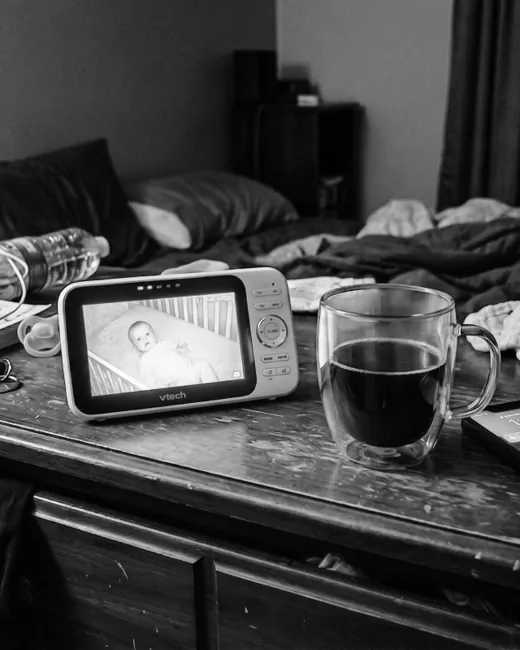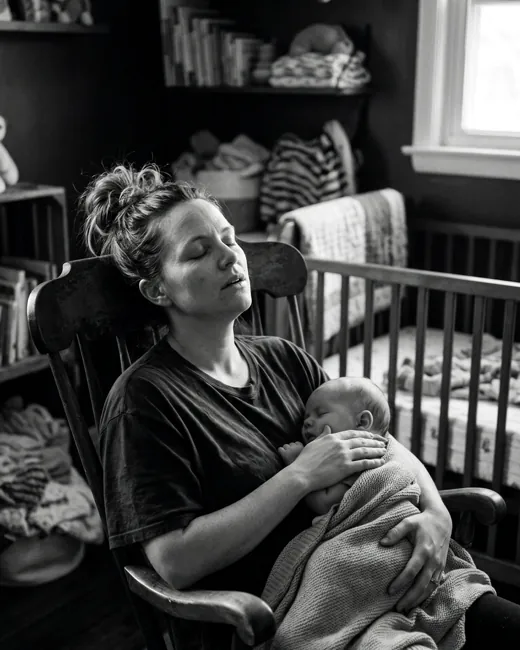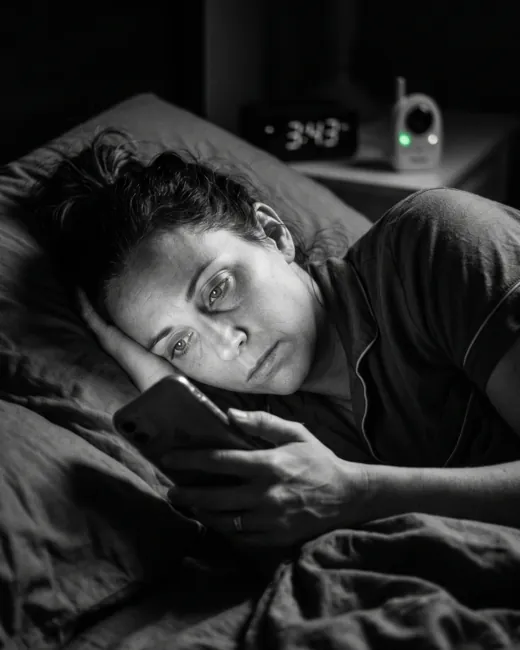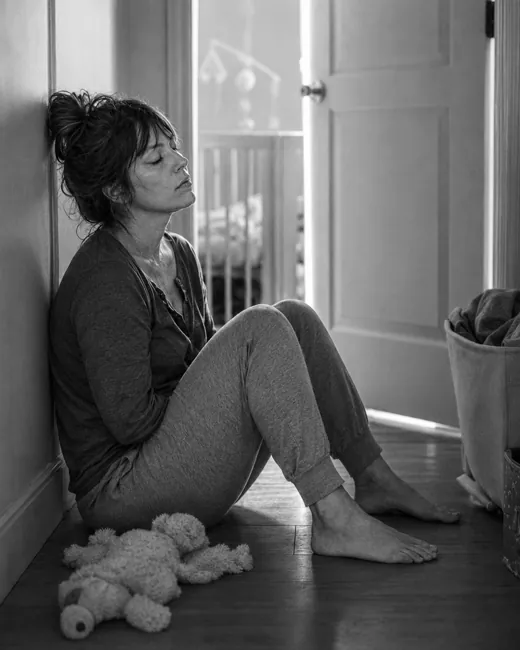

across 115 countries
The State of
Parent & Baby Sleep
August 2026
The largest survey of its kind reveals what’s really happening behind closed nursery doors, and it’s not what the highlight reels show.
4 in 5 parents in our survey are running on less than six hours of sleep a night. This isn’t a phase.
For most families, it’s the baseline.
The 7–9 Month Peak
Nobody Warns You About
Everyone talks about the 4-month regression. But our data shows the real peak in night waking happens at 7–9 months, when 66% of babies wake 3 or more times a night. That’s higher than any other age.
The Co-Sleeping Catch-22
Parents who write about co-sleeping describe it as a deal: less independent sleep, but in exchange for more stretched-out rest. We checked the receipt.
Parents trade independent sleep for the promise of less waking. The data shows the trade doesn’t pay. Co-sleepers’ babies wake more (+10 pp). They settle slower initially. Parents feel just as exhausted. And contact napping, often paired with co-sleeping, produces shorter naps, not longer ones. The data doesn’t argue for or against co-sleeping. It just shows that the implicit deal, “this is hard but it gets us more rest”, isn’t the deal that’s actually being made. The 3am response shows the same pattern: among 7–9-month-olds, babies fed back to sleep wake 3+ times at 69% vs 53% for babies resettled other ways (n=5,691 vs 1,257), an association that runs in both directions, hungrier babies get fed, and fed babies learn to expect it. Based on 6,200 parents who mentioned co-sleeping vs 27,764 who didn’t.
The Naps Reality Check
Nap patterns shift dramatically as babies grow. Here’s what the data shows at each age.
Half of babies under 7 months take short naps (under 60 min). After 7 months, longer consolidated naps become the norm, but only if sleep pressure and rhythm are in sync.
The Nap-Length Myth
Parents of short nappers are often warned that broken days make broken nights. The data mostly disagrees: among 4–12-month-olds, night waking is nearly flat across nap lengths.
Short naps do not doom the night: babies napping under 30 minutes wake no more than longer nappers, and the sub-hour groups are statistically indistinguishable. The one group that stands apart is the 90-minute-plus nappers (54% wake 3+ times), but they are rare (n=639 of 17,867 in this age band), so treat that gap as directional. If your baby catnaps, the night is not automatically lost.
How Are Parents Really Feeling?
Less than 1% of parents in our survey described themselves as “energized.” The vast majority, 82%, are running on empty.
Every Wake-Up Costs You
Parent sleep tracks baby waking as a near-perfect staircase. Each additional wake-up pushes more parents under the 6-hour line.
Exhaustion climbs the same staircase: 55% of zero-wake parents feel exhausted or drained, rising to 69% at one wake, 78% at two, and 87% at three or more. There is no cliff and no plateau, every wake-up costs, which is why reducing night wakeups is the number one goal parents name. The staircase is also the hopeful part: each wake-up eliminated buys real sleep back.
The Doomscrolling Guilt Cycle
Sleep-deprived parents reach for their phones. The phones reach back with guilt. We pulled the cross-tab to see how tightly the loop closes.
Sleep deprivation creates a feedback loop. Parents are too exhausted to do restorative self-care, so they reach for their phones. The phones serve up content that immediately triggers feelings of inadequacy and guilt. The exhaustion → scroll → guilt cycle is the most consistent emotional pattern in the entire dataset, a 52-percentage-point gap between parents at the two ends of the phone-escape scale. Based on 19,565 frequent phone-escape parents vs 3,148 who almost never use their phone this way.
When Parents Disagree About the Fix
13% of parents told us they and their partner disagree about how to handle their baby’s sleep. In the data, that disagreement is the single strongest relationship signal we measured, stronger than the sleep deprivation itself.
The exhaustion is shared; the plan often isn’t. When parents pull in different directions at 3am, the distance shows up everywhere: guilt-often runs 67% vs 54%, and stress and overwhelm jump 15 points or more. The hopeful flip side: 60% of all parents believe better sleep would repair exactly this. Based on 4,515 parents who flagged disagreement vs 29,447 who didn’t.
When You Have a Village, the Bedroom Holds Together
The headline finding, 73% of parents feel distant from their partner, masks a sharp split. Where you fall on it depends on whether you have help.
Based on 30,905 married-partner households vs 285 households where parents named extended family as part of their care setup. Small extended-family cohort, read the gap as directional, not precise.
Across every emotional measure, parents with a village fare meaningfully better: depleted-often drops 15 pp, guilt-often drops 10 pp, exhausted-or-drained drops 18 pp. Sleep deprivation turns the modern isolated nuclear household into transactional survival, but families with extended help absorb the load differently. This isn’t about household structure. It’s about whether the load gets distributed.
Not All Parents Are in the Same Boat
Same overall exhaustion, two very different lived experiences. Where the divergence is biggest:
Single parents feel depleted at an 8-point higher rate
Based on 2,305 single parents vs 30,905 partnered parents.
Experience doesn’t protect you: second-time parents are more worn down
The babies sleep the same (57–59% wake 3+ times regardless of family size), but the parents don’t: guilt-often runs 62% for multi-child parents vs 53% for first-timers, and overwhelm 69% vs 63%. Knowing what you’re doing doesn’t make 2am shorter when a toddler needs you at 6. Based on 8,990 parents of 2+ children vs 23,457 first-time parents.
The Full-Time Work “Paradox”, Solved
A surprising finding from the data: babies of full-time working parents wake less than babies of stay-at-home parents (47% vs 60% wake 3+ times per night). The temptation is to read this as “structured working-parent routines win.” We crossed the cohorts to test that.
It’s not the routine. It’s the babies. Bedtime distribution and time-to-fall-asleep are essentially identical between the two cohorts. What differs is age composition: only 11% of working full-time parents have a 0–3-month-old, vs 25% of home full-time parents. Working parents skew past the peak-waking phase. The “paradox” is mostly age in disguise.
- Working FT, bedtime before 8pm: 53.7%
- Home FT, bedtime before 8pm: 49.6% (a 4pp difference, not a routine difference)
- Working FT babies under 4 months: 11.1%
- Home FT babies under 4 months: 25.3% (the actual driver)
What Parents Told Us
In Their Own Words
Beyond the multiple-choice answers, more than two in five parents wrote additional context about their situation. Here’s what emerged.
The Co-Sleeping Reality: Survival, Not Strategy
More than 2 in 5 parents who shared additional context mentioned co-sleeping, and the overwhelming pattern wasn’t planned co-sleeping. It was desperation.
Parents described falling into bed-sharing after months of failed attempts to get their baby to sleep independently.
“We end up co-sleeping after the first 2–3 night wakings. I never planned this.”
“Co-sleeping but wish we weren’t. Waking 7–12 times a night. Comfort feeding.”
“We co-sleep out of desperation. I never get a sleep.”
“She starts in her room then walks into ours at 2am. When I’m too tired, we just co-sleep.”
The Reflux Surprise
16% of parents mentioned reflux in their written responses, making it the third most common theme after co-sleeping and contact naps. But here’s what surprised us: babies with reflux don’t actually wake more than other babies.
This challenges the common assumption that reflux is the root cause of night waking. While reflux is real and uncomfortable, the data suggests that frequent waking is near-universal across this age group, reflux or not. Parents of reflux babies may be attributing normal developmental waking to their child’s reflux.
The Contact Nap Cycle
27% of parents who wrote in mentioned contact napping, holding their baby for the entire duration of every nap. It’s often described alongside co-sleeping as part of a broader pattern of around-the-clock physical dependency.
“Contact naps only. Currently cosleeping a lot.”
“Naps the best when contact napping. Won’t go down in her crib.”
“She loves contact naps and falling asleep on me. I can’t put her down without her waking instantly.”
“Mix of contact naps, pram naps, cot naps during the day. Our toddler is also in my care so sometimes naps are impacted.”
Parents Who Found Their Way Through
Real Betteroo parents who recognized themselves in the data above, and made changes that stuck.
“I was co-sleeping, feeding to sleep, and waking 5–10 times a night. Within weeks, my baby slept 5.5 hours without a feed.”
Alex
“Naps went from averaging 59 minutes to over 90. Night wake-ups dropped from 5 out of 8 nights to just 1.”
Lauren
“Three weeks in, night wake-ups dropped from 7+ to 2–3, and one night, zero. Naps nearly doubled.”
Aateqah
“We slept through the night 3 days in a row. My daughter went from needing me for every bedtime to letting Dad do it.”
Megan
If this data feels familiar, you don’t have to figure it out alone. Every baby is different, and so is the solution.
Get a personalized sleep plan for you and your baby
Take the 3-Min Quiz →How Does Your Area Compare?
Search for your country, state, or city, or click a country on the map, to see how local parents compare to the global average.
Data available for 32 countries, 159 regions, and 125 cities.
All Statistics at a Glance
Sample: 77,031 survey responses collected July 2025 – August 2026 across 115 countries. All statistics and breakdowns below count unique parents of children aged 0–6, one response per parent (US 15,810; UK 7,765; Australia 4,399; Canada 1,803; Germany 366; New Zealand 346; Italy 310; Spain 273; Netherlands 251; Portugal 183).
Parent sleep & wellbeing: 80% sleep less than 6 hours per night. 82% feel exhausted or drained. 74% report low energy “often”, 66% feel depleted “often”, 65% overwhelmed “often”, 59% use phone as escape “often”, 59% stressed/anxious “often”, 56% guilty “often”. 71% report “often” on 3 or more of these six wellbeing scales.
Every wake-up costs you (dose-response): Share of parents sleeping under 6 hours by baby wake count: baby doesn’t wake 40% (n=659); wakes once 58% (n=2,050); wakes twice 74% (n=6,194); wakes 3+ times 86% (n=18,873). Exhausted-or-drained climbs the same staircase: 55%, 69%, 78%, 87%.
The Doomscrolling Guilt Cycle: Of parents who use their phone as escape “often” (59% of all): 72% feel guilty often (vs 20% for parents who almost never reach for their phone, +52 pp), 76% feel depleted often (vs 44%), 76% report self-care erosion (vs 63%). Based on 19,565 vs 3,148 parents.
When parents disagree about the fix: 13% of parents report disagreeing with their partner about how to fix sleep (n=4,515). Among them, 93% feel distant from their partner vs 68% of others; stressed-often 72% vs 55%; overwhelmed-often 76% vs 61%; guilt-often 67% vs 54%. 60% of all parents say better sleep would mean a better relationship with their partner.
The Village Effect: 74% of married-couple “just us” households feel distant from partner, vs 53% of households with extended-family help (-22 pp). Based on 30,905 vs 285 households.
Baby night waking by age (% who wake 3+ times per night): 0–3 months 48.5% (n=3,522); 4–6 months 64.4% (n=5,936); 7–9 months 66.2% (n=4,554, the peak); 10–12 months 59.3% (n=2,299); 13–18 months 52.1% (n=1,614); 19–24 months 40.2% (n=512); 2–6 years 30.7% (n=404).
Bedtime distribution: 7:00–7:59pm 38.8%; 8:00–8:59pm 23.7%; after 9pm 16.6%; 6:00–6:59pm 12.6%; varies 7.4%; before 6pm 0.9%. Among 0–3 month olds, 31% have bedtimes after 9pm. Bedtime strongly predicts wake-up time: 65% of babies in bed before 6pm are awake before 6am, vs 14% of babies in bed after 9pm (55% of whom sleep past 7am). 26% of all babies are up before 6am.
Time to fall asleep: 30–59 min 24.7%; 10–19 min 20.8%; 20–29 min 17.5%; not sure 15.7%; over 60 min 11.4%; less than 10 min 9.9%.
Naps by age: 36% of 0–3 month olds take 4+ naps. 55% of 4–6 month olds settle into 3 naps. 65% of 7–11 month olds are on 2 naps. 64% of 12–23 month olds are on 1 nap. 63% of 2y+ still nap once; 25% have dropped naps entirely. Among 4–12-month-olds, night waking is nearly flat across nap lengths (under 30 min: 65%; 30–59 min: 68%; 60–89 min: 61% wake 3+ times), challenging the idea that short naps cause bad nights.
Sleep goals (multi-select): Reduce night wakeups 85%; predictable routine 41%; end bedtime battles 41%; improve naps 39%; stop early waking 30%.
How babies fall asleep (multi-select): Feeding 64%; rocking 61%; sitting nearby 43%; singing 34%; it depends 19%; falls asleep alone 10%. Among 7–9-month-olds, babies fed back to sleep at night wake 3+ times at 69% vs 53% for babies resettled other ways.
How parents feel (single-select): Exhausted 46.2%; drained 36.1%; okay 17.2%; energized 0.5%.
Life areas affected by sleep deprivation (multi-select): Mood & patience 78%; self-care 72%; partner/family 71%; physical health 50%; enjoyment of life 35%; work focus 27%; friendships & social life 22%.
Day-to-day behaviors (multi-select): Feeling distant from partner 74%; struggling with daily tasks 69%; skipping things they enjoy 58%; eating cold meals 40%; cancelling plans 31%.
Free-text themes (from 14,473 written responses, 43% of all parents): Co-sleeping mentioned by 43%; contact napping by 27%; reflux by 16%. 70% of co-sleepers are exhausted or drained AND sleep less than 6 hours. 13% of those who wrote in mention both co-sleeping and contact naps. Babies with vs without reflux wake 3+ times at 56% vs 57% (no meaningful difference).
The Co-Sleeping Catch-22: Co-sleepers’ babies wake 3+ times at 64% vs 54% for non-co-sleepers (+10 pp). They settle in under 10 minutes only 7.4% of the time vs 10.1% for non-co-sleepers. Contact-nappers’ babies nap under 60 min at 60% vs 57% for others.
Segment differences: Single parents feel depleted “often” at 74% vs 66% for partnered parents (n=2,305 vs 30,905). Parents of 2+ children are more exhausted (86% vs 81%) and guiltier (62% vs 53%) than first-timers while babies wake the same. Working full-time parents’ babies wake 3+ times less often than home full-time parents (47% vs 60%, n=5,494 vs 20,117), but the difference is age composition: only 11% of working full-time parents have a 0–3-month-old vs 25% of home full-time parents.
Geographic coverage: 32 countries with sample of 30+ unique parents. 159 regions and 125 cities meet the same threshold. Top cities by sample: Sydney (1,653); London (1,170); Melbourne (898); Brisbane (657); Chicago (608); New York (603); Dallas (550); Atlanta (519); Perth (465); Toronto (329); Los Angeles (323).
All percentages cite Betteroo State of Parent & Baby Sleep 2026 (n=77,031). Citations: please link to https://betteroo.ai/state-of-baby-sleep/